SKELETAL LEAP: THE MIND BODY EVOLUTION SERIES
Introduction:
Let me take you on a fascinating journey into the world of skeletal postures and their profound impact on our vision and overall well-being.
As I introduce the concept of ‘Skeletal Leap,’ I emphasize the importance of understanding how our human skeleton is not merely a static framework but a dynamic system capable of miraculous maneuvers.
The present episode begins with an in-depth exploration of the temporomandibular joints (TMJ), which connect the jawbone to the skull.
I will explain that these joints are crucial for various jaw movements, and surprisingly, our resting jaw position should not be with our teeth clenched but rather with a slight gap. This revelation will prompt you to reconsider your everyday habits, as the majority of Homo sapiens has been living with postural faults since the dawn of bipedalism.
I will further explore the relationship between jaw posture and vision, suggesting that blurred vision is often a lifestyle disease that many of us overlook.
I put across my point that this common issue is not just an inconvenience but a symptom of a corrupted mind-body system.
The episode challenges the conventional reliance on corrective eyewear, proposing instead that the key to clearer vision lies in skeletal meditation and proper jaw alignment.
You will appreciate my personal anecdotes, revealing my own struggles with vision clarity and how they led me to discover the importance of skeletal postures.
I also introduce the concept of ‘central fixation,’ a technique that can enhance vision clarity for individuals of all ages, regardless of their current eyesight quality.
The episode also touches on the interconnection of the body’s systems, highlighting that opening one chakra can amplify the effects on others.
I specially emphasizes the significance of a holistic approach to health, advocating for guided meditation as a means to achieve this balance.
As the episode concludes, I would encourage you to engage with your bodies, explore the effects of skeletal postures, and consider the transformative potential of skeletal leap.
This episode is a must-listen for anyone interested in improving their vision, understanding the mind-body connection, or exploring the realms of holistic health.
Tune in now to embark on your own journey toward clarity and well-being!
🔑 Key Takeaways
Human Skeleton
Temporomandibular Joints
The Muscles Associated with Temporomandibular Joints
How Posturing Temporomandibular Joints Affects Eyesight
Systems And Subsystems Like The Visual Subsystem
🎙️ Listen to the Journey:
📽️ Watch the Masterclass:
Transcript:
“I mastered the chakra discipline to understand how opening chakras via re-posturing the skeleton may correct vision.”
My name is Laadi Ojas. Welcome to “Skeletal Leap: A Living Adventure”. Skeletal Leap transforms one’s life into a personal heaven.
Today’s episode will tell you about how skeletal postures affect mind through distorting skeletal joints.
Human skeleton is not just a static chassis on which the rest of the body, with its various organs, stays erect. It is a highly complex moving machine that is capable of making miraculous maneuvers as and when required. It does so with the help of different kinds of skeletal joints.
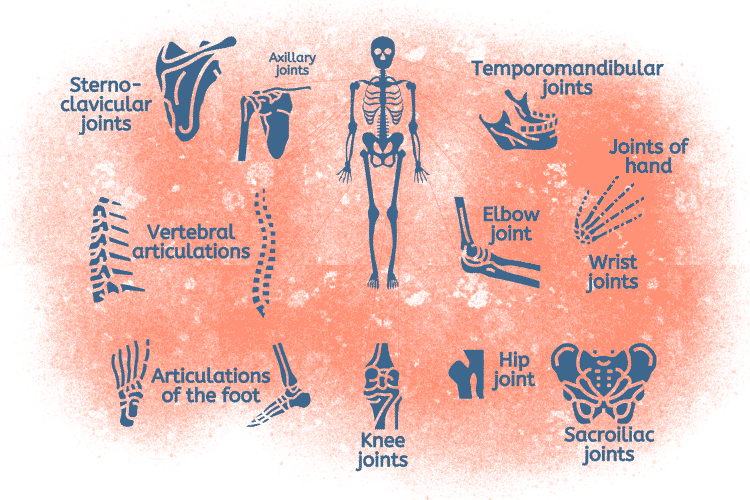
Let’s first look at the temporomandibular joints in greater detail. This joint comprises the only movable bone mandible in the skull.
Temporomandibular Joints
Temporomandibular joints connect the jawbone to the skull at two points. It is a bilateral synovial (freely mobile with synovial fluid) joint between the temporal bone above and the mandible below. Since it is bilateral, the left and right parts always work together.
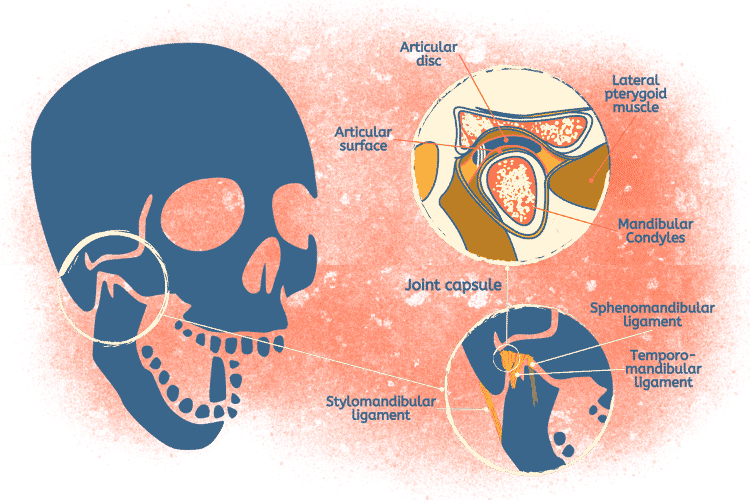
The joint comprises:
The joint capsule is an envelope attached to the mandibular fossa and the articular tubercle above. It is also attached to the neck of the condyle of the mandible below.
The articular disc is a dense fibrocartilagenous tissue between condyle of the mandible and mandibular fossa.
Temporomandibular ligament is the thickened lateral portion of the stylomandibular ligament capsule.
Sphenomandibular ligament becomes accentuated and taut when the mandible is protruded.
When are the temporomandibular joints and their related muscles in a state of rest?
Surprisingly, it is not with the teeth biting together but with a 2mm to 4mm of space between them with both, the upper and the lower dentures, being in the same plane. It is done via protruding the lower jaw forward to bring the two of them in the same plane across their entire width. But almost no one ever postures them that way. That is one of the postural faults humanity has been living with, since bipedalism.
A fully open jaw measures 40 to 50mm between the upper and lower front teeth. When the jaw moves, it is only the mandible that moves.
Mandible movements are called excursions. There are two lateral excursions, left and right. And there is a forward excursion called protrusion that everyone does everyday while brushing the teeth. It is because protrusion brings the upper and the lower dentures in one single plane enabling easy brushing. The excursion opposite to protrusion is called retrusion.
Now that we have got a basic understanding of the temporomandibular joints, let us investigate how and why our vision - far or near - gets blurred. You may be wondering what the jaw has to do with vision!
Well, that is exactly why this is one of the best ways to investigate how skeletal postures affect the mind. Alright…so, now we have gone from the jaw to eyesight, all the way to the brain. We are on the path to understanding how a corrupted skeletal posture corrupts the mind by corrupting the brain’s neurophysiology.
Let me explain further.
How Posturing of Temporomandibular Joints Affects Eyesight
Blurred vision is certainly a lifestyle disease.
It has been present throughout the world since the beginning of bipedalism. Almost everyone falls prey to it, some of them early in life and the rest after the age of 40.
We don’t really bother much about it since the use of eyeglasses has been accepted as part of the modern lifestyle!
But what we are missing is that this lifestyle disease doesn’t end with just a blurred vision. It is just the beginning of a massive problem. It is an indication and warning that the neurophysiology of our entire body, including our face, is not working right. It has already been afflicted with a corrupted mind in our mind-body system. It renders us vulnerable to various other lifestyle diseases in time to come.
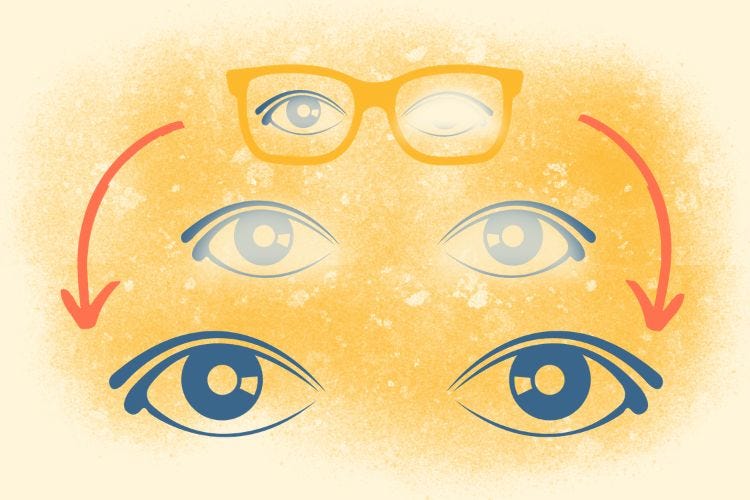
Going for a surgical option like LASIK doesn’t address this vulnerability either. And that is because LASIK just creates proxy eyeglasses within the corneas of our eyes and nothing else.
Another reason to investigate blurred vision as an example is that its correction through skeletal meditation shows instant results. That way, we can be sure about being on the right track with our investigations into a corrupted mind.
Surprisingly, the human skull is partially separate in its anatomy and physiology from the human torso and limbs. Hence, we can immediately empty the mind partially of its visual corruption, in the skull alone, through its skeletal re-posturing. Thus we can check its effect on the eyesight then and there. This eliminates guesswork and time in proving the hypothesis. That is what a laboratory procedure of deciding a hypothesis right or wrong is.
As mentioned in Episode 18, my life has been a seesaw between blurred and crystal-clear vision. Only until I solved the puzzle by discovering a concrete physical procedure, though!
In retrospect, I feel I was lucky to have experienced blurred vision.
Why?
Because that was exactly what made me jump into this entire discipline of Skeletal Leap. At the same time, it also provided me with an instantaneous testing ground for my skeletal hypotheses in an absolutely tangible manner.
But what about those between 0 - 40 years of age who don’t have any problem with their eyesight at present? How can they investigate the effect of central fixation on the clarity of their vision, far and near?
Luckily, they can also witness a marked enhancement in the clarity of their vision when they see with central fixation of the eyes. If their distant vision is 20/20, central fixation can enhance it to be something like 30/20. Same with the near vision! If the near sight measures N6, they can easily enhance it to N3 or even more. Hence everyone can investigate central fixation of the eyes successfully, regardless of the quality of their vision.
I mastered the chakra discipline to understand how opening chakras via re-posturing the skeleton may correct vision. It all amounted to emptying the mind through rectifying the neurophysiology of the visual system to be able to see crystal clear.
It took place via maneuvering the mandible which is the only movable bone in the skull. The mandible is the jawbone forming the lower jaw and keeping the lower denture in place. It is the biggest and the strongest bone in the facial skeleton. The mandible is connected to the temporal bones through temporomandibular joints. Hence when the mandible is maneuvered, temporomandibular joints get maneuvered along.
The said postural maneuver aligns the upper and the lower dentures in one single plane along their entire lengths.
It results in opening the third eye chakra and crown chakra, in one single go, by maneuvering the muscles named frontalis, occipitalis and temporalis in the skull.
The Muscles Associated with Temporomandibular Joints
Now, what are those muscles associated with temporomandibular joints? I said associated, not necessarily attached to the joint! The muscles directly attached are the agonist or the prime movers. But there are many more in the vicinity that are synergistically associated with the same action. They assist the prime movers by imparting an extra punch to the primary action with their own associated actions. The said actions may either be contracting a muscle or relaxing an already habitually contracted muscle.
The prime movers are:
Temporalis Muscle: elevates and retracts mandible
Masseter Muscle: elevates and retracts mandible
Lateral Pterigoid Muscle: depresses mandible
Medial Pterigoid Muscle: elevates mandible and helps lateral pterygoid in moving jaw from side to side
Every chakra is a complex of a corrupted joint and huge numbers of associated muscles, nerves and arteries which have all been corrupted.
That is how a corrupted posture in any part of the body gives birth to a partially corrupted mind.
As we know, we open the third eye chakra and the crown chakra in one single go by moving the temporomandibular joints up and out by maneuvering the mandible.
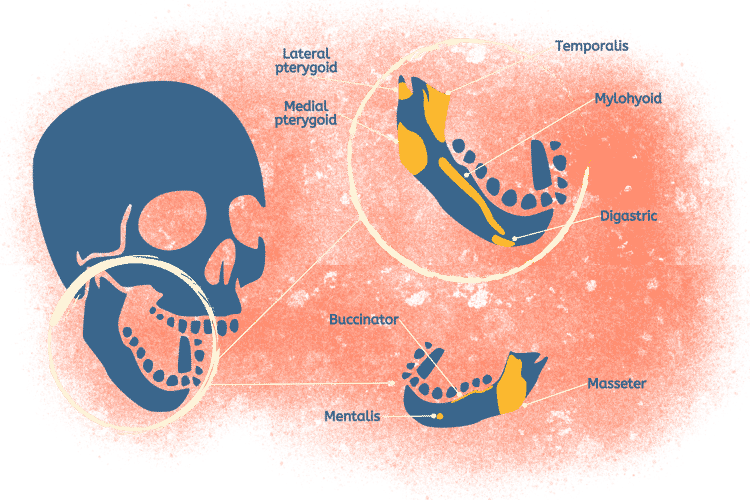
This posture ensures the alignment of the upper and the lower dentures in one single plane along their entire lengths.
But the entire maneuver is extremely subtle, hence quite complex. This is because of an emergent need to balance the actions of the prime movers and other synergetic muscular actions.
This and other such maneuvers for various other joints along the skeleton are what the corresponding sets of guided meditations are made of. Together, these guided meditations enable Skeletal Leap.
A guided meditation under the direct supervision of an experienced guide is the best way to take the Skeletal Leap.
And that is how we can partially empty the mind and set a specific physiological system back on track.
There Are Many Other Systems And Subsystems Like The Visual Subsystem
Blurred vision is a perfect example of a corrupted mind stopping the brain from clear visual perception via unblocked nerve signals.
But there is a caveat here. The visual system is not the only subsystem of the nervous system in our total mind-body system.
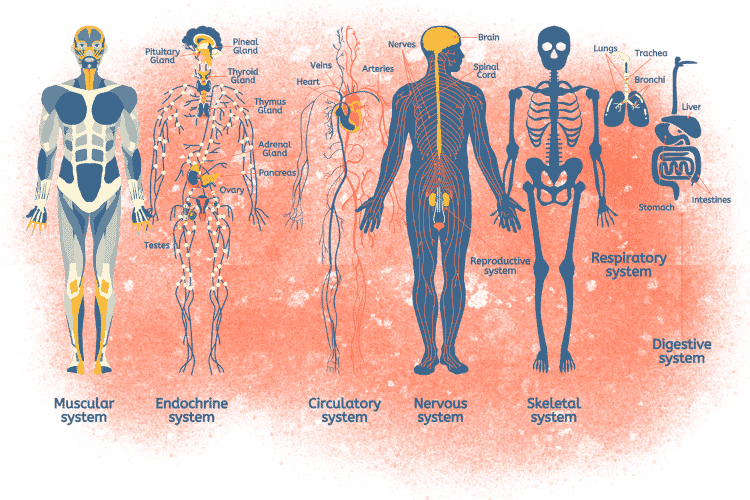
There are several similar ones along with their respective subsystems. The visual system that we investigated is a subsystem of the nervous system. We can certainly correct these individual systems or subsystems locally, but there is again a caveat here.
Like muscles have their synergetic partners, chakras do too.
And why shouldn’t they?
After all, they are the result of corrupted skeletal postures and their associated muscles, nerves and arteries.
By that token, all 7 chakras are synergetic partners of one another. Synergetic partners tend to amplify whatever the prime mover decides to do.
If we decide to open one single chakra, all the other 6 would tend to amplify its action. But that is only possible when those 6 are already open.
Otherwise, they would just do the opposite in the long run, i.e, negate the action taken to open that one single chakra.
So, it is never a wise decision to open any of the chakras in isolation. Our best bet is to open them all in one inter-related, chronological sequence.
We cannot effectively empty a fragment of our mind and hope that it will continue to remain so. Corruptions of the mind from its other fragments would rush to fill in that empty space later if not sooner.
How long shall we be able to keep it protected from its offenders?
But if the entire mind goes empty in one inter-related chronological sequence, it would tend to remain empty forever.
And it is not an impossible task to empty the mind that way.
In fact, that is exactly what leads to Skeletal Leap!
Thanks for listening to this episode of Skeletal Leap: A Living Adventure! In the next episode, I will tell you about how lifestyle diseases and immune system dysfunction take a toll on human health.
Be a part of Skeletal Leap Community! Subscribe to Skeletal Leap Newsletter. Click on the link in the description to subscribe.
🔗 Series Bridge:
This masterclass is a 19-week journey through my book, The Mind-Body Connection. If you missed the foundation, start here: The 16-Part Prequel: 14 Core Principles.
🔑 Unlock the Practical Plan:
To truly master the Skeletal Leap, you need the step-by-step memoir and the associated practice codes found in the book.
Get the Book: The “Resource Codes” for this chapter’s PDF practice plan are found in the Amazon Paperback Edition.
Skeletal Leap Book 1: The Mind Body Connection. Image courtesy of the author. Join the Movement: Download the Free Prequel Ebook via StoryOrigin and join our community.

Subscribe to Skeletal Leap Newsletter. Image courtesy of the author. Subscribe: Follow SKELETAL LEAP: The Mind Body Connection on Substack for weekly deep-dives into the human potential archive.
You may also like…