

Dynamic Core Stability Gets You READY to Challenge Masters! - Show Notes
In today’s fast-paced world, maintaining a healthy lifestyle can seem like a daunting task. With obesity rates soaring and a growing awareness of its detrimental effects, it’s more important than ever to explore effective strategies for wellness.
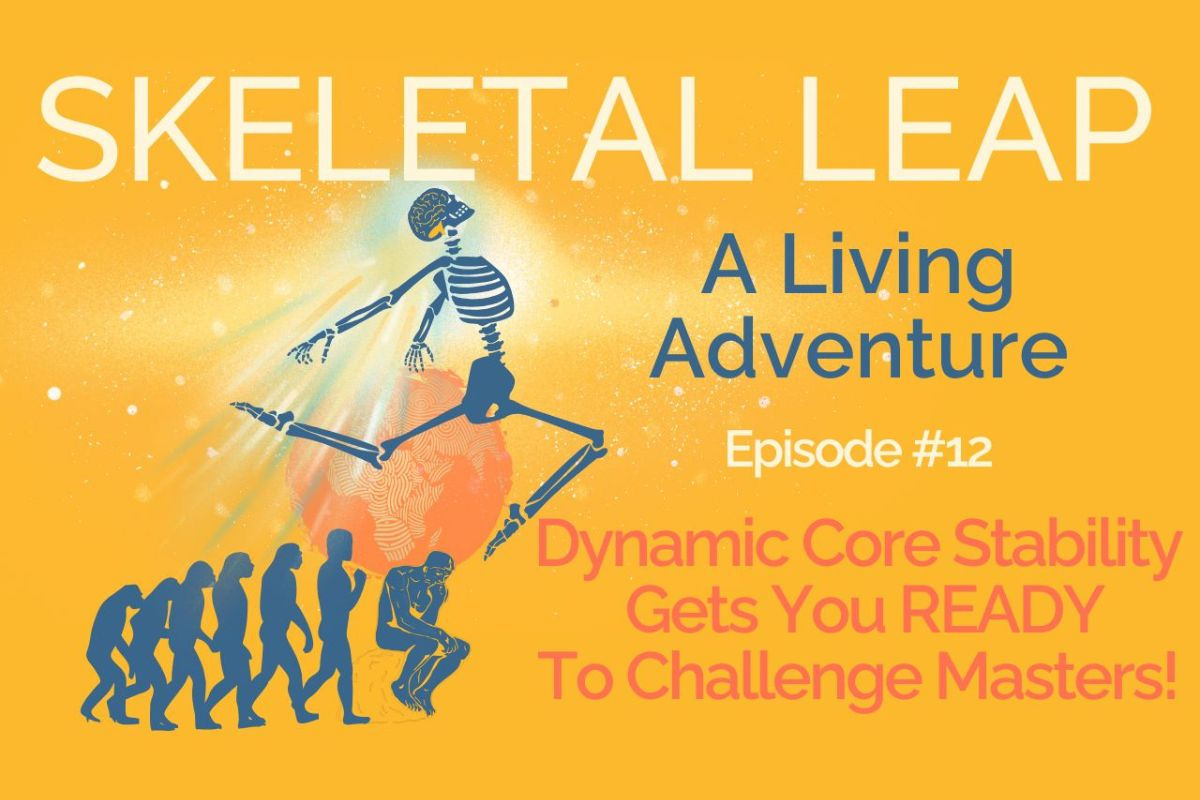
In the latest episode of Skeletal Leap, titled “Dynamic Core Stability Gets You READY to Challenge Masters!“, host Laadi Ojas dives deep into the fascinating science of our bodies and how understanding our evolutionary history can lead to better health outcomes.
Laadi begins by highlighting the significant role of bipedalism in human evolution. Unlike animals that move on all fours, humans have adapted to walk upright, which has profound implications for our skeletal structure and overall movement.
This transition has provided us with enhanced freedom of movement but also comes with the responsibility to maintain our body’s center of gravity.
Laadi emphasizes that keeping this center intact while performing daily activities is crucial for stability and efficiency. One of the standout concepts discussed in this episode is the importance of core strength.
Laadi explains that our core muscles, located around two inches below the belly button, play a vital role in maintaining balance and stability. By strengthening these muscles, we can improve our performance in various physical activities, from casual chores to competitive sports like arm wrestling.
Interestingly, Laadi shares his personal experience of winning arm wrestling matches not due to sheer muscle strength but because of his innate ability to engage his core effectively.
Additionally, the episode touches on the connection between our physical health and mental well-being. Laadi notes that the practice of centering the body can enhance focus and mindfulness, allowing us to navigate our daily lives with greater awareness. He draws parallels to the teachings of Joseph Pilates, who championed the mind-body connection through exercises that promote core stability and posture.
Moreover, Laadi introduces the concept of chakras and their role in weight management. He explains how opening the solar plexus, root, and sacral chakras can prevent belly fat accumulation and promote overall health. This holistic approach to wellness emphasizes the integration of physical, mental, and spiritual practices for achieving optimal health.
As the episode concludes, Laadi invites listeners to embrace the journey of self-discovery and personal development through mindful movement. By understanding our body’s design and harnessing the power of our core, we can combat obesity and enhance our quality of life.
For those eager to delve deeper into these concepts, Laadi encourages listeners to explore the resources available on the Skeletal Leap website. With practical insights and actionable steps, this episode “Dynamic Core Stability Gets You READY to Challenge Masters!“ is a must-listen for anyone seeking to improve their health and well-being.
Tune in now and take the first step towards dynamic core stability for transforming your life into a personal heaven!
Dynamic Core Stability Gets You READY to Challenge Masters! - Subscribe to Skeletal Leap Newsletter

Get my book ‘Eyesight To Insight Memoir’ FREE when you Subscribe to Skeletal Leap Newsletter: https://www.SkeletalLeap.com/newsletter
Dynamic Core Stability Gets You READY to Challenge Masters! - Audio
Dynamic Core Stability Gets You READY to Challenge Masters! - Video
Dynamic Core Stability Gets You READY to Challenge Masters! - Transcript
Obesity throughout the world has assumed a debilitating stature making its scale even larger than a pandemic.
My name is Laadi Ojas. Welcome to “Skeletal Leap: A Living Adventure”. Skeletal Leap transforms one’s life into a personal heaven.
Today’s episode will tell you how I cracked the code of instant central fixation of the body.
After having cracked all these codes and activating them in a focused observant posture that was not moving in space with time, I needed to generalize them under conditions of movement throughout the day involving not only the body but also the mind. I needed to be equally focused and observant to keep them active while doing all kinds of my daily chores whether casual like washing utensils or critical like fighting with someone on road. Occasionally sitting for meditation in an ideal static posture to activate all these codes for a limited duration of time was not a realistic alternative. All these codes needed to remain active all through the day throughout the life. An hour of meditation would never be able to compensate for the rest twenty three hours of anti-meditative action of life.
It all needed to be an integral part of whatever I did, whenever I did and wherever I did. For this, I needed to understand the movement of body in space and the movement of mind in time in deeper details.
I chose the movement of body in space, first. It needed to remain stable while making any kind of movement. The animal movement wouldn’t be able to provide much insight into the human movement. The reason was that the animals carried all their body weight either on four or more of their legs like in mammals and insects or on their entire body like in birds in the sky, reptiles on earth and water animals in the sea. Humans were different. We had chosen to balance our body weight only on two feet, turning the rest two into hands through our ancestors as long as 4-7 million years ago.
Once we changed our body orientation from horizontal to vertical, our organs including our skeleton, brain, muscles, nerves and blood vessels started a new journey of bipedal evolution. The changes involved new arrangement and size of foot bones, hip size and shape, knee size, leg length, shape and orientation of vertebral column and the skull orientation.
With the help of newly evolved larger heels, the foot increased in size. This enabled it to work like a platform on which the body weight could easily rest. It also turned the toes smaller than before as they were no more used to grasp things like tree trunks.
Foot as a platform didn’t evolve as a flat surface but did so as an arched one. This arching distributed the body weight on feet from their heels to the balls of the feet behind the big toes. Such a weight distribution conserved a lot of energy while walking.
Human knee joints also evolved to support the increased body weight on just two of them, as opposed to four before, owing to bipedalism. The degree of knee extension, meaning the angle between the thigh and the shank in the walking cycle, decreased. This change called double knee action reduced energy lost by vertical displacement of the center of gravity. It enabled Homo sapiens to keep their knees straight right under the body, improving its balance.
Evolution, driven by bipedalism changed the length of Homo sapiens’ legs since they were the only ones to function with an upright gait. Leg muscles became the ones that gave a push, through their ankles, to the action of walking. Longer legs also gave an effortless swing to the steps without using the muscles every time. Since forelimbs no more played any role in the action of walking, they were freed to be used for other activities.
Bipedal evolution provided Homo sapiens with upper limbs for visually guided manipulation and lower limbs for mechanically guided bipedal gait. It also optimized the location of the body’s center of gravity. It further reorganized the internal organs and the biomechanics of the trunk through a double S shaped vertebral column. The double S shape of the vertebral column became an efficient shock absorber. The entire skeletal system thus efficiently shifted the weight of the upper body to the soles of the feet. Long, load bearing legs were also very nicely optimized for bipedalism.
All the large joints of the lower limbs got aligned in a vertically oriented straight line.
Bipedalism also resulted in larger hip joints than before to better support the entire body weight. It made the hip shorter and broader, bringing the vertebral column closer to itself. This re-arrangement provided a more stable base for the support of the trunk while walking upright.
The size of the gluteus muscles increased as well, enabling Homo sapiens to assume a balanced stance even on just one leg. The sacrum turned broader, thus increasing the opening of the birth canal in the females of the species.
Today, the vertebral column of adult Homo sapiens, in its natural posture, has two secondary posteriorly concave bends in its lumbar and cervical regions. They are called secondary because they develop after birth. On the other hand, it has two primary anteriorly concave bends in its sacrococcygeal and thoracic regions. They are called primary because they retain the original fetal curvature.
Together, these four bends give rise to the double S shape of the vertebral column. Without its posteriorly concave bend in its lumbar region that develops as the child learns to sit upright, stand, and walk, the body would have kept leaning forward. In that case it would have needed a huge effort to stand upright.
At the top, without its posteriorly concave bend in its cervical region that develops as the infant begins to hold their head upright when sitting, the head couldn’t have been held up straight.
The two anteriorly concave bends in the sacrococcygeal and thoracic regions have been retained from the original fetal curvature.
The posteriorly concave bend in the lumbar region and the anteriorly concave bend in the thoracic region keep the body straight. These two bends do so by keeping body’s center of gravity vertically in line with its feet.
Also, during the bipedal evolution with an accelerated evolution of brain, the skull changed in size and weight very fast as it changed to a vertical orientation freely balanced on the vertebral column at its first vertebra named Atlas. These vertical orientations of the skull and the vertebral column gave them more freedom to move these parts in any desired direction and orientation.
The size of the human brain that kept increasing all this while also played a very big role in bipedal evolution. It went 3-4 times larger, for its body size, than that of its nearest evolutionary relative, chimpanzee.
Today, all these new arrangements have turned us way more susceptible to go off-balance with the slightest deviation in posturing our vertically oriented body from the way it has been designed. It happens when our body’s center of gravity no more remains vertically in line with its feet. In such scenarios we tend to stumble even if we don’t really fall down outright. The more we are able to keep our body’s center of gravity vertically in line with its feet, the more stable we remain in our movements that we keep making all day long.
That’s why we need to center our body and keep that centering intact while we are making movements. The quadrupeds don’t need to be bothered about it since they have a large base to support their body weight which never lets them stumble or fall. We humans gave away that benefit to opt for the enhanced freedom of movement that we achieved as its result. But freedom always comes with responsibility. It has become our responsibility today to keep our center intact while making all kinds of movements. If we fail to do so, we are forced to compromise while making the movements we need to make. It not only makes our body less efficient but also our mind through losing our focus on the action in hand.
I looked for the center of my body that I needed to keep vertically in line with its feet intact in space while making complex movements that took the other parts of my body away from the center. We humans have gone unaware of it, especially so because we don’t keep our vertebral column postured the way it has been designed to keep our body’s center of gravity vertically in line with its feet.
This center is what we call the core located in our abdomen around two inches below the belly button. The muscles around this point in the body allow us to keep it intact and the stronger they are, the better goes the quality of all our movements. They build up our core strength to get centered at the core which is the most efficient way to do any action even with our limbs in conjunction with our core.
Let me give you an example here. My performance in an unofficially popular sport called armwrestling had alway been exceptional since my early childhood. It was not that I was very strong in my arms but whoever I played it with could never defeat me. At times, these challengers were with large and strong muscles in their arms but they would invariably lose whenever they played it with me. They were surprised but no more than I too was. I could never analyze what it was that made me win every time. Of course, it did give me a psychological confidence that later started playing an extra role in making me win. But that could never be the only factor. Moreover this factor had entered much later in the scene. It wasn’t always there when I started my winning spree. Hence it couldn’t be given the sole credit of it.
At this point of time when I started locating the center of my body, I suddenly discovered that I had already been utilizing it for much of my benefit all through my life. Although I never consciously did so but it happened on its own very spontaneously as and when I sat down for a bout of armwrestling. I could now very well see which muscles around my core I used along with using the muscles in my arm. And using them along with the muscles in my arm had made me almost invincible in this sport.
Yes, if we keep our core intact with the help of strong muscles around it in a habitual manner, we will turn invincible in whatever we do through making ourselves entirely focused on that particular action. And it was this that I had been doing unknowingly in a habitual manner while armwrestling with others.
Once I discovered cracking the code of instant central fixation of the body, I started using it in all the movements I made with the help of any other muscles in any part of my body. The results were spectacular increasing my efficiency in whatever I did since then.
In fact, Joseph Pilates had already worked on this approach through correcting the spine posture in the earlier part of the 20th century improving the body balance considerably. He called it “a mind-body exercise that requires core stability, strength, and flexibility along with attention to muscle control, posture, and breathing”.
The stronger the core muscles are and more we use them to keep the core intact, the better goes the performance of all the rest of them in any part of the body.
The core muscles include…
Abdominal group of muscles (rectus abdominis, internal and external obliques, and transverse abdominis)
Erector spinae group of muscles (iliocostalis, longissimus, and spinalis)
Pelvic floor group of muscles (coccygeus, iliococcygeus, puborectalis, and pubococcygeus)
Thoracic diaphragm muscle that activates the diaphragmatic breathing
There are two approaches to centering the body. One of them is strengthening the above-mentioned muscles. But the second one, i.e., the habit of using them while doing any movement in the body plays a more important role as it strengthens them while using them for balancing the body at the same time. In fact, it’s a better way to strengthen your core muscles – we need to use them whether we are making a movement or not. They already have some strength in them. Hence the more we use them, the stronger they go automatically. We get the best of both the worlds!
Download the code of instant central fixation of the body in the ‘Resources’ section of SKELETAL LEAP BOOK 1, available on: skeletalleap.com/themindbodyconnection
Centering the body even while not making any movement has an additional benefit that’s as valuable as its balancing effect turning body stable. It is that it never lets the belly fat get accumulated in the abdomen at all.
Obesity throughout the world has assumed a debilitating stature making its scale even larger than a pandemic. That’s why and how the weight loss business has become one of the most lucrative businesses the world over!
In general, it all starts with adding fat to the belly in the beginning. And the best way to lose belly fat is opening the solar plexus chakra in conjunction with the root and the sacral chakras. It turns our entire abdominal area between the pelvis and thoracic diaphragm in a vertically stretched and perfectly taut stance. If all these three chakras are open, it’s not possible for fat to get accumulated on the belly. If it’s already present, these three open chakras immediately start melting it right then and there. And as it is a 24 hour process, it loses belly fat much faster than any other weight loss method.
Thanks for listening to this episode of Skeletal Leap: A Living Adventure! In the next episode, I will tell you how I cracked the code of instant central fixation of the mind.
Be a part of Skeletal Leap Community! Subscribe to Skeletal Leap Newsletter. Click on the link in the description to subscribe.
Dynamic Core Stability Gets You READY to Challenge Masters! - Get Skeletal Leap Book 1: The Mind Body Connection
The paperback version of SKELETAL LEAP BOOK 1: The Mind Body Connection is available on https://www.SkeletalLeap.com/themindbodyconnection
You may also like…
Introducing SKELETAL LEAP: A Living Adventure
Cracking The Hidden Codes Of An Instant Sovereign Remedy
Unlocking the SECRET of Instant Visual Clarity & Visual Acuity
Unlocking The Secrets of Balancing The Chakras
Root Chakra Opening and Healing - Surprising Secrets Unearthed!
Opening Sacral Chakra: Chakra Healing Secrets That REALLY Work
New Solar Plexus Chakra Healing Tips That Keep It Permanently Open!
How To Unblock Your Heart Chakra Healing Your Love Life Compassionately!
Unblock Your Throat Chakra Healing Your Voice!
Third Eye Opening to Crown Chakra Healing in One Single Go Safely!
READY for SPONTANEOUS KUNDALINI AWAKENING through BREATHWORK Technique?