

SKELETAL LEAP: THE MIND BODY EVOLUTION SERIES
Introduction:
In the 24th episode of my podcast, I will take you along to a bio-historical journey through the biological evolution of our skeletal system, driven by the unique adaptation of bipedalism.
As Homo sapiens, our ability to walk upright has not only transformed our mode of movement but has also significantly influenced the structure of our skeleton.
This episode explores how our anatomy has evolved over millions of years, highlighting the changes in foot structure, knee joints, and pelvic orientation.
I dive deep into how these evolutionary changes have led to specific trade-offs that modern humans must navigate. For instance, while bipedalism has made walking more energy-efficient, it has also introduced various postural challenges.
I share my observations from training individuals in skeletal reposturing, revealing that many people distribute their body weight incorrectly on their feet due to years of poor posture. This misalignment can lead to a range of biological and psychological ailments.
A significant aspect of the episode is the connection between skeletal posture and chakras. I present a compelling thesis that unhealthy postures can block chakras, which in turn disrupt our physical and emotional well-being.
I outline how each part of the skeleton corresponds to specific chakras and discuss the actions required to open these energy blocking centers. You will learn about the ideal positions for various skeletal parts, the importance of maintaining proper pelvic tilt, and how these factors relate to common lifestyle diseases.
The episode also addresses the psychological implications of these physical issues, emphasizing the interconnection between the mind and the body. As I explain, opening the root chakra is essential for addressing pelvic tilt issues, which can lead to a cascade of health benefits.
I continue to explore higher chakras, such as the sacral and the solar plexus chakras, and their roles in our overall health. Each chakra’s function is discussed in detail, providing you a comprehensive understanding of how physical posture affects our emotional and spiritual states.
This episode is not just about anatomy; it’s a call to action for you to reassess your posture and consider how it impacts your life. By the end of the episode, you’ll be inspired to take steps toward achieving a healthier skeletal posture and, in turn, a more balanced life.
Join me for this helpful discussion and discover how the skeletal leap can transform your life into a personal heaven. Don’t miss out on this opportunity to learn a revolutionary procedure and embark on your journey toward optimal health and well-being. Tune in now!
🔑 Key Takeaways:
Bipedalism: Introduction to bipedalism and its impact on human evolution.
Skeletal Structure: Discussing the evolution of skeletal structure for bipedalism.
Foot Structure: The significance of foot structure in energy-efficient walking.
Knee Joint: Knee joint adaptations and their role in balance.
Limbs: The evolution of limbs and their function in bipedalism.
Pelvic Tilt: Understanding pelvic tilt and unhealthy postures.
Chakra Health: The relationship between pelvic tilt and root chakra health.
Vertebral Column: Exploring the vertebral column’s curves and their implications.
Overall Health: The role of all 7 chakras in overall health.
Skeletal Evolution: Closing thoughts on skeletal evolution and chakra alignment.
🎙️ Listen to the Journey:
📽️ Watch the Masterclass:
Transcript:
“Evolution, driven by bipedalism, meant that Homo sapiens were the only species to function with an upright gait. This changed the lengths of their legs.”
My name is Laadi Ojas. Welcome to “Skeletal Leap: A Living Adventure”. Skeletal Leap transforms one’s life into a personal heaven.
Today’s episode will tell you about how skeletal re-posturing opens chakras through completing our bipedal skeletal evolution.
Human bipedalism started around 4-7 million years ago when our ancestors named hominins stood on their twos. As it happened, their skeleton started evolving to suit itself to bipedalism as much as it could. It changed in its arrangement of bones with respect to one another as well as in their shapes and sizes. The changes involved were…
New arrangement and size of foot bones | Hip size and shape | Knee size | Leg length | Shape and orientation of vertebral column | Skull orientation
Bipedalism made walking more energy-efficient and human movement much easier. Though running became less energy-efficient, walking was much more important. Hence the trade-off worked. It increased their locomotion tremendously.
Bipedalism Driven Skeletal Evolution Details
There were other trade-offs as well, all through the skeletal system, that Homo sapiens have been dealing with the adverse effects of, ever since. In the rest of this episode, I will endeavor to describe various parts of our skeleton while pointing out those particular trade-offs that apply to each of those parts. I will, then, go on to describe the ideal position/ posture of those parts while bringing our attention to how we have gotten used to their ‘unhealthy’ versions. This will be followed by descriptions of the corresponding biological/ psychological ailments arising from those ‘unhealthy’ positions/ postures. Finally, I will arrive at my most significant discovery and thesis which is to ascribe the appropriate chakras to these ‘unhealthy’ positions/ postures and their resultant ailments. Needless to say, this will be accompanied with the necessary actions required to dissolve those chakras.
Foot:
With the help of newly evolved larger heels, the foot increased in size. This enabled it to work like a platform on which the body weight could easily rest. It also turned the toes smaller than before as they were no more used to grasp things like tree trunks.
The foot, as a platform, didn’t evolve as a flat surface but did so as an arched one. This arching distributed the body weight along the feet from their heels to their balls behind the big toes. This weight distribution conserved a lot of energy while walking.
Here, I feel the need to share my observations from training people in re-posturing through Skeletal Leap. The energy conservation in walking resulting from body weight distribution is the ideal state. What I have noticed in the majority of my trainees is something different. Owing to posturing their body in a wrong way over years and years, they distribute their body weight on the outsides of their feet. Most of them do so toward the outer sides of their heels whereas the rest do toward their little toes. The first thing I always check in my trainees is the soles of their shoes. More specifically, where those soles have worn the most. My data suggest that most of the modern Homo sapiens distribute their body weight on their feet the wrong way.
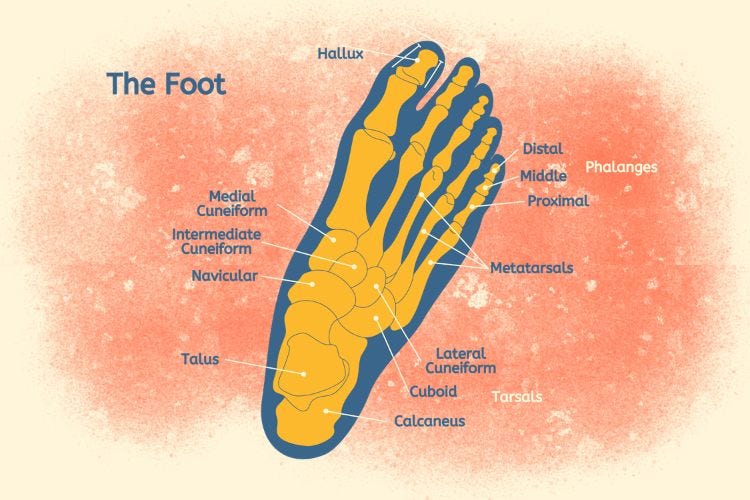
Today, the human foot is a complex structure of 26 bones, 33 joints and hundreds of muscles, tendons and ligaments. The main joints of the foot are:
Ankle joint | Subtalar joint | Interphalangeal foot articulations
A foot has three parts to it:
The hindfoot comprises the ankle bone (talus) and heel bone (calcaneus). The ankle bone connects to tibia and fibula in the lower leg and forms the ankle joint. At its other end, it connects to the heel bone and forms the subtalar joint.
The midfoot has five bones: the cuboid, navicular and three cuneiform bones from its arches, serving as a shock absorber. It is connected to the hindfoot and the forefoot with muscles and plantar fascia.
The forefoot comprises five toes and five proximal long bones forming metatarsus. Toe bones are called phalanges. The joints among these phalanges are named interphalangeal joints while joints of phalanges with metatarsus are named metatarsophalangeal joints.
The human foot has two longitudinal and one transverse arches. They make walking and running more energy-efficient.
Knee:
Human knee joints have also evolved to support the increased body weight between just the two of them, as opposed to among the four before bipedalism.
The degree of knee extension, meaning the angle between the thigh and the shank in the walking cycle, has decreased. This change called double knee action reduces energy lost by vertical displacement of the center of gravity. It enables Homo sapiens to keep their knees straight right under the body, improving its balance.
The knee joins the thigh and the leg with two joints, tibiofemoral joint connecting femur with tibia and patellofemoral joint connecting femur and patella.
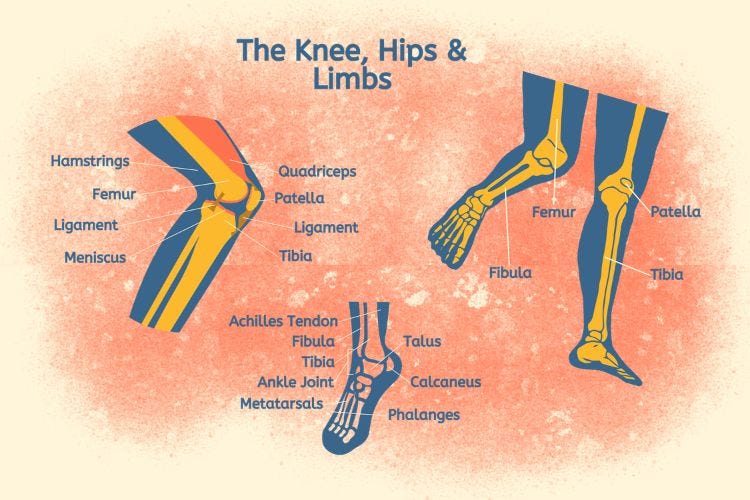
This modified hinge joint is the largest joint in the body. It very efficiently permits flexion and extension along with a limited internal and external rotation.
Limbs:
Evolution, driven by bipedalism, meant that Homo sapiens were the only species to function with an upright gait. This changed the lengths of their legs. Today, leg muscles are the ones that give a push, through their ankles, to the action of walking. Longer legs also give an effortless swing to the steps without using the muscles every time. Since forelimbs, or hands as we now call them, don’t play any role in the action of walking, they have been freed to be used for other activities.
Bipedal evolution provided Homo sapiens with upper limbs for visually guided manipulation and lower limbs for mechanically guided bipedal gait. It also optimized the location of the body’s center of gravity. It further reorganized the internal organs and the biomechanism of the trunk through a double S shaped vertebral column. Today, the double S shape of the vertebral column is an efficient shock absorber. The entire skeletal system thus efficiently shifts the weight of the upper body to the sole of the feet. Long, load bearing legs are also very nicely optimized for bipedalism.
All the large joints of the lower limb are aligned in a vertically oriented straight line.
Hip and Pelvis:
Bipedalism also resulted in larger hip joints than before to better support the entire body weight. It made the hip shorter and broader, bringing the vertebral column closer to itself. This re-arrangement provided a more stable base for the support of the trunk while walking upright. The ilium broadened, thereby adjusting the walls of the pelvis to face laterally.
The size of the gluteus muscles increased as well, enabling Homo sapiens to assume a balanced stance even on just one leg. The sacrum turned broader, thus increasing the opening of the birth canal in the females of the species.
Three pelvic bones fused into one as the hip bone. Today, the hip joins the head of the femur to the acetabulum of the pelvis. This joint supports the weight of the body in its static as well as dynamic state. Thus, the hip joint retains balance and maintains the pelvic inclination angle.
Pelvic Tilt:
Pelvic tilt is a movable postural orientation of the pelvis. It is an orientation relative to the thigh bones, knee joints and the soles of the feet below. It also changes the orientation of the hip joint. When postured right, it subtly supports the weight of the vertebral column above it while keeping its double S shape intact.
But that is just a description of the ideal pelvic orientation. A major chunk of the human population habitually keeps this pelvic tilt wrongly postured.
There are two reasons for this unhealthy habit formation.
The first one is the downward pull by gravity on its orientation. People give in to this constant downward pull when they lack enough life energy to keep its orientation up. They just let the front of their pelvis drop in relation to its back. The newly acquired orientation called anterior pelvic tilt also disrupts the orientation of the hip joint. This further disrupts the double S shape of the vertebral column above. Below, it disrupts the load bearing distribution at the knee joints and at the soles of the feet, thus rendering the entire skeletal posture ‘unhealthy’.
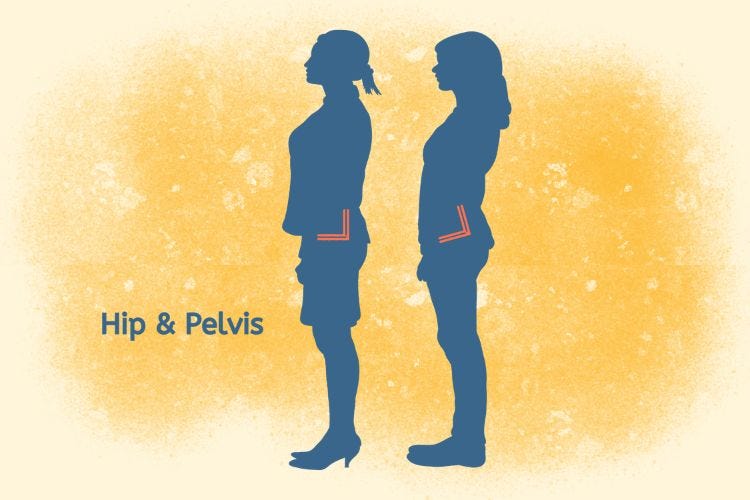
The second reason is an emotionally driven, ‘pulled-in’ psychological state that results in same aforementioned ‘unhealthy’ skeletal posture.
The aforementioned anterior pelvic tilt is just one, albeit the most prevalent, of its many abnormal orientations.
The second most prevalent of the abnormal orientations of the pelvic joint is the posterior pelvic tilt.
Here is a complete list of pelvic tilt abnormalities as and when its orientation gets wrongly postured:
Anterior pelvic tilt drops the front of the pelvis relative to the back of the pelvis. It shortens the hip flexors and lengthens the hip extensors.
Posterior pelvic tilt raises the front of the pelvic relative to the back of the pelvis. It lengthens the hip flexors and shortens the hip extensors.
Lateral pelvic tilt happens when one keeps pelvis tilted to left or right habitually, resulting in scoliosis.
Left pelvic tilt keeps the right side of the pelvis raised more than the left side.
Right pelvic tilt keeps the left side of the pelvis raised more than the right side.
Tailbone vis-à-vis Root Chakra:
Pelvic tilt is the sole cause of a closed root chakra appearing at the lowest point, coccyx (aka tailbone), of the vertebral column. Coccyx lies very near the pelvic belt. And the pelvic tilt drops it down and pushes it forward in the case of a posterior pelvic tilt. When the pelvic tilt is anterior, it still drops the coccyx down but pushes it backward this time. Both these maneuvers sow the seed of closed chakras eventually distorting the double S curve of the vertebral column.
A closed root chakra also disrupts the anatomy and hence the physiology of the pelvis, hip and the lower limb. It disrupts the pelvic, hip, knee, ankle and subtalar joints with interphalangeal articulations of the feet and the associated muscles, nerves and blood vessels.
As a result, the tailbone (coccyx) drops down as well as moves forward or backward at the pelvis. The body weight distribution on the hip, knees and soles of the feet gets distorted centering its thrust on the wrong points. With the passage of time, one develops knee pain, sciatica, varicose veins and constipation in case of posterior pelvic tilt. When it is due to anterior pelvic tilt, constipation gets replaced with chronic diarrhea.
Symptoms of root chakra blockage are indicators of lifestyle diseases related to the root chakra.
It makes us feel ungrounded biologically as well as psychologically. Hence it keeps us perennially concerned with survival and material security in life.
More specifically, a posterior pelvic tilt turns us into misers who fear losing whatever little we have. Biologically, this manifests as constipation, belly fat and/ or hemorrhoids.
On the other hand, an anterior pelvic tilt turns us into spendthrifts. Contrary to common perception, this comes from a place of greed. Here, I’d like to bring our attention back to a point I made earlier, i.e., the opposite of fear is not courage but greed. Therefore, it makes us believe that our wealth would never deplete even when a lot of it gets lost. Biologically, this leads to chronic diarrhea.
Both types of pelvic tilts are accompanied by other symptoms such as acidity and loss of appetite.
Opening the root chakra reverses the wrong done to the pelvic tilt and makes the ideal pelvic posture one’s first nature. Doing away with our pelvic tilt tends to start the first step toward a ‘healthy’ skeletal re-posturing.
Vertebral Column:
The vertebral column of Homo sapiens, in its natural posture, has a forward bend in its lumbar region.
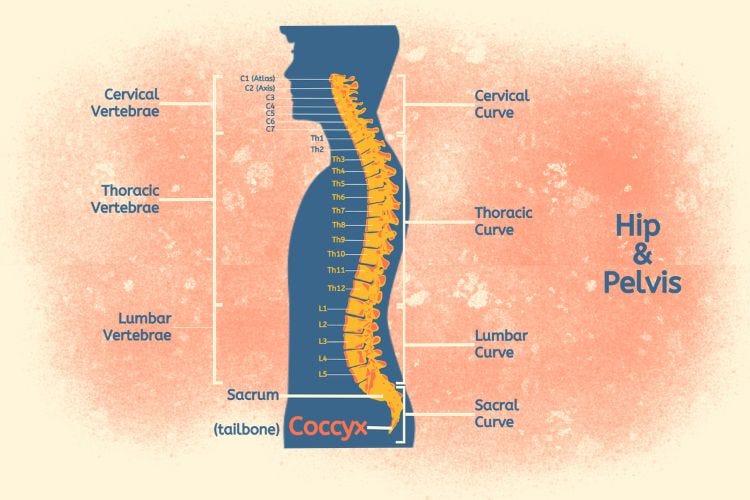
Above this, it has a backward bend in its thoracic region. Together, these two bends give rise to the double S shape of the vertebral column. Without its forward bend in its lumbar region, the body would have kept leaning forward. In that case it would have needed a huge effort to stand upright.
The forward bend in the lumbar region and the backward bend in the thoracic region keep the body straight. These two bends do so by keeping the body’s center of gravity vertically in line with its feet.
The vertebral column is what makes Homo sapiens a vertebrate that has a long chain of vertebrae separated by intervertebral discs. Their nomenclature is done by their region – denoted by a letter – within the vertebral column and their position – denoted by a number – within that region. The vertebral column also has a spinal canal for housing the spinal cord.
Nomenclature of the vertebrae: Cervical spine 7 vertebrae (C1 - C7) | Thoracic spine 12 vertebrae (T1 - T12) | Lumbar spine 5 vertebrae (L1 -L5) | Sacrum 5 fused vertebrae (S1 -S5) | Coccyx 4 fused vertebrae (Tailbone)
There are 33 vertebrae in the vertebral column. The upper 24 of them are of the articulating type and separated from one another by intervertebral discs. The lower 9 of them are of the fused type in human adults, 5 in the sacrum and 4 in the coccyx. Ligaments at the front, back and in between the vertebrae help lengthen the vertebral column. These ligaments join the spinous processes, the transverse processes and the vertebral laminae.
Atlas and axis are the topmost vertebrae in the cervical region and they support the head.
Vertebral body and vertebral arch are the two parts of a vertebra placed anteriorly and posteriorly respectively. These two parts that are in contact with each other enclose the vertebral foramen through which the spinal cord passes.
The vertebral arch comprises two pedicles and two laminae. The arch performs seven processes out of which 4 are articular, 2 are transverse and one is spinous (aka neural spine). The spinous process comes out the back and the two transverse processes come out left and right respectively. Vertebrae are joined by a thin portion of the neural arch called the pars interarticularis with facet joints that allow a restricted movement. Each pair of two vertebrae contains two small holes between them. These holes are named intervertebral foramina. Spinal nerves go out of the spinal cord to the organs through these holes.
As a result of bipedal evolution, the vertebral column got curved at numerous places to stabilize the body in an upright position.
Here is a list of curves in the vertebral column comprising their vertebrae:
C2 - T2: convex forward (lordotic curve) | T2 - T12: concave forward (kyphotic curve) | T12 - S1: convex forward (lordotic curve) | S1 - Tailbone: concave forward (kyphotic curve)
Curvature abnormalities are of four types:
Kyphosis - excessive kyphotic curve | Lordosis - excessive lordotic curve | Scoliosis - lateral curvature | Kyphoscoliosis - combination of kyphosis and lordosis
Sacral Plexus vis-à-vis Sacral Chakra:
Sacral plexus is a nerve plexus comprising sensory and motor nerves for the pelvis (partly), posterior thigh, lower leg and foot.
It originates at the lumbar and sacral vertebrae namely L4 - S4.
It is a formation that comprises:
The lumbosacral trunk | The anterior division of the first sacral nerve | Parts of the anterior divisions of the 2nd and 3rd sacral nerves
The nerves of the sacral plexus meet at the greater sciatic foramen making a flattened band there. From here, new branches turn into the sciatic nerve, ultimately splitting into the tibial and fibular nerves in the posterior thigh.
Sacral plexus is positioned at the back of the pelvis and is fed by the superior and inferior gluteal arteries and veins.
A closed sacral chakra happens when the nerves in the sacral plexus are subjected to long-term compression.
It takes place through the dropping of the sacral vertebrae and the resulting distortion of the lower S of the double S shaped vertebral column.
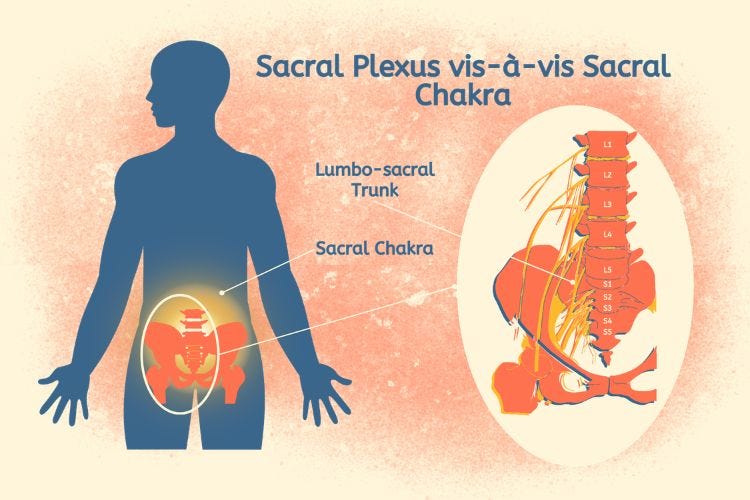
Constant compression of the sacral plexus results in the suppression of the aesthetic of our instinctual structure. The roles of the root chakra and the sacral chakra are just the opposite of each other. The root chakra takes care of the basic survival and material safety or security. Conversely, the sacral chakra is concerned with whatever is beautiful in life and gives it meaning. Its concerns, including curiosity, creativity, sexual drive and potency, fill the pursuit of life with joy and passion.
Symptoms that point to the existence of the sacral chakra, including all kinds of sexual problems like premature ejaculation, impotence, ejaculatory incompetence, orgasmic dysfunction, vaginismus, frigidity and a poor sex performance owing to the lack of a mature orgasm in men and women are all lifestyle diseases that stem from a closed sacral chakra.
A constantly compressed sacral plexus afflicts the sexual process with various types of sexual dysfunctions. But once the compression is released through raising the sacral vertebrae up in the vertebral column, they start getting relieved. Then, it is just a question of keeping the vertebral column raised at its sacral region by making it one’s first nature.
There is a caveat here. The sacral chakra cannot be effectively opened until and unless the root chakra below it is already opened.
Solar Plexus vis-à-vis Solar Plexus Chakra:
The solar plexus aka celiac plexus is located in the vicinity of the thoracic diaphragm near the first lumbar vertebra in the vertebral column. It comprises:
Splanchnic nerves - paired visceral nerves with fibers from autonomic nervous system and organs innervating visceral organs | Anterior vagal trunk - a branch of the vagus nerve with fibers from the left vagus primarily | Posterior vagal trunk - a branch of vagus nerve with fibers from the right vagus primarily
Solar plexus also comprises smaller plexuses within, namely:
Hepatic plexus - receiving filaments from left vagus and right phrenic nerves | Splenic plexus - formed by the left celiac ganglion and the right vagus nerve | Gastric plexus - joining branches from the left vagus nerve | Pancreatic plexus - another solar plexus division | Suprarenal plexus - receiving branches from the celiac ganglion and splanchnic nerves
Solar plexus chakra arises from the L1 vertebra being dropped and tucked in, thereby compressing the thoracic diaphragm along its length.
A closed solar plexus chakra acutely disturbs the breathing pattern, turning it shallow and speedier. It makes one prone to breathing-related illnesses. As a result, diffidence creeps into one’s persona causing one to lose their spirit of interaction, adventure and initiative.
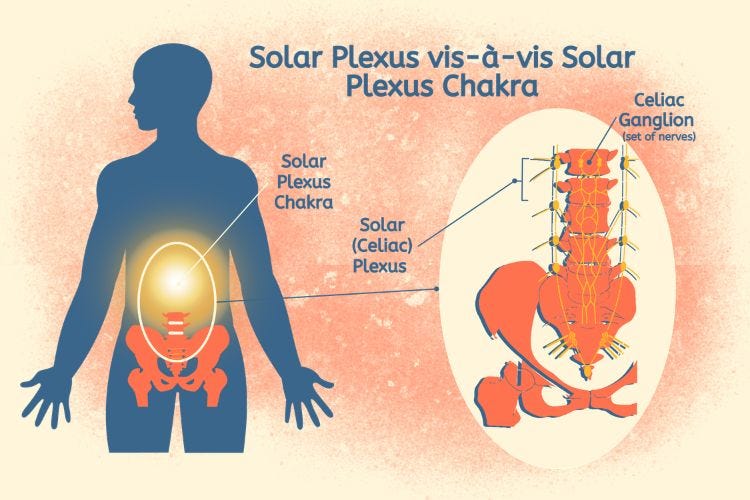
Belly fat leading to obesity, lower back pain, and breathing problems, including asthmatic symptoms, are the lifestyle diseases that stem from the solar plexus chakra.
The way to open the solar plexus chakra is simply to remove its compression by raising the L1 up and out. It further pronounces the lower S of the double S shape in the vertebral column. Once we have learnt how to effectively do this, we just need to make it our first nature.
There is a caveat here. Solar plexus chakra cannot be effectively opened unless the root chakra and the sacral chakra below it are already opened.
Pectoral Muscles vis-à-vis Heart Chakra:
Innervated by the lateral pectoral nerve (C5 - C7) and the medial pectoral nerve (C8 - T1), pectoral muscles have two parts:
Pectoralis major - flexes, extends and rotates humerus | Pectoralis minor - stabilizes the scapula
The pectoralis major is a thick, fan-shaped convergent muscle located in the chest. Its functions are flexion, extension and rotation of the humerus.
It performs four movements for the shoulder joint:
Flexion of the humerus like in heavy weight lifting while doing biceps curls | Adduction of the humerus like in arm-flapping | Rotating the humerus medially like in arm-wrestling | Keeping arms attached to torso like in military “attention” posture
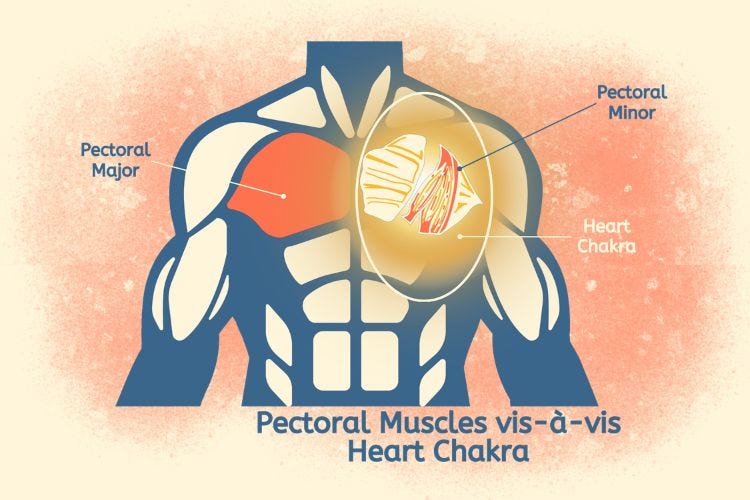
Out of the above four actions, only the second one keeps its associated vertebral upper S shape intact at the C8 - T1 vertebrae. The same holds good for the C5 - C7 vertebrae. The remaining three tend to turn it into an inverted C shape. Also, when we stretch our body for relaxation, it performs the second action alone.
Hence, it is logical to deduce that the second action is the most relaxed state of the muscle. When we make it our first nature, it keeps the heart chakra open.
But when we keep it postured like in any of the other three actions, it closes the heart chakra. It does so by turning the upper S shape of the C8 - T1 vertebrae into an inverted C shape.
The pectoralis minor is a thin, triangular muscle located in the upper chest under the pectoralis major muscle, which is innervated by the medial pectoral nerve (C8 - T1) alone. Same is true about the pectoralis minor which is also able to stabilize scapulae when postured like in the aforementioned second action of the shoulder joint.
This second action is also the one that we adopt for hugging someone.
And that is how we know that an open heart chakra is concerned most with love, kindness and compassion. If it is closed, it leads to narrowness of the heart, keeping us emotionally/ passionately isolated from our fellow beings on earth.
Symptoms that point to the existence of a closed heart chakra, like high blood pressure or hypertension, heart attack and heart failure, are all lifestyle diseases that stem from the heart chakra.
There is again a caveat here. Do you see a pattern repeating? The heart chakra cannot be effectively opened unless the root, sacral and solar plexus chakras below it are already opened.
Deltoid Muscle vis-à-vis Throat Chakra:
Innervated by the auxiliary nerve from the anterior rami of the cervical nerves at C5 and C6, the deltoid is located on the shoulder. It comprises three sets of muscle fibers:
Anterior (clavicular) - fibers assist pectoralis major to flex the shoulder | Posterior (scapular) - fibers assist latissimus dorsi to extend the shoulder like in rowing movements | Intermediate (acromial) - fibers perform shoulder abduction
Out of these three, only the posterior or scapular fibers keep their associated vertebral upper S shape intact at the C5 and C6 vertebrae. The other two tend to turn it into an inverted C shape. Also, when we stretch our body for relaxation, the posterior fibers perform alone.
Hence it is logical to deduce that the action by the posterior fibers is the most relaxed state of the muscle.
When we make it our first nature, it keeps the throat chakra open.
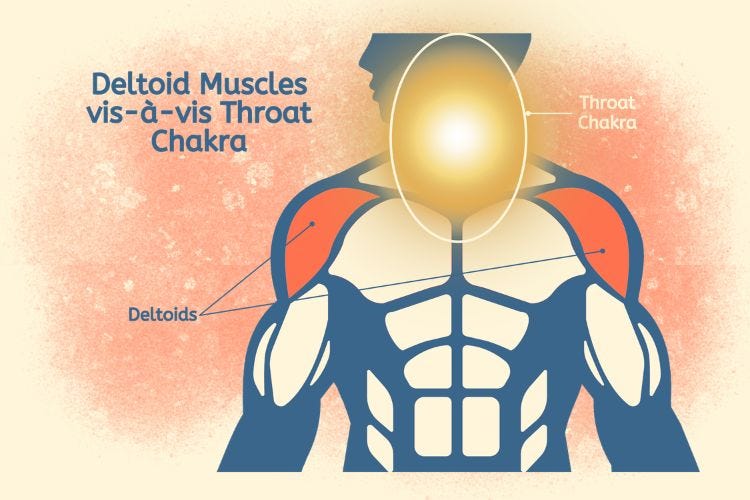
But when we keep it postured in any other way, it closes the throat chakra. It does so by turning the upper S shape of the C5 - C6 vertebrae into an inverted C shape.
The action by the posterior fibers is also the one that brings the top ends of the scapulae closest to each other. It also aligns the collarbones along the neck giving it a 180 degree mobility to move freely. And this freedom that the head experiences on the neck facilitates the opening of the throat chakra, which then becomes ready to open the next chakras (i.e. the ones in the skull). It opens our pathways to intelligence and logical communication. But if it is closed, it corrupts our communication and logical comprehension.
Symptoms of the throat chakra include diabetes, hypothyroidism and hyperthyroidism.
As usual, there is the same caveat here as well. You guessed it right! The throat chakra cannot be effectively opened unless the root, sacral, solar plexus and heart chakras below it are already opened.
Skull vis-à-vis Third Eye and Crown Chakras:
The skull of the Homo sapiens is freely balanced on the vertebral column at its first vertebra named Atlas, denoted together by the letter C (for cervical) and the number 1 (for first) as C1. Occipital condyles maintain the balance of the vertebral column dynamically. This is the main reason a human head can be postured erect even without the prominent supraorbital ridges and strong muscular attachments that are necessary in apes. As a result, the occipitofrontalis (frontalis and occipitalis) muscles are only used for facial expressions and central fixation of the eyes. The spinal cord, as an extension of the medulla oblongata, enters the vertebral column through foramen magnum, an occipital bone opening.
The size of the human brain has also played a very big role in bipedal evolution. It is 3-4 times larger for its body size than that of its nearest evolutionary relative, the chimpanzee.
The skull acts as a protective cavity for the brain. It houses the majority of the sense organs including eyes, ears, nose and tongue. It has two parts to it, the neurocranium and membraneous viscerocranium with the mandible as the latter’s largest bone. Numerous flat bones are fused together as sutures to give the human skull its shape. The mandible is the only major movable bone that engages with the neurocranium via the temporomandibular joints.
In all, the skull has 22 bones in it. Out of these, eight are the cranial bones:
Occipital bone | Temporal bones (2) | Parietal bones (2) | Sphenoid bone | Ethmoid bone | Frontal bone
There are 14 more bones in the facial skeleton:
Vomer | Inferior nasal conchae (2) | Nasal bones (2) | Maxilla (2) | Mandible | Palatine bones (2) | Zygomatic bones (2) | Lacrimal bones (2)
Also, there are paranasal sinuses (air-filled cavities lined with respiratory epithelium) and numerous foramina (openings in the skull).
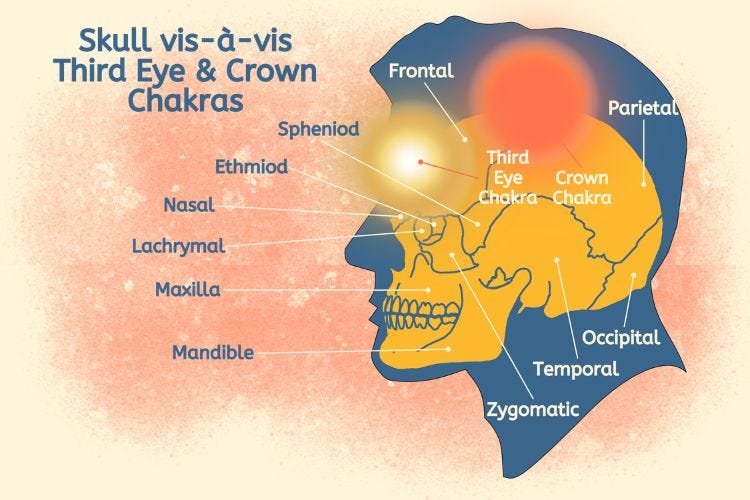
In episode 21, I had written about the third eye chakra and the crown chakra coming into existence due to bipedal evolution. I had also explained how to open them by maneuvering the temporomandibular joints. You will also find a full account of the only movable temporomandibular joints in the skull there. I had described it there in the context of how the mind got structured and could be emptied. You can go back and check these if you need to refresh their description in context of this episode again.
Symptoms that point to the existence of the third eye and crown chakras mainly include problems in one’s vision, chronic headaches and signs of stress.
An open third eye chakra is characterized by a sharp perception. Similarly an open crown chakra is characterized by a deep insight into life.
The two of them are very similar to each other with only one difference between them. An open crown chakra can see the macro view of what an open third eye chakra can see only the micro version. In other words, what an open third eye chakra can see in one single degree, the crown chakra does in 270 degrees.
In fact, as I discovered, there are two types of visual central fixation possible.
One is associated with an open third eye chakra alone, providing a crystal clear, bright and sharp tunnel vision aka perception. It is achieved by relaxing the frontalis muscle while accommodating with the help of occipitalis. Everything outside of this tunnel is blurred and dull.
The other one is associated with both, an open crown chakra and an open third eye chakra. This central fixation provides a crystal clear, bright, sharp and wide vision including peripheral vision, perception as well as empathy. It is achieved by relaxing both, the frontalis and the temporalis muscles while accommodating with the help of occipitalis. In my personal opinion, this has been my biggest discovery in the chakra discipline.
In the second type of central fixation, the eyes turn extraordinarily bright and empathetically shiny. I call this shine the real ‘smize’.
Also, the sharpness of the eyesight is closely linked with an insight into life. The brain’s perception needs to be aided by the recording tool that is a sharp eye. In other words, a clear vision in the eye leads to a clear worldview as well. Therefore, we must really say that our eyes are the real windows to the brain and not to the mind!
That is why the third eye chakra has been assigned two iconic petals whereas the crown chakra has been assigned full one thousand! And that is why the crown chakra is called the king of all chakras.
Let’s not forget that same caveat here! The crown chakra cannot be effectively opened unless third eye chakra is already opened. Also, the third eye chakra cannot be effectively opened unless the throat chakra is opened.
Thanks for listening to this episode of Skeletal Leap: A Living Adventure! In the next episode, I will tell you about an unintended evidence strengthening the skeletal chakra hypothesis via achieving central fixation of the eyes.
Be a part of Skeletal Leap Community! Subscribe to Skeletal Leap Newsletter. Click on the link in the description to subscribe.
🔑 Unlock the Practical Plan:
To truly master the Skeletal Leap, you need the step-by-step memoir and the associated practice codes found in the book.
Get the Book: The “Resource Codes” for this chapter’s PDF practice plan are found in the Amazon Paperback Edition.
Join the Movement: Download the Free Prequel Ebook via StoryOrigin and join our community.

Subscribe: Follow SKELETAL LEAP: The Mind Body Connection on Substack for weekly deep-dives into the human potential archive.
You may also like…
Release Stress: Psychological Stress Vs Biological Stress!

SKELETAL LEAP: THE MIND BODY EVOLUTION SERIES