

SKELETAL LEAP: THE MIND BODY EVOLUTION SERIES
Historical Reference: Historical Timeline of 12k Years! - Introduction
The Industrial Revolution marked a turning point in human history, ushering in an era of unprecedented achievements and profound losses.
In this episode of Skeletal Leap, I present a historical timeline that spans over 12,000 years, illustrating how human cultural and social institutions evolved from simple hunter-gatherer societies to complex civilizations.
The episode begins with a fascinating overview of the Agricultural Revolution, a pivotal moment that transitioned humans from nomadic lifestyles to settled farming communities.
I highlight the significant lifestyle changes that accompanied this shift, including the development of private property and the emergence of patriarchal structure.
This transformation not only altered social dynamics but also had lasting implications for human health, as sedentary lifestyles led to new diseases and a decline in overall well-being.
As I navigate through the timeline, I discuss the birth of rudimentary business practices that arose from increased food production and the need for specialized trades.
This transition laid the groundwork for the formation of states and empires, which further complicated human relationships and societal structures.
Warfare, driven by competition for resources and territorial expansion, became a recurring theme, showcasing the darker side of human progress.
The episode also touches on the rise of ancient civilizations, the Renaissance, and the Age of Discovery, highlighting significant achievements in culture, science, and technology.
However, I don’t shy away from addressing the losses that accompanied these advancements, including imperialism, economic depressions, and the ongoing threat of climate change.
In a thought-provoking conclusion, I emphasize that while the Industrial Revolution brought about remarkable progress, it also introduced significant challenges that continue to impact our world today.
As we grapple with the consequences of our actions, it becomes clear that understanding our history is crucial for navigating the future.
Tune in to this enlightening episode of Skeletal Leap to explore the intricate tapestry of human history and reflect on the lessons we can learn from our past. Whether you’re a history enthusiast or simply curious about the evolution of human societies, this episode is a must-listen!
🔑 Key Takeaways:
(00:00:00) - Human History: From hunting, gathering to farming. Historical timeline of the past 12,000 years
(00:05:00) - What Happened to the Social Structure of Communities: During Paleolithic period, there was a naturally balanced distribution of labor
(00:11:22) - Warfare in Human History: Neolithic period witnessed systematic warfare aimed at capturing and securing women
(00:22:01) - Human History in Terms of Accidents and Losses
🎙️ Listen to the Journey:
📽️ Watch the Masterclass:
Historical Reference: Historical Timeline of 12k Years! - Transcript
“Industrial revolution was a great achievement but it also created the demon of impending human-induced climate change.”
My name is Laadi Ojas. Welcome to “Skeletal Leap: A Living Adventure”. Skeletal Leap transforms one’s life into a personal heaven.
Today’s episode will tell you about historical reference with historical timeline of the past 12,000 years.
Historical Timeline of The Past 12,000 Years1
Human cultural and social institutions are the most recent developments to emerge from a speedy evolution of the brain. Around 12,000 years ago, the mind had already established its dominance as a partially autonomous entity vis-à-vis the brain.
From Hunting-Gathering to Farming2
It was around then that human cultural and social institutions started getting structured as hunter-gatherers adopted an agricultural lifestyle.
This lifestyle comprised farming and rearing domestic animals for food, milk and wool. It marked the end of the Paleolithic period and the beginning of Mesolithic and Neolithic periods.
Humans slowly and gradually stopped living in caves that they had adorned with paintings, in favor of huts and skin tents.
They had already started using fire for heating and cooking as early as 0.5 million years ago
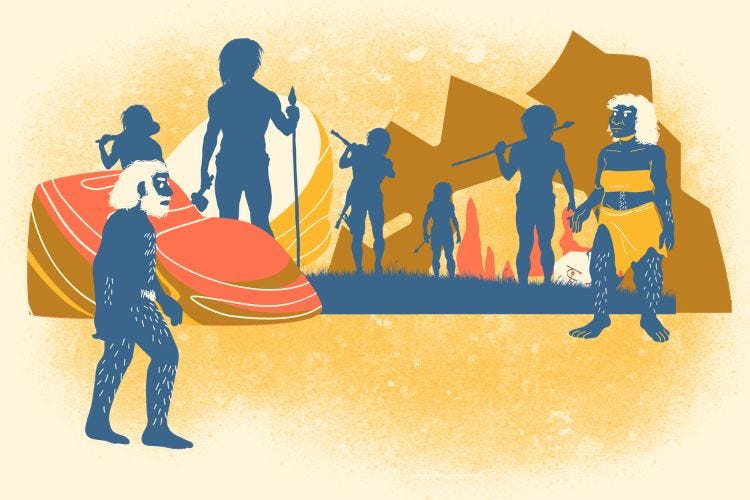
They had also developed language to communicate with others between 150,000-50,000 years ago. Now, with the agricultural revolution, they started constructing individual dwellings with mud bricks and timber on the lands they had started cultivating.
Paleolithic humans had started wearing loincloths and tunics prepared from plants and animal skins by chewing them to make flexible. They also wore rudimentary shoes. In the Neolithic period, woven garments started appearing, mostly from wool.
Lifestyle Changes
Nomadic tribal lifestyle gave way to permanent settlements on the farmlands as farming became the major source of food.
It gave them more control over their lifestyle with largely increased food production and a more efficient security system. The tools became sharper from grinding
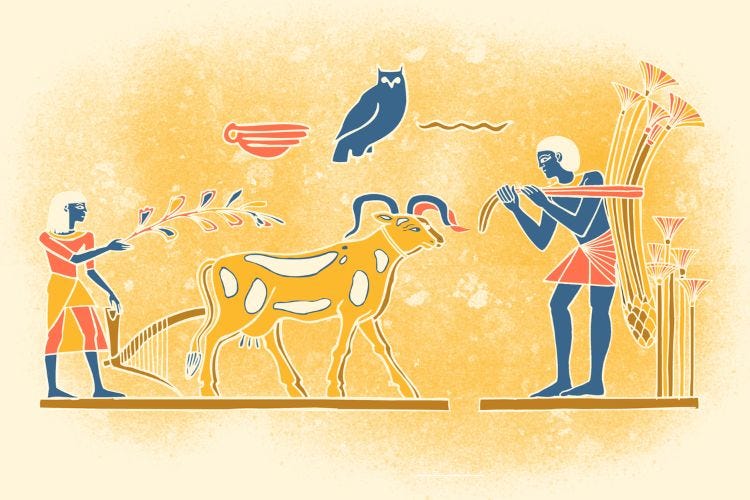
With the faculty of the mind having gained dominance over the faculty of the brain, the control of the tribes shifted from elders to military and religious leaders, giving birth to rudimentary monarchies.
Personal Ownership of Resources Was Born
At this juncture of time came one of the most important shifts in human culture. In the Paleolithic period, there was no concept or need of private property ownership. By the Neolithic period, though, people started having individual ownership of land, domestic animals and tools. Thus entered the concept of the crudest form of prosperity in human culture, changing it forever. It was the seed that ultimately grew up as a huge and mighty tree of money ruling the world.
Health Took Its First Toll
Paleolithic humans were taller and healthier owing to a primarily active lifestyle that was combined with lots of free time at their disposal. The relatively more sedentary lifestyle of the Neolithic period turned people shorter and more prone to diseases.
Tooth decay and typhoid were the main ones among them which lowered their life expectancy. As people got settled, women started bearing more children resulting in a population explosion. Their food comprised more cereals like wheat, corn and rice. It wasn’t as nutritiously balanced as that of Palaeolithic humans which comprised meat, fruits and roots. That is how farming not only took its toll on Neolithic humans’ health but also made them much busier than before.
The Birth of Marriage & Family3
Apart from private property, another institution started appearing in its rudimentary form - the family
During the Paleolithic period, there was a naturally balanced distribution of labor between males and females. While men went for hunting, women took charge of gathering and they all ate together. Life was simple. Sex happened in a spontaneous way of attraction rather than a lifelong commitment to one single person. Children belonged to the community along with their mothers. Fatherhood wasn’t exclusive but inclusive.
But in the Neolithic period, all these equations started changing. As a result (or cause) of population explosion, women had to be much busier in the act of bearing children. Most of the time, they weren’t fit enough to carry on the laborious chores of farming. With the passage of time, it gave them a subjugated status where the male headed the family and the female status got degraded. Her main role got limited to that of being a child-bearing machine and her main value to that of being the object of sex.
She almost lost her natural right to sleep with the man of her choice. In fact, she slowly got restricted to just playing the role of a bed partner to her children’s father. This was a gradual shift from an egalitarian society toward patriarchy. It went on like this until it officially got approved as marriage. Marriage as an institution was announced to be a lifelong one-man, one-woman relationship ultimately around 2350 BC. From there, it evolved to be the most basic unit of society, spreading far and wide separately by every culture, surprisingly all through the world.
The Birth of Rudimentary Business4
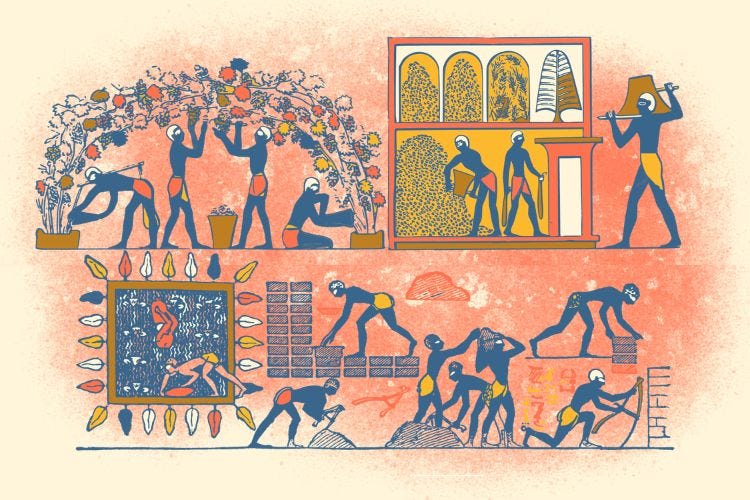
Transition from the mode of hunting-gathering to that of agriculture and cattle-rearing resulted in increased food production. Nomadic life had come to an end as sedentary lifestyle became a norm, adversely affecting health through increasing infections. Only a few members of a community were sufficient to grow food for the needs of the entire community. This left members of communities with a lot of free time on hand.
Side by side, communities started needing a few more things than food alone. The main ones among these new impending needs were:
Permanent durable building structures | Clothes | Medical treatment | Education | Tools | Utensils
There were members of the agricultural communities who specialized in learning and providing for these new needs. Thus came into existence different kinds of trades and tradesmen like farmers, masons, weavers, healers, teachers, blacksmiths, potters et cetera. They offered their services and products to others. In turn, others provided them with what they had in surplus.
The Birth of State5
This was how the ancient business started taking shape with a barter system as its primary mode of transaction.
First, small villages took shape, followed by bigger towns in their vicinity serving as market hubs for barter-based businesses. Ultimately, an entity called the state took shape comprising a number of towns and villages to keep them secure. Other communities could attack them and snatch away what they had. In the absence of a means to wider interaction, communities had their world-view limited to the boundaries of their own communities.
Arms & Ammunition to Armies6
The state needed the strong men of these communities to promise safety to all its members and their businesses. For this, they would require more strength under their control. Hence the friendly ones combined to make states and created armies equipped with new products for them called weapons. The person at the helm of this new institution became the autocratic king whose wishes became the laws of the land.
Many such states came to existence that would, again, often keep fighting against one another. With the passage of time, the winners kept on getting stronger by extending their control over bigger chunks of land. Thus empires came into existence merging identities of small communities into a new concept of nationality. Big cities were populated to centralize big businesses further.
From Ownership of Resources to Ownership of Money7
The sizes of businesses grew larger and barter system didn’t seem to be working efficiently for them anymore. In such a scenario, token money got conceptualized by the state that became the commonly used currency for exchange of goods and services. These currencies were given different names by the states issuing them. Currency as metal coins was way more portable than an item to be used as barter for business deals. It also enabled standardization of prices of various commodities, services and products. No one other than the state itself could mould those coins as they were marked with the seal of the state.
Warfare8
Adding to these woes was the beginning of systemic warfare during this same period, owing to the population increase and land ownership that arose from those institutions of property ownership, patriarchy and marriage. Several evidences of such warfare have been found in the excavations of Neolithic skeletons. One such representative evidence has been found in the massacre of Talheim Death Pit of 5500 BC in Germany. It points to two neighboring tribes in war with each other with the sole purpose of capturing and securing each other’s women. This can be deduced from the fact that there were no female skeletons found on the defending tribe’s turf suggesting that they were not killed but taken along. There have been quite a few such excavations suggesting that the main purpose of Neolithic warfare was capturing women.
When evolution entered the Copper Age from the Stone Age, more organized warfare took place with the help of copper weapons. Soldiers had started getting employed by city states professionally as far back as 4,300 BC. In 3,000 BC, Hamoukar was completely destroyed by warfare. Later city states were engulfed by newly built empires like Babylonia and Assyria in Mesopotamia. By 1700 BC, chariots started playing the central role in warfare.
The Copper Age transitioned to the Bronze Age, marking a gradual transition from prehistoric age to historic times. Weapons turned more lethal and empires kept fighting with one another. Whenever warfare happened, thousands of soldiers fought from each side. By now, army had gotten professionally established as another inseparable socio-political institution of human culture.
It only expanded further as the Bronze Age transitioned to the Iron Age.
Warfare kept getting more lethal and more organized by Homo sapiens to kill members of their own species.
So, concluding up to this point, during the Neolithic Period:
Achievements:
Replacing hunting gathering with agriculture and rearing domestic animals which is there in place to date
Establishing strong security systems against attacks from predators
Accumulation of extra food storage to use at times of emergencies
Sparing a chunk of population to engage in developmental occupations other than food production making life more comfortable
Losses:
Beginning of private property turning life stressfully complex
An overall toll on human health with lifestyle diseases
Matriarchy replaced with patriarchy subjugating women as the secondary gender
Let us now proceed further beyond the Neolithic period to assess human achievements and losses to date. From the prehistoric age, we are moving on to historic times below.
The rise of ancient civilizations (3,000 BCE - 500 BCE)9:
The first complex civilization came up in the city state of Sumer in Mesopotamia around 3,000 BCE. It started with a pictorial form of writing system known as cuneiform script. The trend further spread in the fertile river valleys of the Old World. These included Tigris and Euphrates in Mesopotamia, Nile in Egypt, Indus in India with Yangtze and Yellow Rivers in China.
City states later turned into huge empires by expanding their control, first, on neighboring and, later, on far spread regions. New empires kept rising and destroying the older ones to establish their rule and control through warfare.
Post Classical History (500 BCE - 1,500 CE)10:
Post classical era marks…
Holy Roman Empire and Byzantine Empire in Europe | Ottoman Empire in Central Asia | Various Islamic Empires in India | Mali and Songhai Empires in Western Africa | Sui, Tang, Song, Yuan and Ming Dynasties in China | Inca, Maya and Aztecs in South America later conquered by European Colonists
Early Modern Period (1500 CE - 1800 CE)11:
Early modern period is marked by…
Renaissance - rise of capitalist economies; cultural, scientific and technological achievements; economical and social rise of Europe; artistic creations of polymaths like Leonardo da Vinci and Michelangelo; fall of feudalism and the power of the Catholic Church; rise of Humanism, Scientific Revolution and Age of Enlightenment | Thirty Years War - from 1618 CE - 1648 CE within Holy Roman Empire killing many millions of people | The Age of Discovery - covering the Age of Sail discovering sea routes to distant lands | European Colonial Expansion throughout the world | Witch-hunt - tens of thousands of witches practicing witchcraft were burned alive between 1450 CE - 1750 CE
Late Modern Period (1800 CE to Date)12:
This period is marked by…
Industrial Revolution – transition to new manufacturing processes in the UK, Europe and the USA as a result of scientific revolution | Age of Imperialism – annexing control over many countries the world over by the UK, France, Spain, Portugal, Netherlands and Prussia | Age of Revolution – numerous revolutions in Europe and Americas changing autocratic monarchies to democratic governments | World Wars - entire world turning into two blocks fighting with each other to ultimate destruction. World War 1 during 1914 CE - 1918 CE killed 20 million and wounded 21 million people. World War 2 during 1939 CE - 1945 CE killed 85 million people | Roaring Twenties - the decade of 1920s marked by economic prosperity in the USA and Europe with a unique cultural edge | Great Depression - a daunting worldwide economic depression during 1930s | Cold War - acute political tension between the USA-led Western and the USSR led Eastern Bloc after WWII | Green Revolution - a set of research technology transfer increasing agricultural production all over the world starting from 1960s | Space Exploration - using astronomy and space technology to explore the outer space and far-off satellites and planets | Digital Revolution - extensive use of digital computers for computing and record keeping in the latter half of 20th century | Economic Globalization - breaking the national boundaries for commercial activities through use of the Internet | The Internet - a global system of interconnected computer networks | Mobile Phone - communication revolution through making phone calls wireless and approachable all the time over the world | Great Recession - a daunting period of recession in the national economies during 2007 CE - 2009 CE | Worldwide Competition for Natural Resources - the new currency for prosperity and growth | Environmental Degradation - human activities interfering with the quality of environment getting deteriorated | Climate Change - comprises human-induced and rapidly changing climate patterns threatening to kill all life on earth | Covid-19 - a global pandemic that killed more than 7 million people. And that’s only the official figure! If that weren’t enough, it also seriously disrupted global trade, generating widespread economic recession the world over.
Let us now synthesize the aforementioned data of historical records in terms of achievements and losses.
Achievements:
Spread of civilization | Renaissance | Discoveries and inventions | Industrial revolution | Change from autocracy to democracy | Economic prosperity | Green revolution | Space exploration | Digital revolution | Economic globalization | The internet | Mobile phone
Losses:
Never-ending warfare | Wastage of human resources on warfare | Huge loss of human lives in warfare | Colonialism | Witch-hunt | Imperialism | Economic depression | Economic recessions | Cold War | Worldwide competition for natural resources | Pandemics | Environmental degradation | Human-induced climate change
Let us consider that this, our common history, has brought us Homo sapiens to the present day and placed us on the precipice of imminent threat to all life on earth by human-induced climate change. As we grapple with this reality, it seems as though the scale of human progress seems to have tilted toward losses a bit more than toward achievements. Industrial revolution was a great achievement but it also created the demon of impending human-induced climate change.
Thanks for listening to this episode of Skeletal Leap: A Living Adventure! In the next episode, I will tell you about the subtleties of Skeletal Leap as a personal methodical system.
Be a part of Skeletal Leap Community! Subscribe to Skeletal Leap Newsletter. Click on the link in the description to subscribe.
🔗 Series Bridge:
This masterclass is a 19-week journey through my book, The Mind-Body Connection. If you missed the foundation, start here: The 16-Part Prequel: 14 Core Principles.
🔑 Unlock the Practical Plan:
To truly master the Skeletal Leap, you need the step-by-step memoir and the associated practice codes found in the book.
Get the Book: The “Resource Codes” for this chapter’s PDF practice plan are found in the Amazon Paperback Edition.

Join the Movement: Download the Free Prequel Ebook via StoryOrigin and join our community.

Subscribe: Follow SKELETAL LEAP: The Mind Body Connection on Substack for weekly deep-dives into the human potential archive.
You may also like…

______________________________________________________
References
Harari, Y. N. (2015). Sapiens: A brief history of humankind. Random House.
Bergh, J. C. J. M. van den. (2018). Human evolution beyond biology and culture: Evolutionary social, environmental and Policy Sciences. Cambridge University Press.
Salmon, C., & Shackelford, T. K. (2008). Family relationships: An evolutionary perspective. Oxford University Press.
Richards, R. J. (1987). Darwin and the emergence of evolutionary theories of mind and behavior. University of Chicago Press.
Cohen, R., & Service, E. R. (1978). Origins of the state: The anthropology of political evolution. Institute for the Study of Human Issues.
Emlen, D. J. (2015). Animal weapons: The evolution of battle. Picador Henry Holt and Company.
Herrera, R. J., & Garcia-Bertrand, R. (2018). Ancestral DNA, human origins, and migrations. Academic Press.
Kim, N. C., & Kissel, M. (2018). Emergent warfare in our evolutionary past. Routledge, Taylor & Francis Group.
Bauer, S. W. (2007). The history of the Ancient World: From the earliest accounts to the fall of Rome. W.W. Norton.
Stringer, C. (2012). The origin of our species. Penguin.
Maxfield, J. E. (2008). A comprehensive outline of world history. Connexions, Rice University.
Cropley, D. (2019). Homo problematis solvendis-- problem-solving man: A history of human creativity. Springer.