

SKELETAL LEAP: THE MIND BODY EVOLUTION SERIES
In this episode titled “Science Vs Spirituality As Two Popular Approaches To Life!“ I take you on an enlightening journey through two contrasting philosophies: scientific materialism and spiritual vitalism. These approaches to understanding life have shaped human thought for centuries, and I dive deep into their implications on our existence and consciousness.
Scientific materialism states that all living beings, including humans, are complex machines. This perspective, rooted in the scientific traditions of thinkers like René Descartes and Charles Darwin, suggests that we can eventually understand the intricacies of life through rational inquiry and scientific exploration. I also highlight the significance of the cell theory and Darwin’s theory of evolution, which emphasize a natural, mechanistic view of life.
On the other hand, spiritual vitalism introduces a more mystical element, suggesting that life is animated by a non-physical energy, often referred to as “life energy.” This viewpoint has ancient roots in various cultures and disciplines, including alternative medicine practices like acupuncture and homeopathy. I further discuss how vitalism has been dismissed by mainstream science due to a lack of empirical evidence, yet it remains deeply ingrained in human culture and belief systems.
Through my real life personal stories, I illustrate the intersection of these two philosophies in my own life. I recount miraculous experiences of healing and self-discovery that challenge the strict boundaries of materialism and vitalism. These real life stories serve as a reminder that our understanding of life may require a synthesis of both approaches.
You are invited to reflect on your own beliefs and experiences as you navigate the complexities of existence. By exploring the interplay between materialism and vitalism, I further invite you to consider a more holistic understanding of life that embraces both the scientific and the spiritual.
This episode is not just an academic discussion; it’s a call to explore our inner selves and the world around us. Whether you lean toward a materialistic view or find resonance in vitalism, there’s something valuable to learn in this exploration. Tune in to this thought-provoking episode of Skeletal Leap and embark on your own journey of discovery.
🔑 Key Takeaways:
Materialism vs Vitalism: The historical context of materialism and vitalism, featuring insights from thinkers like René Descartes and Charles Darwin.
Technology Vs Philosophy: The implications of these philosophies on our understanding of consciousness and existence.
Real Life Stories: Personal stories that illustrate the unexpected intersections of these approaches in real-life situations.
Healing & Healthcare: The vitalistic perspective’s enduring influence on alternative medicine and cultural belief
🎙️ Listen to the Journey:
📽️ Watch the Masterclass:
Transcript:
“Was he a materialist or a vitalist?
Almost every single person is a complex integration of both these approaches.”
My name is Laadi Ojas. Welcome to “Skeletal Leap: A Living Adventure”. Skeletal Leap transforms one’s life into a personal heaven.
Today’s episode will tell you about materialistic vs vitalistic approaches to life.
As early as I came to my senses, I found myself wondering.
I remember the little kid that I was, wondering who he was or even what he was. It was like a third person wondering about my self, the self that I thought I was. I also wondered if stones could do the same. I was told they could not.

Today, I comprehend it as something very unique. It was the awareness of being aware. I also wondered if animals could do the same. No one could tell me anything about this for sure. I wished I could turn into a cat, even if only for a moment, to know the answer. But that was not to be.
Later, I tried to satiate my curiosity from the stores of knowledge, i.e., books. Those were the days when the worldwide web hadn’t yet come into existence. So I devoured anything and everything that I could get my hands on regarding the subject.
What I first came to know from there about life were its characteristics in the living beings, such as:
Homeostasis meant regulating their internal environment.
Organization meant being composed of one or more of the basic units of life called cells.
Metabolism meant decomposing chemicals turning them to energy for cells to maintain life.
Growth meant increasing in size in all its parts.
Adaptation meant evolving to adapt with the changing environment.
Response to Stimuli meant moving for safety and other purposes.
Reproduction meant ability to create similar life as their offsprings.
What I also came to know from there was that people had two basic approaches to life. One sided with materialism and the other, vitalism.
Materialism
Materialism opines that animals including humans are extremely complex machines. They are so complex that we haven’t yet been able to fully understand this level of complexity. But we may, someday. Or we will, one day.
Rene Descartes was the first to propose this hypothesis in the seventeenth century. Later, in the nineteenth century, biologists discovered the cell theory of life. It established, without doubt, that all living things were cellular in structure.
Then came Charles Darwin with his impeccable theory of evolution. This striking theory said that evolution took effect through an automatic natural selection of genes within those cells. And it was this alone that enabled Homo sapiens to turn bipeds.
A little before Darwin, Jean-Baptiste Lamarck had proposed that animals could pass on their acquired characteristics to their offsprings. These were the characteristics that they had acquired in their lifetime through use or disuse of select anatomical features, consciously, as a choice.
The two theories appeared to be in contrast with each other. Darwin’s theory sided with natural selection whereas Lamarck had sided with conscious use or disuse responsible for evolution. But Darwin never negated Lamarck’s proposition even once in any of his works. He rather supported it. This is simply indicative of the weight in both their propositions.
In fact, the latest synthesis of human evolution by the Baldwin Effect is a reconciliation between the neo-Darwinian and the neo-Lamarckian approaches. It shows Lamarckian adaptive changes being followed by Darwinian genetic changes without needing to inherit them directly from the parents.
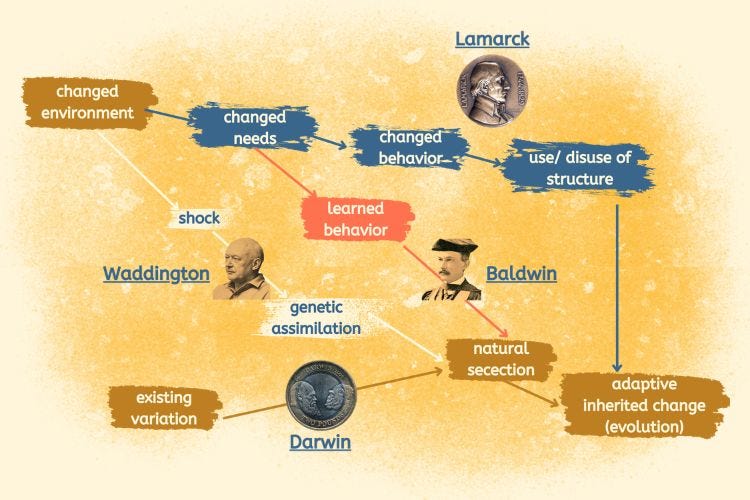
Here is a quote by Ian Alexander…
“Lamarckian use and disuse compared to Darwinian evolution, the Baldwin effect, and Waddington‘s genetic assimilation… all the theories offer explanations of how organisms respond to a changed environment with adaptive inherited change.”
Courtesy, Ian Alexander
That was a bird’s eye-view of the materialistic approach to the question of life and evolution.
The other less scientifically accepted but extremely widespread approach in people’s psyche has been the vitalistic approach to life.
Vitalism
Vitalism opines that life comes to existence only when matter imbibes life energy that is cosmic in nature. This energy is supposed to be non-physical in its nature. It has been given different names in different cultures and different disciplines. It enjoyed the status of a testable hypothesis in the field of biology till as recently as the nineteenth century.
But despite several experiments, vitalism has failed to provide any substantial evidence to prove its verity as yet. Hence it has been denigrated to the level of a superseded scientific theory at best in the scientific community.
The scientific community, despite quite successfully dealing a lot with the question of how matter came into existence, accepts it as self-evident as matter is always visible to us. There has never been a necessity to explain its existence. Isn’t it the same way that life is always visible to us too? Hence, why can’t we start taking life as self-evident as well?
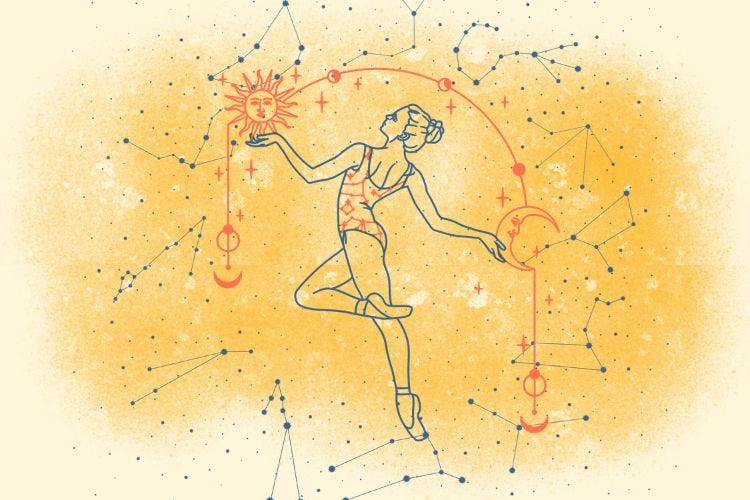
That is what vitalists say when they challenge materialism to prove exactly what that complexity is about. This question comes up when materialism claims complexity in the material organization as the precursor of life. But materialistic science has no irrefutable answer to it yet.
Vitalists claim that, in this context, science has no moral ground to criticize vitalism as a superseded scientific theory. They argue that, by the same token, complexity could also be called a superseded scientific theory.
Vitalism claims that non-physical life energy can exist on its own without being imbibed by the matter. It claims its omnipresence as cosmic energy.
In fact, vitalism has a very long history, especially in the field of alternative medicine. The list is extremely long but the main proponent systems as vitalistic medicine are homeopathy, acupuncture, acupressure, aromatherapy, chiropractic, Chakra healing, Reiki, Pranic healing, cupping therapy, energy healing, Ayurvedic medicine, hypnotherapy, naturopathy, mind-body Interventions and quite a few more.
Also, apart from the field of medicine, vitalism has its roots dug really deep in human culture in the form of religion, spiritualism, morality, piety, yoga, meditation, rebirth, enlightenment, karma theory and the most importantly the concept of theism.
A majority of the world’s population believes in almost all these aspects as part of its culture. I don’t need to go numerical here posting their percentages but everyone knows they are quite high.
Then there are materialists in various spheres who are also vitalists in their wider approach to life. A certain Dr. Einstein comes to mind!
The Story of A Materialist Who Was A Vitalist Deep Within
Let me tell you a story that took place in the year 1981. I had just gotten married when I met with an accident. It was a serious accident that seemed to have severed one of the tendons on my right biceps.
I was admitted in one of the best government hospitals. As I was whiling away my time sitting on the hospital bed, waiting to get my tendon stitched surgically, the head of the orthopedic department came with his students. He had planned to demonstrate my condition as a case study to them.
He started explaining how it was a classical case of biceps severed at its tendon at the elbow joint. I immediately took objection. I said I felt it was at the shoulder joint and not at the elbow joint.
“Are you a doctor or I?” he challenged.

I got offended by the tone of his voice. “Are you suffering from a severed tendon or I?” I retorted in the same tone.
He started muttering, trying to save face from his students.
“I know better than you do. So better keep shut,” he came up with his next attack without even being humble enough to listen to his patient.
“I feel I have lost faith in you. So I wouldn’t like to continue with my treatment here,” I declared my decision then and there.
“It will be your responsibility alone in case your problem gets worse because of this,” he threatened me.
“I know that and I will indemnify the hospital when I sign my papers relieving me from here,” I gave my final verdict.
After I got relieved, I immediately went to another private orthopedic surgeon and told him the entire story. He checked my arm very cautiously for a long time. Then he silently came up with the words, “You are right. My teacher is wrong. It is severed on the shoulder joint.”
“So?” I asked.
“Please don’t tell the orthopedic head that I said so. In fact, he has been my teacher. Let him not get hurt further on knowing I have taken up your case. I can immediately start the operation if you are ready,” he looked for my approval.
I immediately agreed, “Please go ahead.”
It was a long operation and I got my biceps stitched with 22 sutures on my right shoulder. He discharged me saying that I would be able to start lifting my arm in a month or so.
I went back home and waited for a full month to pass. But even after that, there seemed to be no signs of me being able to lift my arm at all.
I rushed back to the doctor. As he checked my arm again, his face went serious. “You’ve been very unlucky,” he said.
“Your tendon has nicely gotten attached to your shoulder joint. But unluckily the musculocutaneous nerve has also got crushed in the accident, I suspect,” he further explained.
“So?” I asked again.
“I am referring your case to the head of neurosurgery in the government hospital famous for its neurosurgeons,” he said.
The said hospital was just across the road and I immediately met the head of its neurosurgery department. He checked my arm and confirmed that my musculocutaneous nerve had, in fact, been crushed.
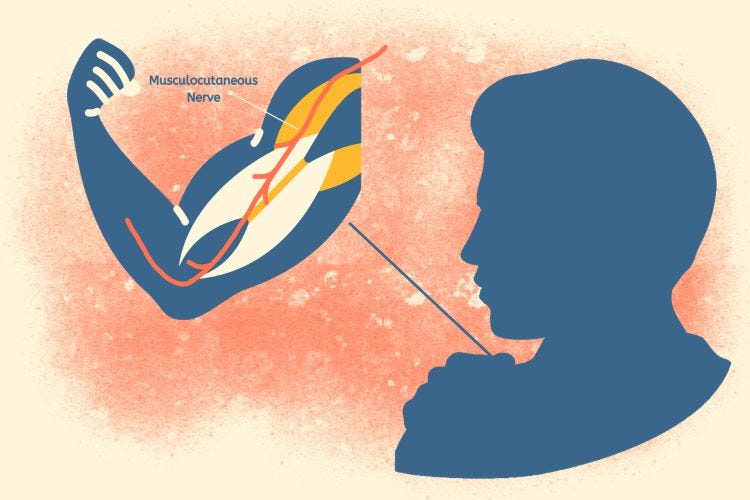
“As this nerve is located deep inside the arm, we generally don’t touch it. That is because it is extremely tedious and the success rate is not very high either. So we do it only if it is a case of life and death or livelihood. You will have to learn living with it the way it is right now,” he gave me his prognosis.
“But doctor, it is a case of life and death in my case too,” I said.
“How come? What do you do?” he asked.
“I write for a living, which I will no more be able to do with my left hand,” I replied.
“Why? You can always train your left hand to be able to write as easily as with your right hand!” he suggested me.
“I am afraid waiting for it to get trained will prove to be a big handicap in my career. I will be left with no alternative but to commit suicide,” my tone sounded like a cool determination to do what I had said I would.
The head suddenly went hyper-emotional, “No, don’t do that!” I could see tears along with empathy in his eyes.
“I’ll be compelled to!” I said in a depressed tone of voice.
“Okay, I am ready to take a chance on operating on your nerve. At least it will be better than dying. Just don’t commit suicide,” and he gave me an appointment for an operation on the 26th day of the month and it was only the 1st that day.
I went back home and kept counting days for the date of my operation to arrive. It was going to be an operation conducted by one of the country’s most skilled neurosurgeons. But it was another thing that the chances of success were as low as hardly 50%.
The 26th day kept coming closer and closer but at a snail’s pace. Every morning, I would look at the calendar and count the days left for the appointment date all over.
I would also keep trying to lift my arm, the first thing to do each morning. It became a daily routine as soon as I woke up. I did so despite no hope for such attempts to be successful at all.
And then the miracle happened on the 26th day!
I woke up in the morning thinking I would rush to the hospital for my operation. It was then that I got the most pleasant shock of my life. Out of habit, I tried to lift my arm and could not believe what followed.
I was able to lift it well above my shoulder.
I lifted it many times until I was 100% sure that I was actually able to do so. I was successful every time!

And the first thing I did was to rush to the hospital in order to show this miracle to my surgeon. As he saw me lifting my arm every time without any obstruction, he looked to be extremely elated.
I could again see the tears in his eyes though, this time, they were the tears of happiness. He raised his hands toward the sky and could only say, “God is great!”
I was excited to relive my life without carrying a tag of a disabled man written on my body.
Later, when I reassembled the entire scene in my critical memory, I really wondered. I wondered how a top ranking expert of a strictly materialistic discipline had spontaneously reacted to what had happened. It hadn’t ignited any spirit of curiosity in his mind as to how it could have happened. It had rather ignited a spirit of gratitude for something his materialistic discipline had never adhered to.
Was he a materialist or a vitalist?
Almost every single person is a complex integration of both these approaches. This great neurosurgeon was no different.
There is a reason for it. There are quite a few phenomena that the materialistic approach explains and handles way better than the vitalistic approach. But then, there are quite a few other phenomena that the vitalistic approach claims it can explain better. These are the ones that the materialistic approach has no clue about yet.
At this point, I urgently feel a real need to tell you another story from my life. These are the stories that I can personally authenticate to be true, word for word. And it is their authenticity that makes them meaningful vehicles to investigate into the nature of life.
It is again a story of another miracle that happened many years ago.
The Story of An Instant Materialistic Miracle That Happened to My Eyes
I still remember the date. It was on 12 December 2004 that I was standing near Sarojini Nagar Market in Delhi. I was waiting for my wife to join me for some shopping. She had gotten a little late leaving me standing for a while.
It was then that the miracle happened.
I stretched my body a little in order to come out of my static inertia. It was the static inertia of keeping standing at one place for a long time.
As I looked around after this stretch, I got a tremendously pleasant shock of my life. I was suddenly seeing everything in the field of my vision, far and wide, absolutely crystal-clear. I had never seen so clear in my life before.
It was a pleasant shock because I had been a myope since I came to my senses. I had been provided with a pair of glasses. That was the first pair of glasses that had been given to me. They had a diopter number of —5.00 in my left eye and 0.00 in my right. Since my right eye was fine, I had kept those glasses in my drawer and forgotten about them.
Days had kept passing by and I had forgotten everything about my myopic eyesight. More so because I had been able to see clear with at least one of my eyes. It had also been because I had never liked the idea of wearing those crutches on my eyes.
A few years later… by this time, I had completed my engineering and gotten a job as a scientist in the defense ministry. Before starting at my job, I had to get my medical exam done at a scheduled government hospital. When they had tested my eyes there, it had again come to me as a surprise. Both my eyes had needed a corrective diopter number of strength —2.25.
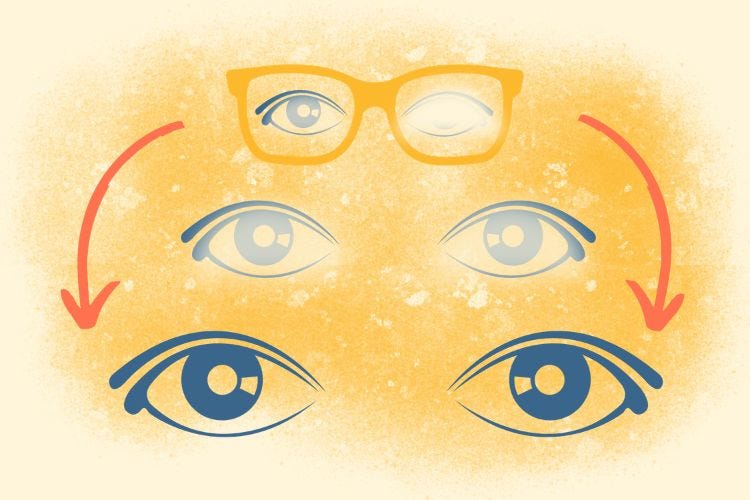
What a surprising change it had been! My right eye (pun intended) had gone wrong from 0.00 to —2.25. On the other hand, my left eye had improved tremendously from —5.00 diopter to —2.25 on its own. No theory in mainstream ophthalmology had been able to explain this improvement!
Back (in fact, forward) to the clarity of vision that I experienced on 12 December 2004!
I was seeing crystal clear in both eyes. It was instantaneous! I wasn’t able to believe my eyes. In fact, I didn’t blink for a long time.
And then I blinked. As my eyes opened again, they were back to the same old blurred vision, far and wide, that I was used to.
I felt disappointed. But I was not the kind of a vitalist that would say, “God is great!” for my instantaneous experience of clarity. Had I been one, I would have forgotten it forever after thanking God for blessing me with a one-time miracle.
No! Unlike the neurosurgeon who had been so kind to me, I wouldn’t leave it at that. I didn’t know how I was able to see so clearly just a minute ago. But I was curious enough to want to know. My mind was totally clueless about it. Keeping this in mind, I turned to my body to repeat what it had done a few seconds ago.
Luckily, the body still had its memory of the maneuver it had done a few seconds ago, intact. It rolled me back into the same clarity of vision again. I tried with my mind to take notes of the body maneuver but failed. The maneuver, though instantaneous, was so complex that my mind wasn’t able to understand it in clear steps of action.
It was frustrating not to be able to know it as a clear series of steps. At the same time, though, it was also exciting to experience my body being able to jump into it at will.
In the coming days, I kept playing this mind-body game. It went on for two full years. That is how long it took for my body to slowly and steadily explain all the steps it had used in the maneuver, to my mind. One by one…by one! It was my perseverance alone that got it done, though it had taken two full years in the process. I had to upgrade my mind to achieve this; something I did through a lot of research. Research in any and every discipline I suspected of having an answer.
During my research, I studied mainstream German ophthalmology which was unable to explain how I was able to correct my own eyesight.
I then came across the works of Dr W.H.Bates, an American ophthalmologist. I learned that Dr. Bates had discarded mainstream German ophthalmology very early in his ophthalmology practice as far as the process of accommodation was concerned. In return, mainstream German ophthalmology had ostracized him; something that stands till date. That had never bothered Dr. Bates himself, though.
He was a perfect materialist who created his own version of the process of accommodation in ophthalmology. German ophthalmology has always maintained that it is impossible to reverse eyesight once it has gone bad. Bates, however, claimed otherwise. In fact, he claimed to have cured thousands of myopic patients during his lifetime.
Regardless, Bates’ method had a serious shortcoming in that its results were not instantaneous. It almost never showed an instantaneous effect to its practitioners. They needed to have a great amount of patience which very few of them really had.
The reason was that Bates primarily targeted the relaxation of mind rather than that of body. It was not a direct physical method. It was rather a more circuitous one addressing the mind. It depended on the mind to convey the message of relaxation to the eyes in an indirect way. And that was why it took so much time.
Moreover, mind is never a concrete and always a vague entity. It may delude itself into believing that it is in a relaxed state even when it is not at all so. Therefore, maneuvering the body is way more concrete than maneuvering the mind. In the domain of the body, one can be 100% sure that one is following the exact procedure laid out in front of them.
Bates was more concerned with central fixation of the mind in order to achieve central fixation of the eyes.
I was lucky enough to be able to turn it around.
I could focus my research on central fixation of the eyes via physical maneuvering of the extra ocular muscles.
Just as changes in the mind affect the body, changes in the body affect the mind as well.

That is why and how a skeletal procedure for achieving relaxation is able to demonstrate instantaneous effects in its small, little steps of achievements. An instant feedback at each and every step assures one that they are on the right track.
Imagine being able to read an extra line on the Snellen chart in a few minutes if not seconds.
How much will that enthuse us to proceed further with the meditative procedure of central fixation!
That is what Skeletal Leap has replaced the Bates method with as far as vision improvement is concerned.
The Chakra Discipline
However, there was much more to my research than this. I accidentally came across an ancient Indian procedure of opening chakras in the body in order to achieve a complete relaxation of the mind-body system.
The problem with this system was that it was quite esoteric in its structure. It was esoterically enshrined deep inside multiple layers of secrecy and an extremely complex mysterious vitalistic framework. All that we can find on the Internet about chakras is merely plagiarized copies of the same esoteric scriptures. Their so-called authors are mostly equally devoid of personal experience and hence a real insight into the discipline.
The Chakra discipline really helped me a lot in my research. I was again very lucky in being able to shift its central theme from complexity to simplicity. I could turn its vague and complex ‘spiritual’ procedures to extremely simple skeletal procedures to open chakras for mind-body relaxation.

The best test of my being on the right track was that these procedural shifts produced their intended results exactly as well as instantaneously. Instant eyesight improvement was only one of them.
Here is what I ultimately came up with…
7 chakras, when they are closed, are anatomical deformities in functional groups of internal body organs. These are the groups of skeletal joints along with muscles, nerves and blood vessels attached to them. The vagus nerve is also a part of them. They block Kundalini from moving up through Sushumna to the brain in a streamlined flow. As a result, it starts rotating in a circle, like a vortex, at the location of the block rather than moving ahead straight. That is why the said blocks are called chakras. The ultimate results of opening them, as predicted in the scriptures, are a gushing surge of energy from the gut to the brain.
It is called Kundalini Awakening in the language of the Chakra discipline. And this is what the most central theme of Skeletal Leap is.
Skeletal Leap: Materialistic Or Vitalistic?
In the system of Skeletal Leap, the skeletal posturing corrections are called skeletal meditations. This is because they are as intense as they are simple when it comes to making them one’s first nature 24 x 7 x 365. It means being in a meditative state every single moment and not only for the duration of sitting in meditation alone.
That is why I call skeletal meditations the mother of all mediation on earth.
They are more physical than spiritual, constantly ensuring that we are undoubtedly on the right track. We simply cannot delude ourselves with something absolutely non-meditative while doing these skeletal meditations.
Siding with physical skeletal meditations doesn’t mean that I ignore the mental and spiritual realities. I only say that we should start our journey into the unknown from the well-known grounds of familiarity and clarity. That way, we are less prone to get lost in its labyrinth.
And the ultimate skeletal meditation has the power to take us to spiritual awakening. In the language of skeletal meditation, it means freedom from all illusion.
It is illusion that blocks our sensitivity from sensing the free flow of energy in our mind-body system.
The physical approach is the surest and the shortest way to all salvation, be it physical, mental or spiritual. And this is so, even if our ultimate goal is spiritual alone. That is what Skeletal Leap ultimately stands for.
Thanks for listening to this episode of Skeletal Leap: A Living Adventure! In the next episode, I will tell you about bioenergetics vs kundalini and which one of the two passes to be the energy that creates life.
Be a part of Skeletal Leap Community! Subscribe to Skeletal Leap Newsletter. Click on the link in the description to subscribe.
🔗 Series Bridge:
This masterclass is a 19-week journey through my book, The Mind-Body Connection. If you missed the foundation, start here: The 16-Part Prequel: 14 Core Principles.
🔑 Unlock the Practical Plan:
To truly master the Skeletal Leap, you need the step-by-step memoir and the associated practice codes found in the book.
Get the Book: The “Resource Codes” for this chapter’s PDF practice plan are found in the Amazon Paperback Edition.
Join the Movement: Download the Free Prequel Ebook via StoryOrigin and join our community.

Subscribe: Follow SKELETAL LEAP: The Mind Body Connection on Substack for weekly deep-dives into the human potential archive.
You may also like...
At Times MIRACLE HEALING Manifests Spontaneously! Why?

At Times MIRACLE HEALING Manifests Spontaneously! Why?
Introducing SKELETAL LEAP: A Living Adventure - Podcast Episode 1

Introducing SKELETAL LEAP: A Living Adventure
This interplay is so interesting! Thank you and I look forward to reading more!