

SKELETAL LEAP: THE MIND BODY EVOLUTION SERIES
Wants vs Needs: Corruption of Esteem Needs: Introduction
In 32nd episode of Skeletal Leap, I embark on a profound exploration of moral values and their origins. I pose a thought-provoking question: Why did humanity feel the need to create moral values if they were not inherently part of our psychobiological structure?
This episode explores the intricate relationship between our instinctual drives and the moral codes that govern our lives. From the outset, I highlight how moral values were established as a means to navigate the complexities of human existence.
These values, often perceived as necessary for social order, were born out of fear. It was the fear of our instinctual drives that, when left unchecked, could lead to chaos.
As humanity transitioned into a more structured society, particularly under a plutocratic male-dominated system, the need for moral guidelines became apparent. However, these guidelines also served to suppress individual spirit and autonomy, particularly in the context of charitable organizations.
One of the most striking revelations in this episode is the idea that while we are born with instinctual drives—such as the need for interaction, love, and adventure—we are not born with moral values. These values must be taught and indoctrinated, often leading to confusion and internal conflict as individuals navigate their desires against societal expectations.
I argue that this suppression has resulted in a spiritual scarcity, where material abundance does not equate to emotional or spiritual fulfillment. The episode also critiques the role of charitable organizations, which, while appearing altruistic, can perpetuate the very systems of oppression they claim to combat. By placing charity on a pedestal, society may overlook the deeper issues of inequality and moral corruption that these organizations can embody.
I emphasize that the true essence of human interaction should be rooted in love and connection, not in the rigid structures of moral obligation. You are encouraged to reflect on your own understanding of moral values and how these have been shaped by cultural and societal influences. As we navigate through our lives, it is essential to recognize the distinction between our natural instincts and the moral codes imposed upon us.
The episode concludes with a promise of further exploration in upcoming episodes, including discussions on the corruption within the education system and organized religion.
Join me on this enlightening journey as I peel back the layers of moral values and their impact on our lives. Tune in to this episode of Skeletal Leap and engage in a conversation that challenges the status quo and encourages personal growth and understanding.
🔑 Key Takeaways:
(00:00:01) – What are Moral Values in our Socio-cultural Evolution?
(00:09:18) – Human Morals
(00:14:59) – Sense of Duty and Respect
(00:19:48) – Loyalty is a highly respected moral value supposing commitment
(00:26:55) – How established value systems resulted in charitable organizations
🎙️ Listen to the Journey:
📽️ Watch the Masterclass:
Wants vs Needs: Corruption of Esteem Needs: Transcript
“Why did humanity feel the need to create moral values at all if they were not naturally built in our psychobiological structure?”
My name is Laadi Ojas. Welcome to “Skeletal Leap: A Living Adventure”. Skeletal Leap transforms one’s life into a personal heaven.
Today’s episode titled “Wants vs Needs: Corruption of Esteem Needs!”, I will tell you about corruption in charitable organizations.
Value systems fall under sociocultural throat chakra to fulfill the needs of self-esteem. The currency here is ‘morals’. ‘Morals’, the sociocultural currency of the next deficiency need, i.e., self-esteem, turned more important than need itself. The cultural extension of morals, i.e., value systems, started as ethical codes for social esteem but soon turned into moral codes for suppressing the individual spirit. Charitable and non-profit organizations became the face of this suppression and resulted in the sociocultural throat chakra getting closed.
Value Systems
In our journey of sociocultural evolution, our value systems have also been disintegrating and are confusing us at each and every step we, the Homo sapiens, take today.
Moral Values & Instinctual Drives:
We are born with a set of instinctual drives which are inherent in our psychobiological structure. We don’t have to go anywhere in order to learn about them. On the other hand we are not born with any set of moral values in our psychobiological structure. Hence, they are not inherent to the human being and need to be taught anew to every new child born
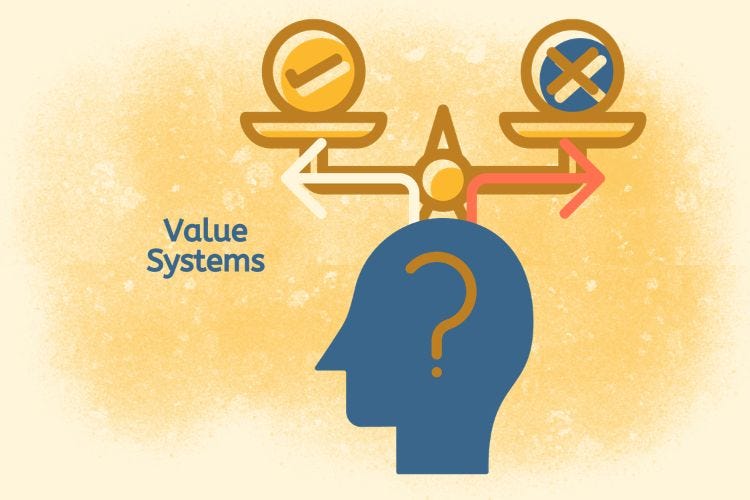
Is there any relationship between the two?
Certainly yes! But before investigating into this relationship, we need to ask another more important question.
Why did humanity feel the need to create moral values at all if they were not naturally built in our psychobiological structure?
Moral values became necessary because a few of those purely instinctual drives scared humans who then perceived them as threats. This happened when humans set out to create a new social order for the first time in our distant past.
Which social order were they scheming to establish?
It was a plutocratic (the rule or power of wealth) male dominated social system, operating from an already closed sociocultural root chakra, that these moral values were plotting to uphold. And the plutocrats could simply go ahead and push these so-called values using their wealth. They could apply that wealth to either bribe or starve their subjects to buy their opinion.
Wealth in the form of personal ownership of resources had very recently made its entry into human life. The ones who were either strong or cunning or both, for that matter, were able to amass these resources more than the rest, like we discussed in Episode 30.
And why were these initiators predominantly males?
It was so because males were stronger (even if not more cunning) than females. Also they had more time at their disposal to accumulate more wealth than their female counterparts. It was simply because females lost time in delivering and rearing up their kids.
The kids decidedly belonged to their mothers and not fathers since no one could establish fatherhood beyond doubt. And as they grew, they would support their mothers in the pursuit of amassing wealth. In a way, it could be seen as the wealth regained that their mothers had lost access to while delivering and rearing them up.
So, males needed a way to know, beyond doubt, who the father of any given kid was. With their sociocultural throat chakras closed, the males felt ignored as compared to the females, thus hurting their esteem. But this would only be possible if the females agreed to it as well. For this, they needed to stop following their instinctual drive to have sex with any males of their choice at any time.
Why would they agree?
Powerful males in those early societies designed a new faculty of thought which would uphold newly envisioned ‘moral values’ as essentially opposite alternatives to certain instinctual drives predominantly including sex. They did so because, by this time, their collective sociocultural throat chakras were already closed.
They were supported by so-called supernatural practitioners who enjoyed a high status among ignorantly naive early human dwellings. These supernatural practitioners, initially looking forward to transcendence, had already fallen prey to its currency named ‘faith’, thus closing the sociocultural crown chakra of the society. More on that in Episode 33.
The first of such newly established moral values declared sex as the basic sin to be avoided as much as possible. But since curbing such a powerful instinct en masse wasn’t feasible practically, a new rule was framed that one female having sex with multiple males was ‘immoral’. If she did, she would be severely punished by another new entity created by the supernatural practitioners, named ‘God’.
An Unfortunate Consequence:
In order for this rule to look unbiased between genders, it was framed as such for both of them.
But as an unfortunate consequence, it was never implemented for males as strictly as it was done for females. This was because human biology went against females. Any female engaging in stealthy sex would sooner or later conceive children and be caught for her transgressions. On the other hand, males could easily evade detection of their own transgressions without any telltale signs.
Monogamy – Marriage Comes Into Existence:
To put an official stamp on this rule, a new social institution named marriage was designed. It limited the choice of sex partners to just one over an entire lifetime as against many for as much time as desired. In some societies a male could marry several females simultaneously. But females were rarely, if at all, provided this luxury!
Monogamy, initiated under the domination of morals effecting sociocultural throat chakra, changed its shape to a new social institution, namely marriage. Marriage, designed under the domination of the currency we are calling ‘personal ownership of resources’ further extended adherence to monogamy, thereby effecting the sociocultural root chakra.
This enhanced adherence ensured that the males could be surer about being the biological fathers of their spouse’s children. It turned them all into a close-knit family, another sociocultural institution that came into existence.
Hence, before they died, the males could hand over their personal ownership of resources to their children without any doubt, like their mothers had always done. Thus marriage, further strengthening sociocultural root chakra, facilitated males to weave a close-knit safety network in their immediate familial vicinity, too.
Human Mind
Now, a new moral science was envisaged comprising a set of morals.
These were the morals that humans ought to follow even if they were directly against the calls of their own instinctual drives.
Eventually, all such social morals that were implemented went against those allegedly dangerous natural instinctual drives in one way or the other.
We as humans are born with instinctual drives alone in our mind-body system. We don’t have any sort of human emotions or morals in our mind that we start our life with.
Later, in our journey from childhood to adulthood, we learn the history of human development. We learn it in each and every subject and store it in the knowledge base of our mind. Then, as we grow, we add to that knowledge base from our own personal experiences to enhance it further.
This is what the ideal development of human mind is supposed to be like. It is a set of instinctual drives along with a knowledge base of human achievements in various subjects.
However, in practice, that is not all that our mind is subjected to during the formative years of our development. It is also indoctrinated with a value system which is not limited to morals alone. Consequently, it tries to turn them into our aesthetic values as well.
Presently, our culture very eagerly nails down several moral values onto our minds.
Sex As A Necessary Evil
We are taught by our religious culture that sex is a necessary evil. This is done at a stage in our lives when we have not even experienced it as a fully developed instinctual drive in our mind-body system. Our minds get conditioned against sex even before our body grows to incorporate it into our system. And the time it does, our conditioning starts making us feel guilty about it.
Truthfulness
We are taught that truth is a desirable parameter of integrity even when we don’t know what a lie is. Hence, the very inception of truth as a desirable moral value sows the seeds of learning how to tell lies.
Prior to sociocultural evolution, our instinctual drives may not have felt a need to tell a lie. But we may not have said we were speaking the truth either. We may have simply said we were speaking. We may not have needed either of the two concepts. Plainly speaking about what we saw and what we did may have been enough.
But the same social system that established monogamy and plutocracy realized it was suppressing extremely strong instinctual drives. It also realized people WOULD tend to satiate these drives stealthily and then claim they did not.
So, a new concept of truth was envisaged as opposite to a more basic concept of a lie. If a lie were never needed, there wouldn’t have been any need for a concept of truth to exist too. But lies entered the domain of human action owing to the establishment of a cunningly unjustified as well as an unhealthy society.
Hence, truth was designed as a moral value to stop people from lying. People, however, lied innocently only to satiate their instinctual drives and hide it from those in authority.
That is why speaking the truth should be brought down from its high pedestal. We need to peel off the facade of reverence that our moral values have assigned to it.
Honesty
Same is the story of honesty. The very inception of honesty as a desirable moral value sows the seeds of learning how to be dishonest.
Prior to sociocultural evolution, there may not have been anything like dishonesty in our instinctual drives that we needed to act on.
But the newly established and unjustified social system feared that people could plot secret schemes to rebel against its inherent suppression. The said moral termed any such possibility as dishonesty and coined a desirable behavior named honesty as its antithesis.
It is interesting to note that most so-called anti-moral values are named to be the antithesis of moral values; dishonesty vs honesty, for example. But in fact, conceptually speaking, these were morals that were actually conceived as the antitheses of the so-called anti-moral acts.
Sense of Duty
Sense of duty is a set of actions we ought to do whether we feel like doing them or not. Why do we need a stipulation like this if we already feel like doing those? And why do we need the ones being stipulated if our mind does not feel like doing those?
Our culture seems to have decided the validity of ‘duty’ even if it goes against the natural composition of the human mind. What good can we expect to come out of those dutiful actions if they don’t have the energy of our natural willfulness behind them? They will simply get reduced to a level of being artificially performed as forced rituals. We will undertake and then perform them only to keep away the guilt of not having done them at all.
Prior to sociocultural evolution, we may have lived with our instinctual drives guiding our actions and behavior. And we may not have needed a concept like a sense of duty. We may have simply acted out what our spontaneous feeling guided us to do.
It is plausible that any such spontaneous feeling may primarily have been of concern and sympathy for one another. So we may not have needed a sense of duty in order to act in the most desirable way.
But with the suppression of our instinctual drives, we wouldn’t feel such concern and sympathy for those who have themselves also suppressed those same drives.
Once again, as yet another anti-thesis to instinctual drives, the sense of duty was formulated as one more moral value. Morals were supposed to be upheld under any circumstances. Otherwise, the sin that we committed would not let us live without a feeling of guilt.
Respect
We are taught to respect our elders and seniors. We are not taught to respect our juniors. Why this one-sided approach to something that our culture considers such an important value? Therefore, respect as a value immediately strikes us as feudal in its very inception.
The human mind is not designed to respect. It is designed to interact. It is designed to share. And it is designed to love. Respect is a very formal concept that requires a distance between the two individuals involved. The respected one stands on a higher pedestal than the one who respects.
The more we respect like we do our fathers, especially in the developing countries, the less we love them. That is because respect necessitates kind of separation. And the more we love like we do our mothers, the less we need to respect them. That is because love eliminates any such separation.
It is still customary in the Eastern societies (and used to be in all societies until a few centuries ago) for fathers to act like an authoritarian judge in the family court passing sentences on kids that are generally corporal. Mothers can, at best, play the role of kids’ advocates pleading mercy for their ‘crimes’.
Same, till very recently, had been true in case of teachers in schools as well. Teachers have been preoccupied with enforcing respect as a means to extracting their desired behavior from students. This has created an authoritative chasm between the teacher and the student, thereby eliminating any possibility of a healthy kinship.
Such kinship may have resulted in the desired behaviors more organically in the first place. Laws have been made in some of these countries prohibiting teachers assigning corporal punishments to the students though they are often broken.
Obedience
Obedience, as a value, is a sub-set of respect. As a younger person, we are not supposed to question or raise doubts against the orders of our elders. This again is a very feudal value.
Here again, in the Eastern countries, kids are supposed to be more obedient to their fathers than to their mothers who they can argue with at times, though in the absence of their fathers.
Similarly they are culturally supposed to be obedient to their teachers as well. As a result, they seldom question their teachers even if they have genuine queries in their minds. Questioning teachers is not culturally encouraged as learning is supposed to be a one way communication from the teacher to the student. The students are supposed to learn by rote what instructions their teachers have passed on to them.
The human mind is not naturally designed for feudalism. And if we force it to conform, we are simply suppressing the instinctual drives we are naturally born with.
Good Manners
Good manners are all protocols in their essence. We are supposed to behave a certain way in a certain scenario. And we do so whether we are feeling like behaving that way or not.
The more we follow these dictats, the less authentic we become.
We must say, “Very pleased to see you,” on meeting someone even if we are not so. Aren’t we telling a lie which violates another moral value named truthfulness?
Faith
If we have faith, we don’t question. But our minds are wired to question. And faith as a moral value tries its best to suppress curiosity that we are born with as an instinct. Unfortunately, it doesn’t limit itself to being a moral value alone, it also plays its role as a currency for transcendence needs. As the currency becomes more important than fulfilling the genuine need as such, the sociocultural crown chakra falls prey and gets closed as well. We are going to look into it in Episode 33.
Loyalty
We have already talked about loyalty clouding real love and belonging needs as their currency through a closed sociocultural heart chakra in Episode 31. But it goes a step further from there as it assumes the status of ‘morals’ as well, closing sociocultural throat chakra along.
Loyalty is a highly respected moral value which supposes us to be committed. It is a commitment to a certain person, institution or an idea. In addition, loyalty is uniquely characterized by its blind and unconditional support for the same.
Our minds, however, are not so indiscriminate in their natural structure.
Loyalty simply stands against our judicious sense of discernment between one action and another.
Now, we can go into further details of each one of these values. We can easily show that they all stand against instinctual drives either overtly or else in a covert way.
Instinctual Drives
Eating | Drinking | Excreting | Curiosity | Movement | Play | Adventure | Interaction | Love | Grouping | Sex | Reproduction | Parenting
The moral values are nailed very hard and deep into the structure of the mind and away from the structure of the brain. They play their role very well in suppressing the energy of our death instincts and keep it so.
But, like water, energy can never be kept suppressed for long. And like water finds new channels for its flow, energy also invents new channels for its expression.
Human Emotions
The channels that the energy of these suppressed instinctual drives invents for its expression are named human emotions. Of these, the main ones are:
Desire | Greed | Hope | Happiness | Surprise | Anger | Envy | Jealousy | Disappointment | Guilt | Sadness | Fear | Anxiety | Depression
These human emotions are channelled to express the energy of the blocked instinctual drives. But they are never as innocent and as straightforward as the instinctual drives themselves are. They are rather the distorted forms of expressing the suppressed energy. And they do so in bursts rather than a smooth flow, unlike instincts.
Will vs. Will Power
Human emotions generate a new faculty of will in the structure of our mind. Will is nothing but an urge to compensate for the loss of sensitivity, joy and creativity suffered by instinctual drives.
Moral faculty is very much able to see through the real purpose behind the generation of this new faculty. And in its attempt to keep it suppressed as it was before its inception, it comes up with a newer faculty that we call will power.
Contrary to what we believe it to be, will power, in reality, is the power acting against the execution of will, not for it. Will power is armed with the appeal of being morally judicious to work against the execution of will. It does so by projecting will as irresponsible even if it cannot brand it as immoral.
Will is not a very healthy faculty in our mind but will power is even less so! Will, comprising both positive and negative human emotions, creates sharp edges in our personality. It is because will expresses energy in hot aggressive bursts and not in a cool smooth flow like instinctual drives do.
And as far as will power is concerned, its sole purpose is to block the flow of life energy. It doesn’t bother if this energy belongs to instinctual drives or to human emotions.
How Established Value Systems Resulted In Charitable Organizations
We saw how moral value systems always worked to suppress and even repress the passion and joy of the free instinctual drives of sex, curiosity, adventure and interaction.
They turned life mechanical and the masses into cogs of the incessant wheel of consumerist production. Consequently, despite the abundant material progress that humanity made, the individual cogs of the wheel always felt a sense of spiritual scarcity. The fruits of this abundant growth were never distributed liberally. Hence the masses always felt material scarcity as well.
As cogs of the wheel, the individuals also seriously limited their potential for insight. Insight could have turned humanity into a real abundant society for all and not for only a chosen few sitting at the helm of those wheels of production. However, we took the less valuable path of mere innovation, arising from a sharp mind as opposed to a truly intelligent brain. Thus, moral value systems ruined it once again.
The more materially abundant humanity grew, the more impoverished its individuals felt.
Moral value systems worked very well to keep its individuals alive enough to keep working as those cogs in its giant wheel of perennial growth. It very cunningly created charitable organizations, putting charity at a high pedestal as a liberal moral value.
Do you see the pattern yet? When esteem needs got corrupted by the currency of morality, we ended up, yet again, with an institutional manifestation of another sociocultural chakra, this time the throat chakra.
Charitable organizations gradually gained credence to such a degree that, today, a significant portion of the population is surviving on the government charity in some parts of the developing world today.
Thanks for listening to this episode of Skeletal Leap: A Living Adventure! In the next episode, I will tell you about corruption in education system, self-improvement industry and organized religion.
Be a part of Skeletal Leap Community! Subscribe to Skeletal Leap Newsletter. Click on the link in the description to subscribe.
🔗 Series Bridge:
This masterclass is a 19-week journey through my book, The Mind-Body Connection. If you missed the foundation, start here: The 16-Part Prequel: 14 Core Principles.
🔑 Unlock the Practical Plan:
To truly master the Skeletal Leap, you need the step-by-step memoir and the associated practice codes found in the book.
Get the Book: The “Resource Codes” for this chapter’s PDF practice plan are found in the Amazon Paperback Edition.
Join the Movement: Download the Free Prequel Ebook via StoryOrigin and join our community.
Subscribe: Follow SKELETAL LEAP: The Mind Body Connection on Substack for weekly deep-dives into the human potential archive.
You may also like…
