

Brain Lift with Guided Breathwork Establishing Gut Brain Connection Discovered! - Show Notes
Meditation has long been regarded as a transformative practice, but how often do we truly understand its potential?
In the latest episode of Skeletal Leap, host Laadi Ojas delves deep into the intricacies of meditation, revealing how it can lead to instant brain activation and a profound clarity of vision.
Ojas begins by discussing the common misconceptions surrounding meditation.
Many people believe that simply sitting in silence for a designated period can yield significant benefits. However, he argues that true meditation extends beyond those moments of stillness. It requires an active engagement with the present, a dynamic state of being that can be integrated into our daily lives.
Throughout the episode, Ojas shares his personal experiences of how he cracked the code to brain activation. He emphasizes the importance of emptying the mind to allow for pure awareness.
This process involves recognizing the habitual chatter of thoughts that often distract us from the present moment. By surrendering control to our awareness, we can unlock a new level of perception, one that allows us to experience life with fresh eyes.
The conversation also touches on the significance of chakras and breath in meditation. Ojas explains how extending the duration of exhalation while keeping all chakras open can lead to surges of energy that rejuvenate the nervous system. This practice not only enhances mental clarity but also fosters a sense of joy and vitality.
Moreover, Ojas challenges the notion that meditation is merely a tool for relaxation. He argues that true relaxation comes from a state of being where the mind is empty and free from conditioning. Instead of seeking temporary relief, we should aim for a continuous meditative state that permeates our actions throughout the day.
Listeners are encouraged to explore how they can bring mindfulness into their everyday activities, whether it’s savoring a meal or engaging in conversation. Ojas illustrates this through relatable examples, demonstrating that the essence of meditation lies in our ability to be fully present in every moment.
As the episode concludes, Ojas leaves us with a powerful message: meditation should not be confined to a specific time or place. Instead, it should become an integral part of our lives, allowing us to experience each moment with a renewed sense of awareness.
If you’re ready to embark on a journey towards deeper understanding and transformation through meditation, don’t miss this enlightening episode of Skeletal Leap. Tune in now and discover the keys to unlocking your potential and living a life filled with clarity and joy.
Brain Lift with Guided Breathwork Establishing Gut Brain Connection Discovered! - Subscribe to Skeletal Leap Newsletter

Get my book ‘Eyesight To Insight Memoir’ FREE when you Subscribe to Skeletal Leap Newsletter: https://www.SkeletalLeap.com/newsletter
Brain Lift with Guided Breathwork Establishing Gut Brain Connection Discovered! - Audio
Brain Lift with Guided Breathwork Establishing Gut Brain Connection Discovered! - Video
Brain Lift with Guided Breathwork Establishing Gut Brain Connection Discovered! - Transcript
It looks like people have such great faith in meditation that they feel it can provide them with all kinds of things they seek…
My name is Laadi Ojas. Welcome to “Skeletal Leap: A Living Adventure”. Skeletal Leap transforms one’s life into a personal heaven.
Today’s episode will tell you how I cracked the code of instant brain activation and coming to here and now.
As and when I sent surges of energy up my spine through extending the duration of exhalation with all my chakras open, it always extended the limits of crown chakra opening renewing itself with every single surge. It felt like tearing my eyelids apart enhancing the clarity of vision more and more as it renewed itself with every new surge. This clearer perception every time coincided with stopping the train of thoughts resulting in emptying the mind progressively. This felt like establishing an inverse relationship between the clarity of vision and the control of the chattering mind on my pure awareness.
As the mind progressively surrendered its control, I started feeling a little uneasy like one feels when stepping out of one’s comfort zone. It was a feeling of being left alone on my own. Actually it was my mind that was feeling uneasy as a result of progressively surrendering its control over my pure awareness. It wasn’t liking the entire procedure but it couldn’t stop it since it was initiated in the body and not in the mind. It felt helpless and was forced to limit its boundaries at being purely aware of reviewing the drive of instincts alone. As I was currently focused at seeing alone, the awareness had entirely centered itself on reviewing the drive of perceiving the visual information in front of my eyes. I was just perceiving and not doing anything else inside me. And this action of mine was clarifying my vision way more than ever.
It suddenly occurred to me that exactly the same would happen if I focused on any perception other that vision as well. It could be the perception of sound or smell or taste or else touch as well. It was certainly an insight coming direct from the brain. Suddenly another insight followed the earlier one saying when the mind surrenders its control over pure awareness, the brain takes over the charge independently and starts thinking on the spur of the moment without getting obstructed by the habitual train of thoughts disturbing its focus on thinking here and now.
The habitual train of thoughts is not only fragmented in itself disturbing the focus but also slows down the entire thinking process often ending up as wrong decisions and consequently wrong actions taken. When brain thinks in its independent capacity, it’s instantaneous as there is no train of fragmented thoughts disturbing its spontaneous focus. And it’s so speedy that despite getting registered in its memory cells, it doesn’t give the awareness of mind a chance to turn it into an emotional or moralistic thought and then keep chewing the cud of it.
This was how and why the mechanic miraculously saving the child in my story in episode 11 and I climbing up the high rock right above the gushing flow of the river below in my story in episode 13 had just forgotten how he and I were able to do what we did.
This is what the ultimate aim of meditation is.
Meditation has been revered as a highly esteemed practice in human culture ever since human society took shape with sociocultural evolution. Lately, it has almost become a fashionable trend among the cultural elite for their wellness concerns. On the other hand, people having a deep faith in spiritualism follow it as a spiritual practice. Thirdly, people with different kinds of lifestyle diseases are also advised to sit in meditation by their healthcare specialists.
The modus operandi of such meditations has mostly been to sit in an erect posture with eyes closed for a certain duration of time. During this period, the meditators are supposed to do something specific with their mind. What that something is widely varies depending on what they want it to achieve for them.
It looks like people have such great faith in meditation that they feel it can provide them with all kinds of things they seek.
According to a recent study, out of people’s top 50 concerns, 16 fall under the category of wellness. 5 of them fall under the category of religion and spirituality. 2 of them fall under material gains. A whopping 27 fall under the category health and healing, 14 of them being mental health issues. Hence people’s priorities for what they expect out of meditation are in the following order…
Health and healing
Wellness
Religion and spirituality
Material gains
How do we think meditation would be able to do what we want it to do for us? And, that too, just by doing it for an hour a day? For the remaining twenty-three hours, we are again going back to our unhealthy state of mind-body disposition.
Sitting for meditation for an hour or so has just become a fashion to satisfy ourselves of doing something good. It rather strengthens our ego further.
Also, what exactly do we do when we sit in meditation with our eyes closed? Here are a few things that people are guided to do in the name of meditation. We chant mantras or affirmations, count beads or breaths, concentrate on a thought or imagine a sequence. Such practices just numb the mind, sending it to a kind of stupor. It makes us feel as if we have become relaxed. But that’s not what relaxation means. A lethargic mind is not a relaxed mind.
Mindfulness meditation sounds to be a better alternative at relaxing the mind. Mindfulness means trying to focus on being aware of the train of thoughts without judging them, or else trying to focus mind on a particular sensation, a particular thought, a particular thing or a particular action. People sit down in a cross-legged posture and start making all efforts to channelize their mind.
But mind, as such, is a fidgety child! It doesn’t pay much heed to our efforts. In fact, it loves to keep jumping from one casual thought, thing or action to another, like a monkey.
We try to discipline it with our determination. It doesn’t say no. But then it stealthily slips away from under our attentive control to some of its other casual concerns. We always need to keep bringing it back to the track that we have decided for it to move along.
But the problem is it gets bored over there. The very nature of the mind is to keep jumping from one concern to another. And the reason is that it is full of concerns, not only consciously but unconsciously as well. It tends to keep scanning everything within its consciousness and even underneath it, unconsciously.
It’s to this point that mindfulness, at its best, can take us up. We need to continuously keep exerting the pressure of our determination on the mind to tame it into behaving the way we want it to.
But then, who is this ‘we’ that is making all this Herculean effort to tame our mind? Isn’t it a part of our mind alone?
Anyway, even if we are able to relax the mind for an hour or so, it’s not of much use. We are again going to fall back into the same unhealthy disposition. How do we expect it to do permanent good to us?
On top of it, the very idea of relaxing the mind is contradictory in itself. Mind in itself is the name of an entity full of contradictions, thereby fragmenting itself, and hence, our ‘self’. The fragmented parts keep fighting with one another making a noise. That’s what is called a chattering mind. The techniques mentioned above try to calm it down through turning it numb or through exerting pressure as in mindfulness meditation.
But the only rational way to stop its chattering is emptying its content. That’s what we call emptying the mind. We have already discussed it in its operative details in the last episode. And that’s what meditation must do if it’s to do any real good to us.
At the same time, any such real good should preferably not be limited to a limited duration of time. It should happen twenty-four hours a day, three-hundred and sixty-five days a year.
That simply means we should try to replace sitting at one place for meditation with being dynamically meditative in whatever we do, all day long. And that can only be done by making it our first nature.
Once it happens so, we no more need to keep sitting for meditation everyday. We simply need to live in a meditative state all day long. Once we have learnt how to do this, we need to say goodbye to the idea of ‘sitting in meditation’.
We need to empty our mind once and for all. This will mean that we can be meditative even while talking to someone, smoking a cigarette, sipping our wine or while making love, for that matter.
How can we turn whatever we are doing at the moment into a meditation?
It’s possible when we keep enjoying what we are doing every single moment of it. It makes us fully involved into the action with total awareness as opposed to getting indulged into it habitually.
Suppose we are doing something that we like doing a lot. There is every risk of getting indulged into its action by emotionally getting attached to it. Let’s take an example of eating our most favorite dish. Even before we start tasting it, we have already conditioned our taste glands to taste something familiar that we like. And when we taste it, we don’t really taste it right then, we just taste our past perception of it. We live our mental past while chronologically being in the present. That’s how the mind affects the brain’s perception by falsely limiting it to a perception of the past.
Now let’s play a game. In the same scenario, let’s pretend we have lost our memory. We no more remember that it’s our favorite dish nor do we remember its taste. It depends on how good an actor we are, being our own audience at the same time. Let’s start eating it now. We would effectively be tasting it for the first time in our life.
If we are unable to feign loss of memory, let’s take our first bite slowly, tasting it in its totality. This, too, will effectively result in the feeling that we are tasting it for the first time in our life.
Do we see a parallel between the two actions, i.e, pretending to have lost our memory and performing an action slowly in its totality? The result is the same in both scenarios. When we do something slow enough to do it in its totality, we have already kept our emotional mind aside which is akin to keeping our emotional memory aside.
And we taste the dish like we are tasting it for the first time in our life. This amounts to tasting it in the present moment. Liking or not liking it no more remains important. What matters is tasting it afresh with all its passion and joy or else pain (if so ever).
Let’s repeat the same experiment, this time with a dish that we dislike the most. As we slowly taste it afresh in its totality, disliking it no more remains important. What matters is tasting it afresh with all its passion and pain or else joy (if so ever).
When we perform an action slowly enough to be able to do it in its totality, we are no more governed by our mind. It’s our nervous system that takes over. And our nervous system is way more intelligent than our mind. It does things with passion and joy or else pain. All emotional strings attached to the past experiences of liking or disliking simply vanish into thin air. And the nervous system then performs actions without ever emotionally liking or disliking them at all.
I don’t mean to say that slowness of an action is the only thing that leads to its totality. At times, it’s just the opposite that works. For example, running to save a child from being overrun by a speeding car works totally when done miraculously fast.
However, these same types of slow or fast actions, when non-meditative, are either lethargic or impulsive, performing those actions either extra-slow or extra-fast. That’s when we call them mental lethargy or mental hurry. The key difference is that when the brain is in charge in an independent capacity, which is what I’m calling the truly meditative state, the speed of the action turns optimum; it is neither extra-slow nor extra-fast. The same happens to the quality of the action as well.
Mental lethargy and mental hurry are modern-day epidemics. The two are solely responsible for human actions being non-meditative.
It doesn’t have to be that way because, as we just saw, being meditative all through the day in whatever we do is no rocket science.
And when we enter that meditative state, we no longer need to ‘sit’ for time-limited meditation. The very things we do, turn meditative. The mind no longer controls the brain and is restricted to playing the role that it has been designed to play.
When the brain performs an action in its totality, it does register it in its memory cells. But that memory is not accessible to the mind. That’s how the mind gets trained to remain empty and keep doing its job of comprehending reality quietly.
A meditative action performed in its totality with passion and joy leaves no desire for recreating it in the future. Similarly, a meditative action performed in its totality with passion along with pain leaves no fear of avoiding it in the future. When a similar situation does arise in the future, they become entirely new actions performed afresh right then. In both cases, no conditioning of the mind occurs, thus always keeping it empty.
But old habits die hard. Our already conditioned minds pose a tough challenge to being emptied out in the beginning. For example, when we go out in the scorching sun in a hot climate, our mind contracts our facial muscles. That’s how it may turn into an attack of tension headache for a certain duration of time. The same happens in a snowy blizzard in a cold climate. All these are conditioned reactions of a conditioned mind.
Let’s take another example to address this problem. Suppose we got an attack of tension headache. When it occurs, we generally tend to avoid it. But it keeps forcing its pain not only in our head but also on our psyche.
That’s how trying to avoid it doubles its uneasiness on our system.
The meditative way to deal with it is to stop trying to avoid it. Let us rather accept it by sensing it in its totality. That’s what people never do in general.
What happens next?
As soon as the mind is sidelined by such passionate acceptance, the brain takes charge. We are left with sensing the said issue in its totality with passion and pain. The nervous system swiftly assesses something wrong in the head. It also recognizes the source of the pain in the muscles of the head being pushed down and tucked in. As soon as the neural signals direct the contracted muscles to relax, pain vanishes leaving our senses with passion and joy instead of passion and pain.
The mind remains empty until it gets afflicted by another habitual pattern of its conditionings.
This way, through being meditative all along, we can go on emptying our mind of its conditionings one by one.
But as we have seen earlier, there is a much better way out. That way is through opening all the chakras via re-posturing and then addressing the extended exhalation of breath. The said impeccable procedure infuses every single moment with passion and joy, with action or without it. That’s because breathing becomes an effortless action turning all other actions meditative as well, as and when they take place.
Activating the brain for addressing everything here and now this way rewards us with a surge of inexplicable joy with every single breath. Every single extended exhalation rejuvenates the entire nervous system by keeping the mind emptied for its duration.
Thanks for listening to this episode of Skeletal Leap: A Living Adventure! In the next episode, I will tell you how I cracked the code of experiencing wholeness and creating a personal heaven in life.
Be a part of Skeletal Leap Community! Subscribe to Skeletal Leap Newsletter. Click on the link in the description to subscribe.
Brain Lift with Guided Breathwork Establishing Gut Brain Connection Discovered! - Get Skeletal Leap Book 1: The Mind Body Connection
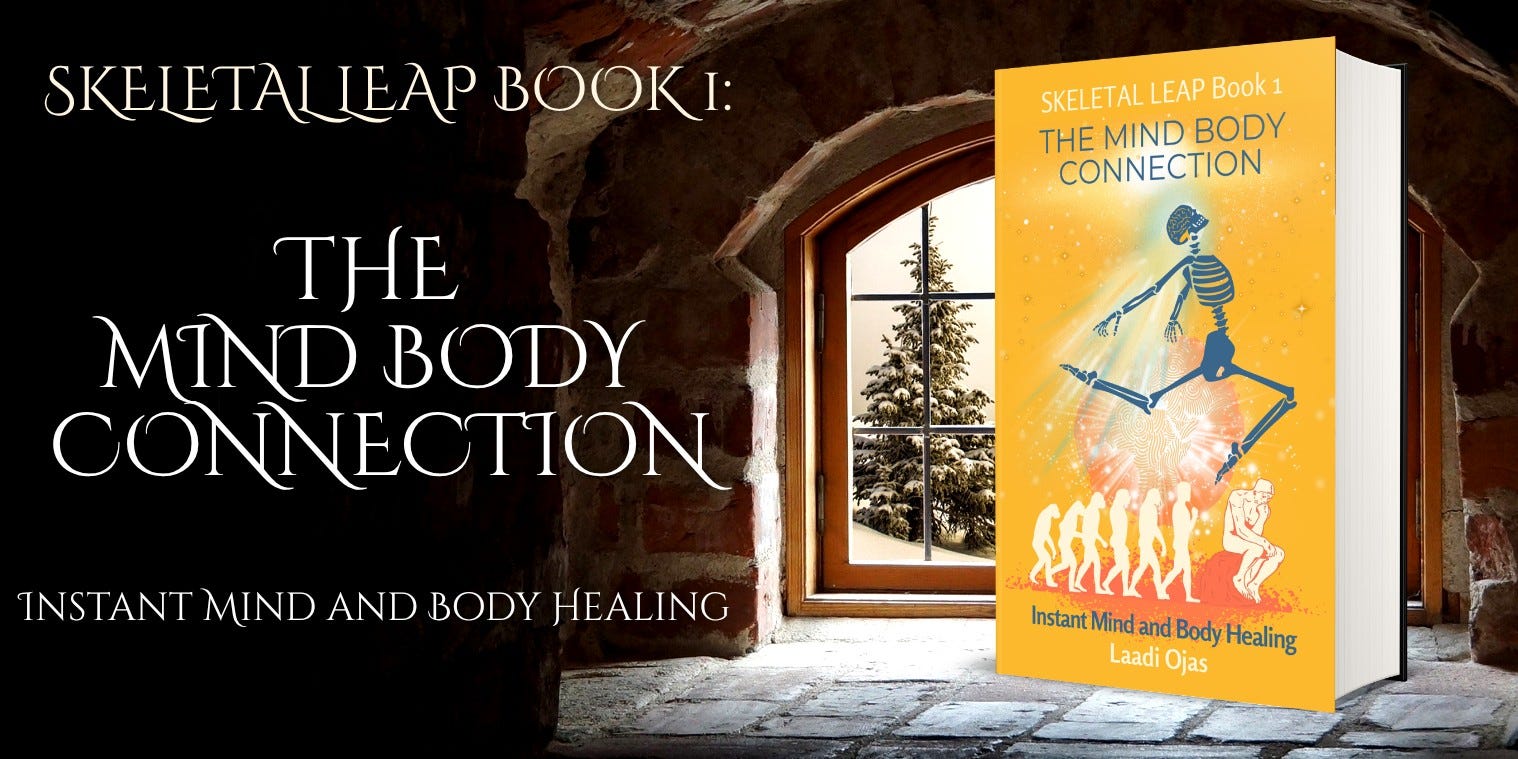
The paperback version of SKELETAL LEAP BOOK 1: The Mind Body Connection is available on https://www.SkeletalLeap.com/themindbodyconnection
You may also like…
Introducing SKELETAL LEAP: A Living Adventure
Cracking The Hidden Codes Of An Instant Sovereign Remedy
Unlocking the SECRET of Instant Visual Clarity & Visual Acuity
Unlocking The Secrets of Balancing The Chakras
Root Chakra Opening and Healing - Surprising Secrets Unearthed!
Opening Sacral Chakra: Chakra Healing Secrets That REALLY Work
New Solar Plexus Chakra Healing Tips That Keep It Permanently Open!
How To Unblock Your Heart Chakra Healing Your Love Life Compassionately!
Unblock Your Throat Chakra Healing Your Voice!
Third Eye Opening to Crown Chakra Healing in One Single Go Safely!
READY for SPONTANEOUS KUNDALINI AWAKENING through BREATHWORK Technique?