

SKELETAL LEAP: THE MIND BODY EVOLUTION SERIES
Introduction:
In the 26th episode of my podcast, I explore the transformative power of breathing and its intimate connection with Kundalini awakening.
Imagine a life where every breath you take connects you to a wellspring of joy and insight.
This episode, titled “Empty Your Mind with This Simple Diaphragmatic Breathing Technique!” invites you to explore how conscious breathing can lead to personal transformation and a heightened state of awareness.
I first introduce the concept of Kundalini, described as life energy that can be awakened through specific breathing techniques.
I then explain that as we breathe, we can dissolve our chakras, clearing obstacles that may have been holding us back.
The journey from the coccyx to the crown of the head becomes a pathway for insightful energy to flow, enriching our lives with joy and passion.
One of the key takeaways from the episode is the importance of diaphragmatic breathing. I emphasize that this method of breathing not only improves physical well-being but also plays a crucial role in emptying the mind of its clutter.
By focusing on our breath, we can shift our attention away from past memories and future worries, anchoring ourselves in the present moment.
This practice is essential for maintaining an open channel for Kundalini energy to rise. I encourage you to embrace the joy of involvement in your actions rather than becoming mechanical in your focus.
I also share an inspiring personal story from my life that illustrates how the mind can be emptied in the moments of extreme adventure and ultimate challenge.
I further highlight that while emergencies can temporarily clear our thoughts, the real goal is to cultivate a state of mind that remains open and aware through this regular breathing procedure.
The episode also touches on the science behind breathing and its effects on our nervous system. I explain how breathing is more than just a biological necessity; it is a vital force that connects our physical and spiritual selves.
Then I introduce the five types of Prana, each playing a unique role in our overall health and well-being.
As the conversation unfolds, you are invited to consider how you can incorporate these breathing techniques into your daily lives. I provide practical tips for achieving this, emphasizing that it’s not about counting breaths but about feeling the joy and energy that comes with each extended exhalation.
In conclusion, this episode is a treasure trove of insights for anyone looking to transform their life through the power of breathing. By learning to empty the mind and awaken Kundalini energy, we can experience a life filled with passion, joy, and a deeper connection with ourselves.
Don’t miss this enlightening discussion—tune in and discover the art of breathing for a richer, more vibrant life!
You will learn about…
(00:00:01) - How Kundalini Activates in the Body
(00:07:46) - Breathing as Prana
(00:12:59) - How diaphragmatic breathing empties the mind
(00:21:10) - How to Empty the Mind permanently
🔑 Key Takeaways:
Introduction: Introduction to breathing energy and insight
Breathing and Kundalini Activation: How breathing activates Kundalini
The Power of Diaphragmatic Breathing: How diaphragmatic breathing empties the mind with its extended exhalations
Empty Your Mind: Personal story of an adventure and mind emptying
How to Keep Your Mind Empty Forever: Techniques to maintain an empty mind through breath
🎙️ Listen to the Journey:
📽️ Watch the Masterclass:
Transcript:
“What else do we want on earth? It is like finding a perpetual goldmine (if gold is really as important as this)!”
My name is Laadi Ojas. Welcome to “Skeletal Leap: A Living Adventure”. Skeletal Leap transforms one’s life into a personal heaven.
Today’s episode will tell you about emptying the mind via breathing energy and breathing insight with every single breath for kundalini awakening.
Breathing becomes the perception of energy with every single exhalation as chakras are opened, removing all obstacles in its way. The way from the coccyx (at the pelvis) to the crown (at the top of the head) gets fully cleared.
How Breathing Activates Kundalini
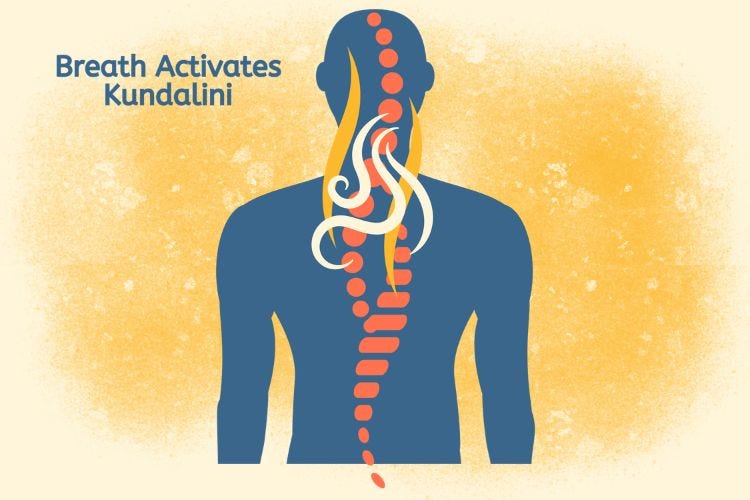
Kundalini rises from the gut to the brain as it works through the nervous system. It does so through the spinal cord provided all the chakras are open. And this is not a one-time event. It rises every single time the breath gets almost fully exhaled in an absolutely quiet manner. There is no force that needs to be exerted at all while exhaling. This way, it keeps the flow of kundalini, aka insightful intelligence, intact incessantly through the passage of time, every time. Therefore, another way to think of kundalini is life energy that is personalized as insightful intelligence.
The first time kundalini rises through a person’s spine via the vagus nerve or Sushumna, it may (or may not) manifest as tantrums. These tantrums can take the form of one of several different reactions depending on the person’s psychological and neurological disposition. Some feel this first rise as an electrifying shock from the left-over impediments along its way. Some others feel it as a sense of extreme joy never experienced before. There is a full spectrum of reactions as varied as there are persons who feel and express those reactions. Once the initial honeymoon (or nightmare) is over, it settles down as a conscious creative potential in the coccyx again.
One cannot take it for granted that this process will occur automatically over and over again, thereby falling back in their mechanical ways of life from before. Getting this life energy of insightful intelligence transferred to the brain with every single breath still lies firmly within the conscious domain of awareness. Therefore, one needs to keep one’s chakras open as one’s first nature. Once this is successfully achieved, one needs to become conscious of every single breath, no matter what one is doing.
You might now wonder, “Won’t focusing on every single breath divide our attention whenever we need to focus on something else of importance?”
Not at all! The focus is not on the breath but, instead, on the joy of one’s involvement into the action.
This will ensure that our attention is focused on that very moment. In fact, it stops us from drifting into the domain of the mind whose emotional emphasis is on past memories and future imaginations. This type of focus keeps us centrally fixated in the process of thinking rather than getting swayed by thoughts which is what unconsciously disturbs our attention.
For this to happen seamlessly, we don’t even need to count our breaths.
That will only make it as mechanical as any other meaningless rituals people employ to increase concentration like counting beads.
Concentration and attention aka focus are two different things altogether!
Here is something really beautiful. Once the insight of energy has gotten awakened as a potential, every single extended exhalation of breath performs a miracle. It fills the head and the pelvic region simultaneously with an extreme sense of joy and passion. This joy always remains as fresh, passionate and spontaneous as it was when we felt it the very first time.
Imagine having a passionate joy of cosmic orgasm at the crown chakra and a sexual orgasm at the pelvis simultaneously with every single exhalation of breath forever! It quite likely occurs due to an optimum release of serotonin, dopamine, oxytocin and endorphins in the nervous system.
What else do we want on earth? It is like finding a perpetual goldmine (if gold is really as important as this)!
What actually happens is that we train ourselves to adopt ‘lightness’ as a personality style. And we do this while equipping ourselves with its traits, namely, interest, insight and adventure. Not even the acutest stress can pull us off-track any more. It is like utilizing the ‘smart vagus’ of Stephen Porges’ Polyvagal Theory. That is what strengthens us in the face of an otherwise sympathetic nervous system response of ‘fight or flight’.
In fact, we have done something even bigger than this. We have emptied our mind along the way. And in doing so, we have become invincible.
And we keep renewing the entire procedure with every single breath! We no more fear even the most imminent of threats - death. We have discovered the most artistic way to live life, live it here and live it now. And we have learnt how to do it, here and now and, best of all, using clear, physical and measurable techniques.
Consciously extending exhalations a little longer than inhalations after opening all the seven chakras does it all. And it does it well too. It is simple. It is no rocket science.
As this combination of keeping chakras open while extending exhalations a little longer than inhalations becomes our first nature, the miracle happens. We no more need to keep an account of both these processes separately in a list of ‘things to do’. We just perceive its effect as a sense of non-stop passionate joy. If ever a break is perceived in that joy, we immediately need to set it right then and there.
Breathing As Prana1
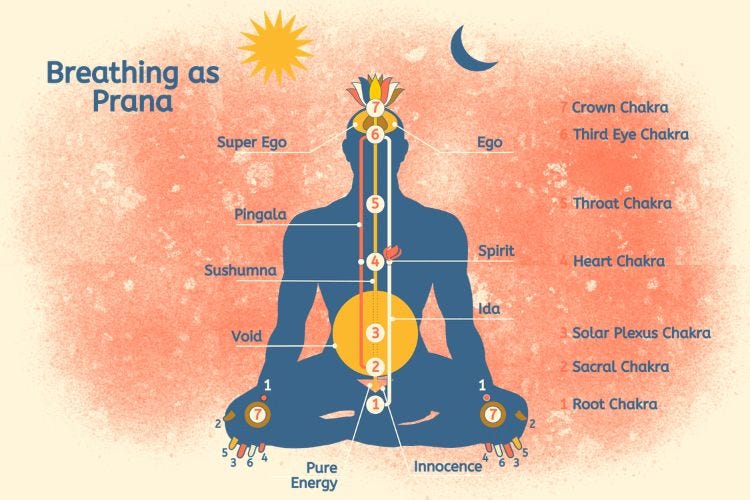
Breathing is not just a simple exchange of gases within the lungs. It is way more than that. That is why in the ancient chakra scriptures, it has been named as ‘Prana’ meaning the basic core of life energy. It is conceived as having the following five types of winds in the human system:
Prana - located at head, lungs and heart with an inward and downward movement, empties the mind
Apana - located at lower abdomen with an outward and downward movement, activates healthy digestive and reproductive systems
Udana - located at thoracic diaphragm and throat with an upward movement activates healthy respiratory and communication systems
Samana - located at navel with a spirally churning movement over there activates healthy metabolism
Vyana - located along circulatory system with outward movement activates healthy circulatory and nervous systems
There is also a mention of ‘Nadis’ meaning channels in the body like nerves, arteries, veins, capillaries, bronchioles, and lymph canals. The main three among them are:
Ida - controls mental processes
Pingala - controls vital processes
Sushumna - connects the root chakra to the crown chakra
Breathing is a biological process of moving air out from and into the lungs thus replacing carbon dioxide with oxygen. The exchange takes place in the alveoli through diffusion as the gases are transported to and from the cells by the circulatory system. This makes cellular respiration possible where cells extract energy from digested food through its oxidation. Carbon dioxide is generated as a waste product which then needs to be expelled out of the body through external respiration called breathing.
Breathing also controls speaking, laughing, creating facial expressions and reflexes like yawning, coughing and sneezing. The respiratory tract has the following different parts in it to perform all these activities:
Upper airways – nasal cavities comprising nostrils, pharynx and larynx
Lower airways – comprising trachea, mainstem bronchus, lobar bronchus, segmental bronchus, bronchiole and alveolar duct named alveolus
Three Different Breathing Styles2
There are three different breathing styles that people adopt as a lifelong habit.
Diaphragmatic breathing (Deep breathing) is done by contracting thoracic diaphragm for inhaling air inside the lungs. It is a muscle located between the thoracic and the abdominal cavities.
It comprises slow and deep inhalation through the nose followed by slow and complete exhalation. Diaphragmatic breathing improves the blood flow while reducing pulse rate and blood pressure. It also relaxes the vagal nerve and optimizes the sympathetic mode of the nervous system which is the source of a ‘fight or flight’ response.
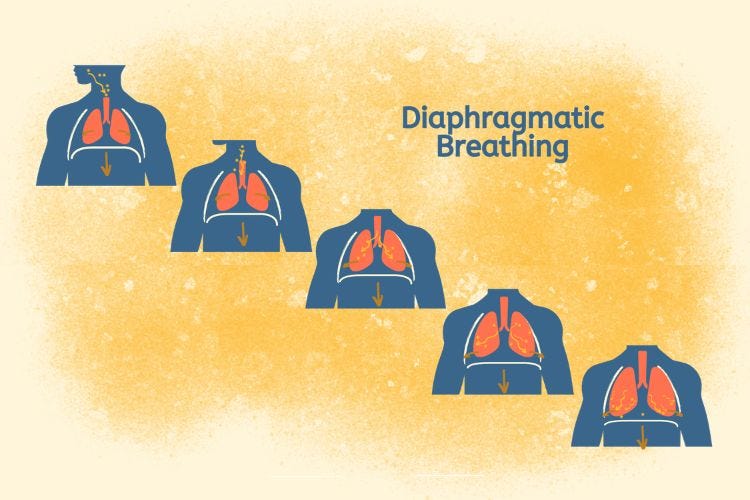
It is also one of the best cures for belly fat in particular and weight loss in general.
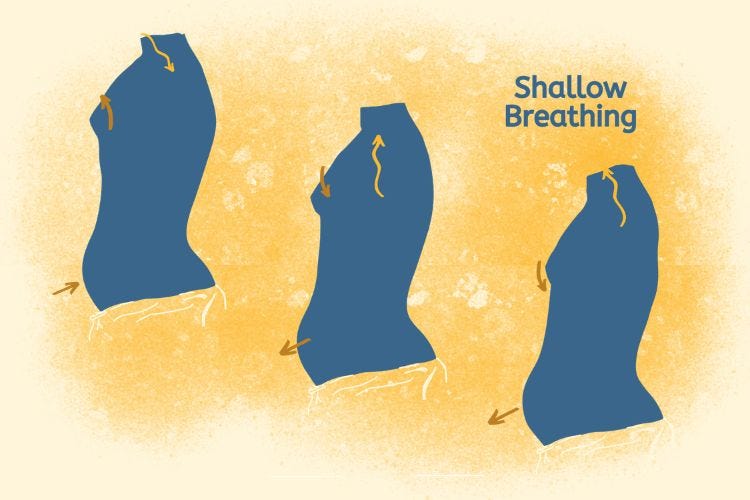
Shallow breathing, also called thoracic breathing or chest breathing uses intercostal muscles drawing much less air into the lungs.
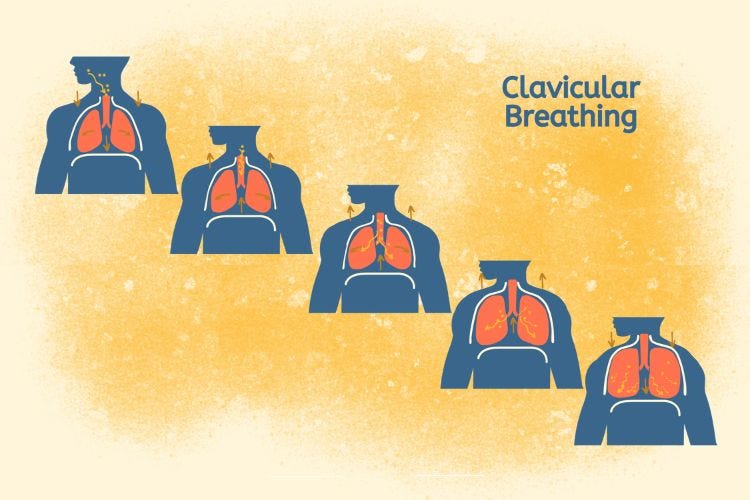
Clavicular breathing raises the shoulders and the collarbones (clavicles) while simultaneously contracting the abdomen for inhalation. Its process is a very tiring one and cannot be held for long durations of maximum air intake.
One must opt for diaphragmatic breathing alone, because it takes the maximum air in. It’s also because diaphragmatic breathing alone can awaken Kundalini pushing it up after all the chakras go open.
During exhalation, the lungs are left with the functional residual capacity of air which occupies a volume of 2.5-3 liters. An extended exhalation can reduce it further to 1 liter, not more than that.
In other words, one may extend their exhalation such that the leftover air in the lungs is anywhere between this range of 1 to 2.5-3 liters.
How Diaphragmatic Breathing Empties The Mind
How can breathing empty the mind?
Emptying the mind means getting rid of all its beliefs, habits, fears and desires. If we try to do this through conscious mental effort using our will power, we fail miserably. This is because we are trying to kill the mind by the mind itself. Why would the mind ever commit suicide? It is happy being in control not only of our psychology but also our biology. It does so by turning our perceptions and urges mechanical.
It is only possible to empty the mind using itself when it is posed with an impending emergency that it has no solution for. It stops working in such an impending scenario. Consequently, it gets forced to surrender its reign over any action that could get rid of the said scenario. Ultimately, in such a situation, the brain takes charge and performs the appropriate action to come out of that scenario.
The Story of My Mind Emptying Itself And Handing Over The Charge to My Brain in An Emergency
I remember a story from my life when my spirit of adventure posed a similar challenge to my mind. And my mind just resigned. But my spirit still went ahead with my brain alone and faced the challenge. My mind was absolutely emptied in the process and, thus, held back.
It was in the year 1992 that I visited a beautiful, high altitude valley in the Himalayas named Manali. I had already booked a cottage for a month-long stay over there. We were three in our family; my wife, my six-year-old daughter and I. We were enjoying our stay, doing something new each day.
After around ten days, we thought of going on an unconventional trek in the valley - a trek along the untrodden side of the River Beas that flowed through the valley. There was no road on that side of the river. Any roads that existed would be on the other side of the river from our trek.
Regardless, we started our trek and kept moving along the river, upstream. After around half an hour of our trek, the river got us stuck. It was taking a sharp turn there after hitting a high rock on our side of the trek. So, there was no way to go further. We were a little disappointed. I looked around the hill to the side of the river. I was looking for a bridle path, hoping to climb up a little and then come down to move further along the river. That way, we could have circumvented the sharp turn and climbed down to the river ahead of the sharp turn.
As I was investigating the visible bridle paths, I spotted a man standing at the hilltop looking curiously toward us. I shouted, aiming my voice in his direction, “Hey!”
“Hey!” the man shouted back from the hilltop.
I explained to him in my sign language what we were up to.
Seemingly a local, he immediately understood what we wanted. He threw a fleeting look along the bridle paths up the hill. Then he looked down around the river bend, and then waved at us to climb up.
As we started climbing up, I spotted him coming down toward us as well. That surprised me a bit. But as we climbed up a little further, I realized why he had made his way down. As we reached a nearly horizontal patch lined up with a nearly vertical rock, we found him standing up there.
What a helping spirit combined with a curious involvement! He smiled, sitting atop the approximately 7 feet high rock tilted at around 105 degrees from the patch.
“I had seen this rock from above and I knew you would need my help to climb it,” he said, smiling. “Thanks a lot!” I felt grateful. As I looked down once from where we were standing, I found us to be exactly over the river-bend which meant that, by then, we had climbed a few hundred feet.
The man lied down on his stomach on the horizontal patch atop the rock. From there, he hung his arms down along the slope of the rock.
First, my wife held his hands and I pushed her from behind as he pulled her up to the top.
As the patch above the top was comparatively narrow, he made her sit a little away on a gentle slope. Then he came back to the rock-top and lied down on his stomach hanging his arms down, again. This time, I lifted my daughter and pushed her up from behind as he pulled her up easily. He made her sit along with my wife and came back to the rock-top again. As he lied down on his stomach a third time hanging his arms down to pull me up now, he realized it wouldn’t work.
“Oh!” he exclaimed, disappointed.
By then I, too, had realized that we had not accounted for this scenario. With my wife and my daughter, I was there below to push them up. But now, I was alone with no one to do the same for me.
The man and I looked into each other’s eyes and then down at the river below flowing with roaring ferocity.
“We forgot this,” I said.
“Now?” he asked me.
“It’s risky,” I said with a sigh.
“Disappointing,” he sighed back dropping his head on the top of the rock.
“Hey! Is it really impossible?” I looked at the height and the slope of the rock.
“Not exactly, but yes, almost!” he opined.
“Why don’t we do it! I can push myself up with all my might,” my adventure bug bit me further.
“I don’t bother about myself. But you have a family along. If you aren’t able to make it the very first time, we both will be down there in the river. We will be flown away by its gushing waters…not to be found even as dead bodies, ever! A drowning man catches at a straw. So, you’ll end up pulling me down as well!” he explained what all it could entail.
“Oh, then send them back and we will go down the way we came up from,” I felt concerned about a stranger’s life not to be jeopardized.
“But I won’t feel good!” he exclaimed as he looked into my eyes intently.
I kept looking back into his.
“Okay, let’s do it. Just take care to sync your push with my pull exactly at the same moment,” he finally gave his verdict.
“Think twice before you say yes,” I said.
“You too!” came his reply.
“Ready?” I asked.
“Ready?” he asked.

We both started counting aloud, “ One, two, three!”
As we counted three, I found myself lying along him up on the patch at the top of the rock.
Two sighs of relief from the two of us and we smiled calmly looking at each other’s faces!
I did it. In fact, my body did it. I didn’t know how I had done it. It was exactly like what that middle-aged mechanic in my story in Episode 19 had done. He, too, didn’t have any clue to how he had done what he had.
My wife and daughter were oblivious to what we both had come up through.
My mind was just empty and it remained so for a long while after.
But habits die hard. The entire pattern comes back to the same square one once the emergency gets over.
Hence, though imminent emergencies can empty our mind in a flash of a second, they aren’t a permanent modus operandi. But yes, they can give us an instant glimpse of what an empty mind feels and works like. They can certainly demonstrate the superiority of any action done on our part without any doubt about it. That was what had happened in the above-mentioned story as well as in the mechanic’s story mentioned in Episode 19.
How to Empty The Mind Permanently
But then, how can the mind be permanently emptied?
Remember the firsthand account of a first timer in skydiving quoted before in Episode 20?
I repeat it here for your convenience:
I was OUT… everything mentally ended… over… started… me… perhaps more dead than alive… perhaps more alive than I will ever be… breathing just as I had been taught… wind… wind and breath… until wind and breath became indiscernible, became as one… and yes, almost weightless… it was true! … weightless and so surreal… there was the earth, neither coming at me, nor me at it, … no up… no down… no me, in the ego sense of me, just some thoughtless consciousness… and yes, it was awesome simply to be… or not. The sky was in my lungs and it never once occurred to me would the parachute open.
It is a perfect example of a mind having gone empty. And what a tremendous experience this was!
But unfortunately, this, too, stays only for a maximum duration of 6-7 minutes. That is while the skydiver is falling free before the parachute opens. We could extend this time with the help of a virtual reality simulator without even having a real skydiving session. But how long for?
We could even consider improving the quality of virtual free-fall simulator as compared to a real skydiving session. That could even entail removing the decelerating effect of air with a better control on experiencing acceleration due to gravity.
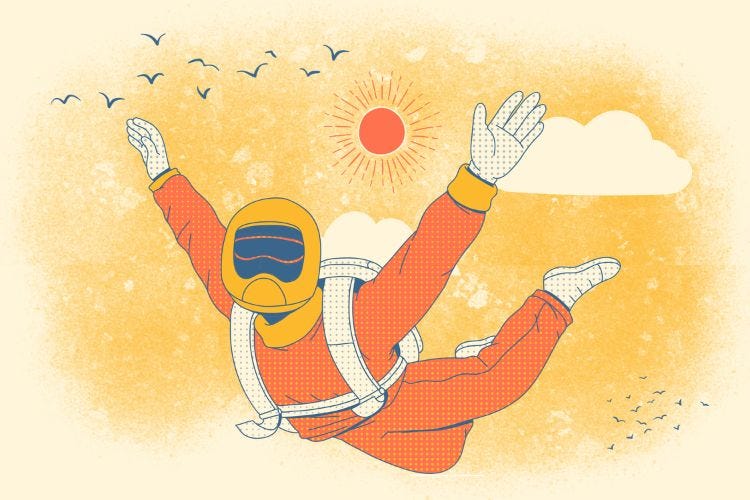
We could hypothesize that such a perfect simulation for a certain minimum time might empty the mind permanently as well.
In fact, I am already working on a project that proposes to testify this hypothesis under strict laboratory conditions.
But we cannot wait for this hypothesis to get proved correct. We do have a surer method though a little slower than the proposed hypothesis, at least for the time being.
And that is what I have already mentioned in this episode. We can easily keep emptying our mind continuously with every single extended exhalation when all our chakras are open. From a vitalistic angle, it amounts to sending periodical surges of kundalini from an open root chakra to an open crown chakra. From a materialistic angle, it amounts to sending periodical surges of neural communication from the gut to the brain.
Whatever it might be, but it does fill the crown of the head with inexplicable joy through every single extended exhalation. Along with joy, it also embellishes the brain with newer energy and newer insights.
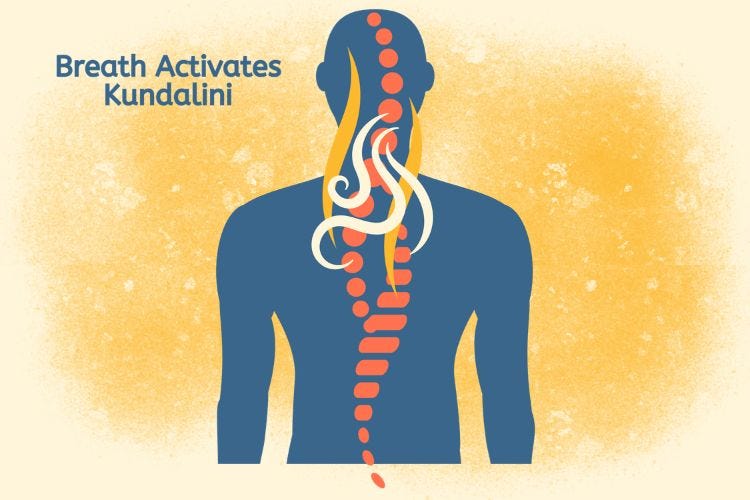
And every surge of this inexplicable joy keeps the mind emptied for its duration, in fact a little longer. Before it starts waning, the next surge appears with the next extended exhalation, reinforcing the mind’s emptiness again.
In case we ever miss the sequence, the sky is not going to fall loose on earth. We can pick the thread of breath up from wherever it right now is and restart the sequence once again.
That is what Skeletal Leap rewards us with!
Thanks for listening to this episode of Skeletal Leap: A Living Adventure! In the next episode, I will tell you about skeletal meditation emptying the mind and then keeping it empty for kundalini awakening.
Be a part of Skeletal Leap Community! Subscribe to Skeletal Leap Newsletter. Click on the link in the description to subscribe.
🔗 Series Bridge:
This masterclass is a 19-week journey through my book, The Mind-Body Connection. If you missed the foundation, start here: The 16-Part Prequel: 14 Core Principles.
🔑 Unlock the Practical Plan:
To truly master the Skeletal Leap, you need the step-by-step memoir and the associated practice codes found in the book.
Get the Book: The “Resource Codes” for this chapter’s PDF practice plan are found in the Amazon Paperback Edition.
Join the Movement: Download the Free Prequel Ebook via StoryOrigin and join our community.

Subscribe: Follow SKELETAL LEAP: The Mind Body Connection on Substack for weekly deep-dives into the human potential archive.
You may also like…

_____________________________________________________
References
Satyananda Saraswati, S. (1981, September). Prana: The universal life force. Yoga Magazine.
Hobert, Ingfried (1999). “Healthy Breathing — The Right Breathing”. Guide to Holistic Healing in the New Millennium. Harald Tietze. pp. 48–49. ISBN 978-1-876173-14-2.