

SKELETAL LEAP: THE MIND BODY EVOLUTION SERIES
Introduction:
In this eye-opening (pun intended 🙂) episode of Skeletal Leap, I strengthen the fascinating connection between central fixation of the eyes and the skeletal chakra hypothesis.
Titled “Eye Training for Crystal Clear Eye Vision NOW!”, the episode explores how achieving central fixation not only enhances vision but also transforms our physiological systems and personal well-being.
I share a personal story involving my cataract surgery and a groundbreaking realization about visual accommodation, challenging conventional ophthalmological beliefs.
I discuss the significance of the oblique and recti muscles in the eye’s ability to focus and how their habitual constriction leads to common vision problems like myopia, hyperopia and astigmatism as well as presbyopia after the age of 40.
Discover the historical context of Dr. W.H. Bates’ work and how it paved the way for understanding the relationship between the mind, body, and vision.
I introduce the concept of central fixation through chakra meditation, revealing how this practice can lead to profound changes in both vision and overall health.
Join me on this journey of self-discovery, as I uncover the tangible effects of opening chakras on our anatomy and physiology, and emphasize the importance of achieving a harmonious mind-body connection.
You will learn about:
(00:00:00) - Central fixation through the opening of chakras improves our vision and changes our physiological systems
(00:10:25) - Dr. W.H. Bates challenged mainstream ophthalmology 100 years ago
(00:16:01) - Modern ophthalmology is a gigantic multi billion dollar industry
(00:26:27) - Third eye and crown chakra meditation not only clarifies eyesight
🔑 Key Takeaways:
Central Fixation: The relationship between central fixation and vision improvement.
Muscle Constriction: How habitual muscle constriction affects eyesight.
Dr. W.H. Bates: The historical significance of Dr. W.H. Bates’ findings.
Chakra Meditation: Practical steps to achieve central fixation through chakra meditation.
Personal Transformation: The broader implications of achieving central fixation for personal transformation.
🎙️ Listen to the Journey:
📽️ Watch the Masterclass:
Transcript:
“Central fixation, through the opening of chakras, not only improves our vision and changes our physiological systems, it also changes us as a person.”
My name is Laadi Ojas. Welcome to “Skeletal Leap: A Living Adventure”. Skeletal Leap transforms one’s life into a personal heaven.
Today’s episode will tell you about an unintended evidence strengthening the skeletal chakra hypothesis via achieving central fixation of the eyes.
As I’ve mentioned earlier, the biological miracle that I have long been working with is the skeletal codes of instant central fixation of the eyes, the body and the mind.
Let me tell you another story, a recent one that reinforces my above statement.
The Story of Activating A So-called Impossible Visual Accommodation
“I seem to have cracked its code.”
This was what I said to my ophthalmological surgeon who was preparing to start a surgery for my cataract removal. I got my cataract removed in 2022.
I said to my surgeon again as he had not yet replied, “I think I have cracked the code of central fixation of the eyes.”
It was a few seconds before lying down on the operation table that I spoke these words.
This time, he looked at me and replied, “Right now, I am not listening to you.”
He added, “I am in my pre-surgery trance. We will discuss it once the surgery is successfully completed.”
It was a Tuesday. A few days prior, I had met him in his clinic. I had asked him to replace my clouded natural crystalline lens with an intraocular lens of the same diopter power.
The normal procedure of cataract surgery simply removes the clouded natural lenses in the eyes and replaces them with artificial clear lenses. These natural lenses which get clouded owing to protein coagulation with age are called natural crystalline lenses. The artificial clear lenses that replace them are called intraocular lenses.
It is a very simple, 10-minute surgical procedure though it does demand impeccable precision from the surgeon. And, as per modern ophthalmology, since these intraocular lenses cannot fatten like natural crystalline lenses, they cannot help in reading at close proximity when they are optimized for distant vision. Hence they require reading glasses employing presbyopic convex lenses.
“Why?” he asked while replying to my request to replace my clouded natural crystalline lens with an intraocular lens of the same diopter power, “Why wouldn’t we optimize it for your distant vision, if so needed?”
“It’s because I am doing some experiments with the errors of refraction in my eyes. I don’t want those to get disturbed at all. I believe I have already cured my lifelong myopia with central fixation. But even if your optometric machines find there are some traces left, I would prefer to be left with them. I just don’t want my research to get disturbed by you optimizing my eyes for distant vision,” I said.

“But I find it unethical. We normally optimize it for distant vision with intraocular lenses. And then we provide you with outside lenses for near vision,” he retorted
“How does it become unethical? Especially if I am ready to use outside lenses for distant vision as well, if need be?” I said.
He looked at me with a puzzled expression as no one else had ever asked this to him before.
I added, “Moreover, you may optimize my distant vision by changing the diopter power of the intraocular lenses. But, then, I will no more be able to read near as clearly as I do right now. I read at close proximity perfectly well without using any presbyopic lenses.”
He immediately interrupted me, “Don’t be under the impression that you will be able to do that with intraocular lenses. Right now, you are somehow still doing it as you have natural crystalline lenses in your eyes. But intraocular lenses are just inanimate matter and not animate like your natural crystalline lenses. They will simply not let you see near clear as you cannot manipulate them at all. You will need a pair of near vision glasses after the surgery in any case.”
“I will still like to use a pair of outside glasses for correcting my distant vision. That is, in case I still have traces of myopia left in my eyes. But I would never like my distant vision to be optimized within my eyes. It will disturb the research that I am doing through experiments with central fixation to eradicate all errors of refraction. And it’s not unethical if I prefer outside lenses to inside ones. Am I not right?” I asked him challenging his notion of ophthalmological ethics.
My logic convinced him that what I was asking for was not unethical. I just wanted my natural crystalline lenses replaced with intraocular lenses of exactly the same diopter power as before.
He agreed. And I took a sigh of relief as it was a question of my entire research getting wasted otherwise.
All my preliminary tests including ophthalmological and physiological status got checked. A day before the surgery, the surgeon informed me that everything was alright. He said my natural crystalline lenses would be replaced with intraocular lenses of diopter power +18.5. It was exactly the same diopter power that my natural crystalline lenses had.
On Tuesday, 15 February 2022, my right eye got operated on. As soon as the surgery got completed, the surgeon asked me to open my eyes. As I complied, I immediately saw everything much brighter as well as crystal clear in the field of my vision. It had gotten brighter owing to the surgery done on my eye. And as far as clarity of vision was concerned, replacing my natural crystalline lens with the intraocular lens of the same diopter power had left no negative effect on it.
It was a moment of extreme elation for me. Not optimizing my vision for distance had shown its favorable result.
The next day, on Wednesday, 16 February 2022, my left eye got operated with similar results.

As soon as both my eyes got intraocular lenses inserted in them, I went impatient. I could not stop my temptation of trying to read near with them. And lo! To the utter astonishment of my surgeon as well as of mine, I was able to read everything close clearly too.
The next day, on Thursday, 17 February 2022, my vision was officially tested for distance and for near reading.
Each eye was individually tested separately. Both of them recorded 20/20 vision for distance and N6 for near reading.
I asked my surgeon how he would explain this in light of the accommodation process theorized by German ophthalmology. According to this theory, it should have been impossible for me to read near, especially with N6 acuity.
He simply raised his hands in utter astonishment, saying, “I just don’t know how you are reading near so clear.”
It was a miracle, so to say.
I asked him if I was his first patient not requiring near vision glasses from him after cataract removal surgery. He said I was, indeed, the only one to do so through his entire career.
The Real Scientific Process of Visual Accommodation
The question was how on earth I was able to see near so clear with inanimate lenses in my eyes.
There was only one way in which it could be explained scientifically.
It was that I was able to elongate my eyeball in order to see clear while reading near. And then, I was able to turn it back to near spherical while seeing at a distance.
According to this explanation, the lens has no role to play in the process of accommodation. It is the eyeball that effects and controls accommodation.
It was about a hundred years ago that Dr. W. H. Bates had propounded the same. Here is a quote from him:
“During more than thirty years of clinical experience, I have not observed a single fact that was not in harmony with the belief that the lens and the ciliary muscle have nothing to do with accommodation and that the changes in the shape of the eyeball upon which errors of refraction depend are not permanent. My clinical observations have of themselves been sufficient to demonstrate this fact. They have also been sufficient to show how errors of refraction can be produced at will, and how they may be cured, temporarily in a few minutes, and permanently by continued treatment.”
- Courtesy: W. H. BATES, M.D. (1920)
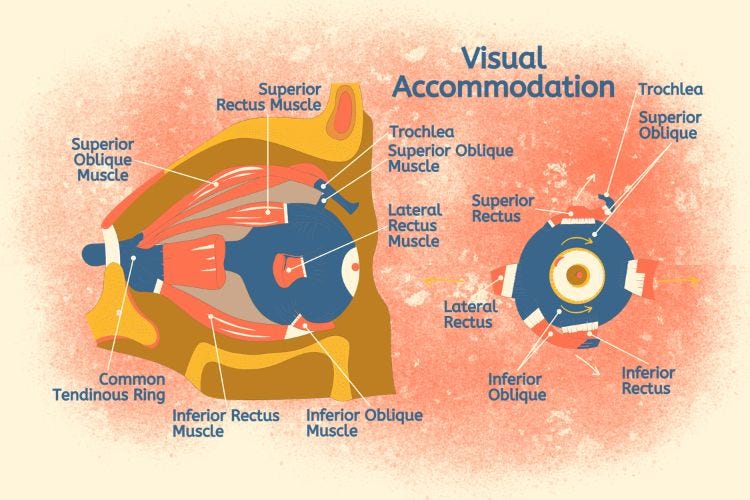
Eyes are constructed1 of eyeballs having two sets of six muscles on each one of them. Two of them are ‘oblique’ muscles and the other four are ‘recti’. The two oblique muscles are there in the shape of a belt around the middle of the eyeball. The muscle above is called ‘superior’ and the one below, ‘inferior’.
The four recti muscles pass along the depth of the eyeball at the top, bottom, left and right sides. They are attached to the sclerotic coat at one end and the bone surrounding the optic nerve at the other. These four muscles at the top, bottom, left and right sides of the eyeball are ‘superior’, ‘inferior’, ‘internal’ and “external” recti.
When we contract the oblique muscles, the eyes can easily read near.
But when this constriction becomes unconsciously habitual, the eyes cannot see clear at a distance. This condition is called myopia and is generally combined with astigmatism which means different levels of constriction in various circular degrees.
Also, when recti muscles are kept constricted habitually, the eyes are not able to read at close proximity clearly. Letters go blurred as in hyperopia and presbyopia, and distorted as in astigmatism.
When the crown chakra and the third eye chakra are blocked, these are the muscles that get affected first. Thereafter, the rest of them, including those in the jaws, on the eyebrows, and around temporomandibular joints get affected.
Surprisingly, there is a direct physiological connection between the muscles on the eyeballs and the rest of muscles in the skull! The major ones among them are the muscles named frontalis, temporalis and occipitalis. By relaxing these three muscles via maneuvering the mandible, we can relax the muscles on the eyeballs as well.
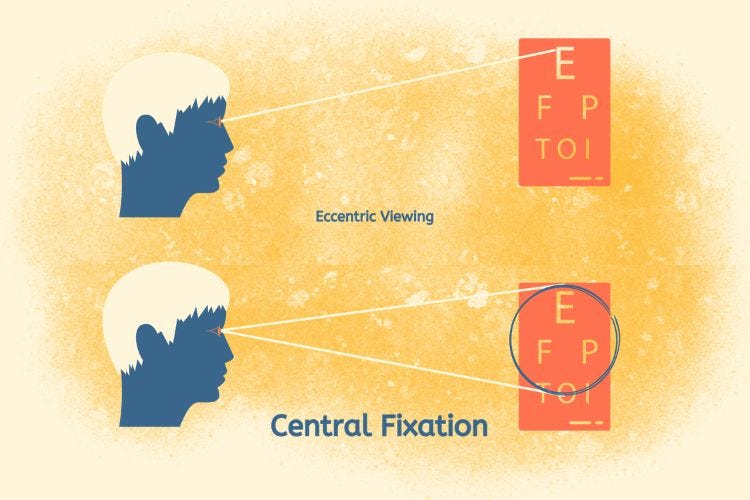
Once that is done, we can achieve full voluntary control on the entire process of accommodation. This is how we can achieve central fixation of the eyes and get rid of all the errors of refraction.
The Role That Dr. Bates Played A Hundred Years Ago
Around a hundred years ago in the year 1920, Dr. W. H. Bates, an ophthalmologist published a book. It was titled “The Cure of Imperfect Sight by Treatment without Glasses”. The book was an account of his case studies which involved curing the vision of people and enabling them to get rid of their glasses. It was also a logical analysis of how vision goes bad in the first place and how to cure it. With his analysis, he happened to challenge mainstream ophthalmology on its theoretical premises.

Mainstream ophthalmology had always maintained that vision, once gone bad, could never be cured. It still maintains the same premise to date. Hence it considers wearing glasses as the primary solution. It has also come up with its surgical derivative named LASIK. In LASIK, they sculpt the cornea in the shape of a lens as per the vision prescription. It simply turns the cornea into an additional lens in front of the eye’s main lens without wearing glasses. Not a big deal! It is rather ineffective in certain cases, especially in the long run. I know many such people whose errors of refraction returned a few years after getting LASIK done.
But mainstream ophthalmology chose not to respond to Dr. Bates’ challenge. It rather chose to ignore him in an attempt to isolate and ridicule him.
The question that arises is why, after all, mainstream ophthalmology chose to ignore its own comrade. Was it just because it thought he was doing something nonsensical? Far from it, his questions were not illogical. Quite to the contrary, he was getting positive results! Why, then, did his own parent organization ignore him like a step child?
The answer, as often is the case, was a conflict of interests between the two. And mainstream ophthalmology continues that same antagonistic approach toward his research and findings at the time of delivering this podcast…even almost a century later!
What would mainstream ophthalmology gain from this antagonism?
The answer seems to lie in a covert conspiracy as such. It is possibly scared of losing a luxurious business that it is the sole beneficiary of. Modern ophthalmology is a gigantic, multi-billion-dollar industry.
Here are two quotes to underline it:
“Global Eyewear Market to reach USD 196.47 billion by 2025. Global Eyewear Market valued approximately USD 110 billion in 2017 is anticipated to grow with a healthy growth rate of more than 7.52% over the forecast period 2018-2025.”
Courtesy: Market Research Reports, 1 January 2019
“Global personalized LASIK surgery market is expected to reach USD 3.69 billion by 2022.”
Courtesy: Grand View Research April 2016
Perhaps, none of this industry’s gatekeepers want to kill the proverbial golden-egg-laying duck?
Dr. W. H. Bates ignored his isolation by mainstream ophthalmology. He went on treating his patients. And, by the time he died in 1931, he had already cured thousands of them. They had gotten rid of their glasses as they didn’t need them anymore.
After his death, many volunteers took up his work and continued treating patients. It has now become an institution in itself that promotes alternative ophthalmology, defying the mainstream authority. These volunteers have kept Bates’ legacy alive through almost a century after his death. The Bates Method, as it is famous now, has sculpted a strong niche for itself.
But there is a problem here. The Bates Method, in general, is very slow in improving vision. Very few people afflicted with errors of refraction in their faulty eyes have that kind of patience. They find wearing glasses a ready-made solution and surrender to it.
They don’t know that, by wearing glasses, they are forcing their eyes to keep seeing through them for life. An eye must keep seeing inherently wrong in order to see clear from behind the lens fitted on it. Therefore, they kill any probability of vision improvement for good.
How I Was Able to Change Bates Method of Central Fixation from A Mental Procedure to A Physical One
As far back as my early childhood, I was diagnosed with myopia. My left eye required a lens of minus 5 diopter to see clear. Luckily, my right eye was 20/20. So my optometrist gave me a pair of glasses which I never liked wearing. I could see things with my right eye without any problem. Hence I put my glasses in the drawer of my table and never took them out.
A few years passed. I finished my engineering studies and got appointed to a government job. I was instructed to get my physical examination done in a specified government hospital before I would begin on the job. So, I went for it, aware of the fact that one of my eyes needed a minus 5 diopter lens.
But I was in for both a pleasant and an unpleasant shock at the same time! The doctor told me that both my eyes had myopia requiring minus 2.25 diopter lenses.
The world went upside down as well as downside up for me. My normal 20/20 vision in my right eye had deteriorated to require minus 2.25 diopter lens to see clear. But my faulty eye had spontaneously improved itself from requiring minus 5 diopter lens to just minus 2.25 diopter now.
How did my eyes manage to do so on their own without my conscious awareness of it? It was against the very basic premise upon which all of mainstream ophthalmology had structured its existence.
According to Jessica Lewis, optometrist from Illinois College of Optometry:
“Not wearing glasses, also, cannot change the shape of your eye, so if you stop wearing glasses, you will not make it so that you don‘t need glasses and you will not make it so that your vision returns to normal.”
How can, then, mainstream ophthalmology explain the reversal of my eyesight from minus 5 diopter to minus 2.25 diopter?
It can’t.
Anyway, I lived up to the age of 53 with both of my eyes requiring correction by minus 2.25 diopter lenses. That was before I accidentally stumbled upon a spontaneous and instantaneous clarity of vision one day. Later, I researched the phenomenon to understand it in depth and how to achieve it at will and sustainably.
Earlier, I had mentioned that the Bates Method was slow to provide even the first flashes of clear vision. At times, it was instantaneous but, in general, it took a long time to do so. I was looking for something in the procedure that would make it instantaneous as well as measurable. Here, by instantaneous, I mean a single session of a few hours. Even if it is not full clarity, the amount of clarity gained should be measurable. Measurability would enable such a procedure to get verified under the test conditions that mainstream ophthalmology would, no doubt, insist on.
And this is what the Bates Method, despite being a brilliant procedure, is lacking. It can’t generate measurable improvements in a single session. Hence, it could never decisively pass the challenge of strict scrutiny done under laboratory conditions.
It was because Bates had positioned his method around relaxation of the mind in order to relax the eyes. In relaxing the mind and the eyes, his basic purpose was to attain the central fixation of the mind. The central fixation of the mind led to the central fixation of the eyes. It meant focusing at a single point in the field of vision so that it made its image exactly at the fovea.
Bates contended that central fixation of the eyes was not achievable without achieving central fixation of the mind.
As I have mentioned earlier, the mind is a very vague entity. It has processes inside it that are intangible, meaning you can’t measure them. And, if you can’t measure a thing, you can’t be sure of its objective existence, nor of its strength. You cannot say with 100% surety that you are going the right way. You can’t even be sure of how much of it you need to achieve the desired results.
At times they may click but rarely so. So, you need to keep making trials and errors until you can hit the target. It takes time, and at times, a lot of it. Not to mention, you can’t even create them instantly and at will with 100% surety.
This is what makes the Bates Method unreliable.
But, if we approach this from the perspective of physical effects, it all becomes solid and tangible. And they are not always the effects. At times, they may be the cause to begin with. We can pinpoint them. We can even measure them. Hence, we are more in control of them. That is why we can activate them instantly and to their fullest.
This was what I did with the Bates Method when it came to achieving central fixation of the eyes. I just changed its direction. Bates had directed it from central fixation of the mind to the central fixation of the eyes. I changed it from central fixation of the eyes to the central fixation of the mind.
I did a lot of research on how chakras affected the anatomy and the physiology of our body. As you might know already, the description and approach to chakras in ancient scriptures is deeply embedded in the spiritual arena. Their shallow, modern-day interpretations follow suit without even understanding what spirituality really means. With their mysterious-sounding descriptions, these misplaced interpretations have tended to turn chakras into an esoteric discipline.
I aimed at understanding the physical effect of chakras at different parts of our body, i.e., on its nerves and musculature. Spirituality, like the mind, is not a concrete entity; it is rather even vaguer than the mind. It is esoteric.
Central Fixation Is Instantly Achievable through Skeletal Chakra Meditation
Consequently, what I did with chakras was exactly what I had done with the mind. I addressed the issues associated with chakras from the perspective of their effects on the body. For all we know, these so-called effects might actually be the culprits causing those issues in the first place!
Since body and spirit, like body and mind, are two sides of the same coin, the former affects the latter as well. It is exactly the way in which the latter had affected the former before, if at all so.
This approach enabled me to discover that central fixation of the eyes was exactly what third eye and crown chakra meditation achieved.
Opening the third eye and the crown chakras meant achieving central fixation of the eyes along with central fixation of the mind.
I could now pinpoint it and activate it instantly to its fullest by measuring it properly. And the best thing was I could do it at will!
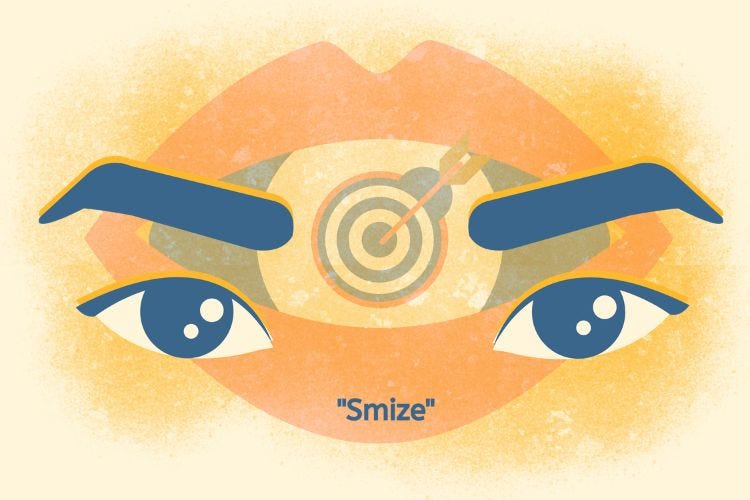
Of course, it does require some time to open the third eye and the crown chakras through third eye and crown chakra meditation. It is because the muscles in its vicinity need time to loosen up their age-old rigidity. Once they have done that, the eyes start seeing perfectly without any artificial aid worn upon them.
Achieving central fixation through opening all 7 chakras is not only about vision correction. Vision correction is merely an indication that we are on the right track in our journey toward Homo sapiens evolution as a whole. It leads us to a perfect state of biological, mental and spiritual health, replete with the flow of cosmic (or biological) energy through us. It enables us to be in peace with ourselves individually, paving the way toward creating a peaceful world around us. It fills us with intelligent insights to mend our deteriorating sociocultural institutions and, then, to create a colorful world around us. In short, it paves the way to heaven on earth!
My central fixation boosted my immunity to an extent that enabled me to live together with my Covid-19-infected family without ever contracting the virus myself. Though unvaccinated, my innate immunity saved me from catching it even from such close vicinity.
Third eye and crown chakra meditation, or central fixation, not only clarifies eyesight but also benefits the body, the mind and the spirit in the following additional ways:
Immunity Boost | Headache Eradication | Depression Alleviation | Anxiety Eradication | Enhanced Focus | Deeper & Slower Breathing | Improved Circulation | Stronger Heart | Faster Assimilation | Improved Digestion | Smoother Excretion | Hormonal Balance | Autoimmune Diseases Eradication
I would even venture to say that third eye and crown chakra meditation or central fixation is not, as Aldous Huxley would say, ‘The Art of Seeing’ alone. It is actually ‘The Art of Healing’ the body, the mind and the spirit.
Whenever the mind is not in a meditative state, it does something detrimental to the body. As a result, the body constricts some specific muscles that are meant to be relaxed and loosens some others that are meant to be kept contracted. With the continuation of such a mental state, the body keeps those muscles constricted or loosened for long.
With the passage of time, these muscles habituate themselves in those same erroneously constricted or loosened states. And, with the further passage of time, the said constriction or loosening turns unconscious. The affected muscles lose their range of flexibility. They start giving a message to the mind that they are not making any effort.
And the fact is that they really start perceiving their constricted or loosened disposition as relaxation. They don’t even realize that this is a serious reduction in their own innate range of flexibility. They start assuming as if the range was always limited.
We can decide to bring the affected muscles back to their relaxed state, but they resist doing so. So, we need to pull them out of this unconscious habitual constriction or loosening by stretching or contracting them out and up. The constricted or loosened muscles perceive it as an effort and hence feel pseudo-tired in the process.
However, if we show perseverance and continue to stretch or contract the affected muscles out of their constriction or loosening, they listen. And they listen because their unconscious memory - what is often referred to as “muscle memory” - gives them a feeling of doing something right. With the passage of time, they start regaining their lost flexibility and range.
Muscles do take their time to get rid of their constricted rigidity or loosened lethargy. Once they have done it, the entire body-mind system comes back to its natural, spontaneous state. With that, the purpose of said meditation is achieved. Thereon, we only need to ensure that we don’t repeat the old habits in the body or the mind again.
So, which muscles go rigid and which ones go lethargic when vision gets compromised, be it for distance or near reading?
These are the muscles in the vicinity of the third eye and the crown chakras. In fact, the crown chakra is a widening of a narrow third eye chakra by 270 degrees.
Central fixation, through the opening of chakras, not only improves our vision and changes our physiological systems, it also changes us as a person.
At that point, we will already have taken an important step toward Skeletal Leap into the next major Homo sapiens evolution. What is left is to activate the rising of energy from the gut to the brain. And this is where we enter the realm of breath.
Thanks for listening to this episode of Skeletal Leap: A Living Adventure! In the next episode, I will tell you about emptying the mind via breathing energy and breathing insight with every single breath.
Be a part of Skeletal Leap Community! Subscribe to Skeletal Leap Newsletter. Click on the link in the description to subscribe.
🔗 Series Bridge:
This masterclass is a 19-week journey through my book, The Mind-Body Connection. If you missed the foundation, start here: The 16-Part Prequel: 14 Core Principles.
🔑 Unlock the Practical Plan:
To truly master the Skeletal Leap, you need the step-by-step memoir and the associated practice codes found in the book.
Get the Book: The “Resource Codes” for this chapter’s PDF practice plan are found in the Amazon Paperback Edition.
Join the Movement: Download the Free Prequel Ebook via StoryOrigin and join our community.

Subscribe: Follow SKELETAL LEAP: The Mind Body Connection on Substack for weekly deep-dives into the human potential archive.
You may also like…

Reference
Shumway, C. L., Motlagh, M., & Wade, M. (2022, October 13). Anatomy, Head and Neck, Eye Extraocular Muscles. National Center for Biotechnology Information. https://pubmed.ncbi.nlm.nih.gov/30137849/