

SKELETAL LEAP: THE MIND BODY EVOLUTION SERIES
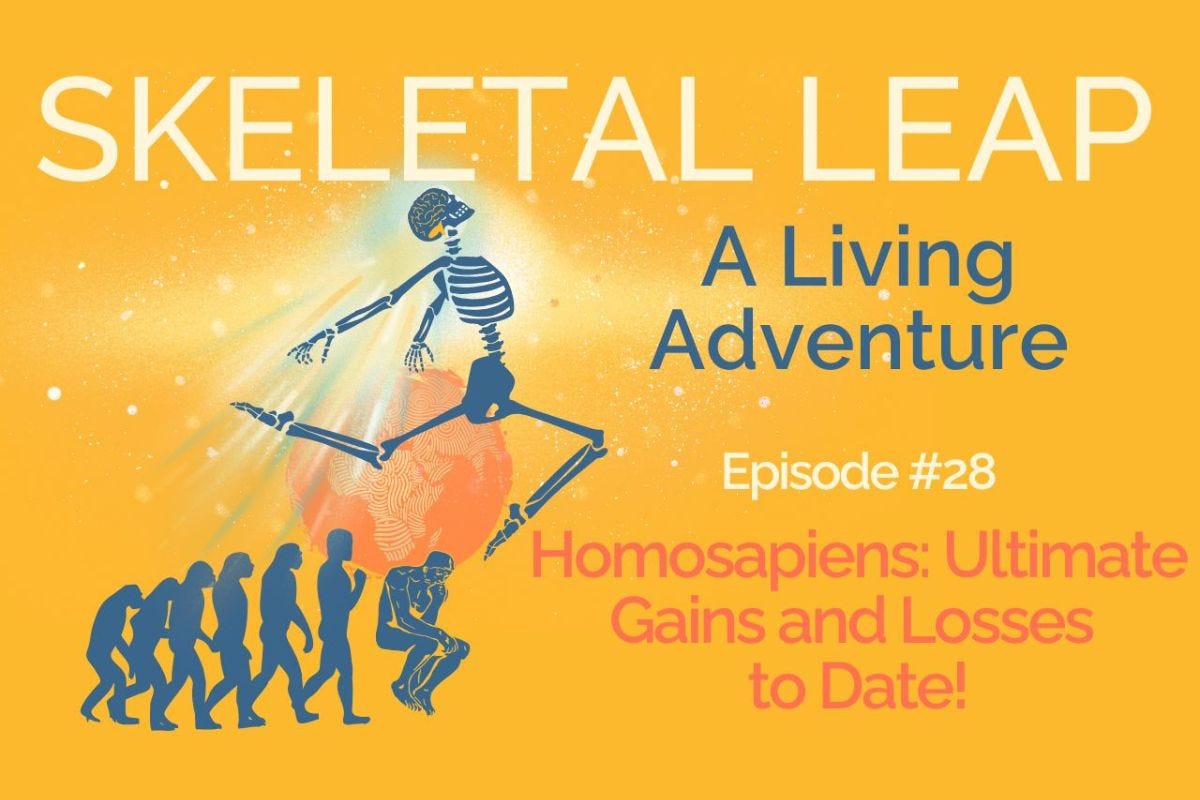
Homosapiens: Ultimate Gains and Losses to Date!Introduction:
In this 28th episode of my podcast, I take you on a thought-provoking journey through the evolution of Homo sapiens and the pressing issues of our time, particularly climate change.
The episode, titled “Homo Sapiens: Ultimate Gains and Losses to Date!”, talks about the duality of human achievements and losses, revealing how our advanced cognitive abilities have allowed us to dominate the planet while simultaneously leading us to the brink of ecological disaster.
I begin by reflecting on the unique advantages that Homo sapiens possess, such as our ability to communicate complex ideas through language and our capacity for abstract thought. These traits have enabled us to form large groups and cooperate effectively, allowing for unprecedented advancements in technology, science, and culture.
However, this success has come at a cost. The very myths and stories that helped unite us have also contributed to fragmentation and conflict, leading to wars and social strife. As we stand at a critical juncture in history, I emphasize the urgent need for a shift in our mindset.
We must recognize that our relentless pursuit of growth, driven by fear and greed, is unsustainable. The consequences of climate change are already evident, with melting ice sheets and extreme weather patterns threatening the planet’s biodiversity.
I quote renowned naturalist David Attenborough, stating, “What we do in the next 20 years will determine the future of all life on Earth.”
A central theme of the episode is the distinction between the mind and the brain. I argue that while the brain is an intelligent organ capable of spontaneous perception and subsequent action, the mind often distorts reality through emotional attachments and preconceived beliefs.
To navigate the challenges ahead, we must “empty our minds” of outdated narratives and prejudices, allowing our innate instincts to guide us toward collective action for the greater good.
You are invited to consider the implications of this paradigm shift and the potential for a unified human experience. I call for a worldwide cooperation that transcends competition, likening it to the immune system of the body that can turn against itself.
If we fail to unite, we risk our own extinction as a species.
In conclusion, this episode is a wake-up call for all of us. It challenges us to confront our past mistakes and take immediate action to protect our planet. By fostering a mindset of cooperation and understanding, we can pave the way for a sustainable future.
Don’t miss this enlightening episode of Skeletal Leap, where we explore the intersection of human evolution, societal beliefs, and the urgent need for change.
Tune in now and join the conversation about our collective responsibility to the Earth and to each other.
🔑 Key Takeaways:
(00:00:01) - Human Gains vs Losses
(00:11:32) - What to Do Now?
🎙️ Listen to the Journey:
📽️ Watch the Masterclass:
Transcript:
“What to Do Now?
Today, if we are humble enough to learn our lesson, we need to take immediate action.
How do we do that?”
My name is Laadi Ojas. Welcome to “Skeletal Leap: A Living Adventure”. Skeletal Leap transforms one’s life into a personal heaven.
Today’s episode will tell you about human achievements vs losses through homo sapiens bipedal evolution.
We humans have been extremely successful in achieving an unchallenged control over the planet we live on, something none of the other 8.7 million living species could even dream of. Homo sapiens are ruling the planet at present like dinosaurs once did.
As a species, we have made immense progress in creating tools that gave us the power to establish the said control. The tools kept getting more and more sophisticated as did our brain’s ability to think in abstraction. We, the sapiens, had another exclusive advantage at our behest. We could communicate much better with one another through the use of our language that was way superior to that of other Homo species.
Hence we were better able to cooperate in groups while fighting with our competitors for the purpose of dominance over them. Neanderthals who were physically stronger and other Homo species could not do it so effectively among themselves and slowly went out of existence.
It was then that the Homo sapiens discovered the power of the mind in creating mythological stories, thanks to their superior language. And then, they soon started believing in them! As this happened, it acted as a double-edged sword. It started imparting an autonomous status to the mind as separate from a reviewer of the brain’s perception and action. It helped the Homo sapiens, driven by their fictitious beliefs, to start cooperating in bigger and bigger groups to achieve dominance over the planet as a species.
But then, humanity didn’t stop over there. It allowed these fictitious beliefs to turn into a unique kind of auto-immune disease, not of the individual but of society. A disease that we have been dealing with the repercussions of, ever since.
Wars became the order of the day.
Marked by the dominance of massive groups cooperating among themselves in an effort to annihilate other massive groups, these wars paved the path for the competitive growth of Homo sapiens’ civilization.
Since then, the story of the growth of human civilization has remained much the same to date. That is why and how these mythological stories acted as double-edged swords. Though they created vast cooperating groups furthering tremendous growth and development, the said growth always remained fragmented. The groups remained disparate, miserably failing to operate as one single cooperating group of a species called Homo sapiens.
This was the power of our fragmented minds following our fragmented beliefs via our fragmented stories that took dominance over the marvels of the spontaneous brains of a unique species that we, the Homo sapiens, were.
Nevertheless, the power to think in abstraction was a great leap in the evolution of the human brain. It gave birth to new disciplines in science, arts, technology and commerce. Human culture started prospering with inventions of digits and letters resulting in mathematics to calculate on one hand and language to communicate on the other.
Today, we marvel at our own achievements within such a short span of time, evolutionarily speaking. Once we, the Homo sapiens, started galloping along the track of new discoveries and inventions, we never stopped. It has been too fast an evolution of the brain in too short a span of time.
Overall, our brain size has increased 2-3 times within the last 3 million years, starting with the species named Australopithecus1. This was a group of hominins from which humans are supposed to have descended. These 3 million years is quite a small fraction of time when compared to the 3 billion years of life on earth. And surprisingly, that process of evolution is still on! And at the same break-neck speed!
The Tipping Point of Crisis
We have almost reached the edge of the point of no return from the harmful effects2 of human-induced climate change.
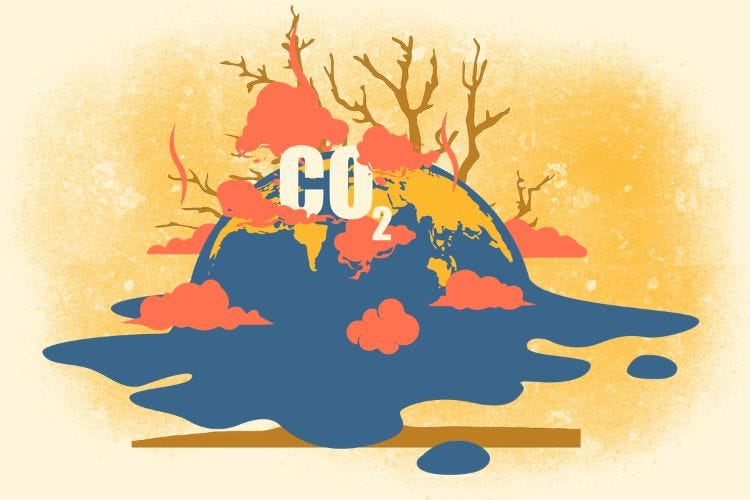
As of today, the two major ice sheets at Greenland and Antarctica are melting speedily. If the greenhouse gases are not stopped from emitting further, the rise of the global sea level is going to cause havoc.
If the global temperature ultimately increases by 1.5-2.0 degree C, the melting of these ice sheets may become irreversible. Higher rainfall and higher flooding events would engulf the northern hemisphere. It would end up in the extinction of quite a few species of plants, insects and vertebrates. Under extreme weather conditions, there are going to be way more spontaneous forest fires. And we have already started seeing all these effects in just the past few years!
As David Attenborough said,
“What we do in the next twenty years will determine the future of all life on earth.”
Who is to be blamed for it?
Our mind, our society and our culture! Who else?
Our mind is greedy. It is greedy because it is fearful. We, as a species, wanted to progress as much as we could, as fast as we could.
We over-exploited our planet’s resources, without giving it back what we took from it. Earth wants to take everything back now.
Isn’t it a lesson for our mind? Isn’t it a lesson for the way we have structured our society? Isn’t it an indictment of the value system that we have erected human culture on?
Where did we go wrong? What was our earliest mistake?
Remember I had said that the mind gets subjectively attached to its faulty apprehensions of threat to life, in Episode 20? It overrates the instincts of self-preservation. On the other hand, it suppresses and even represses death instincts. That is how it distorts reality and corrupts human action. It is because all death instincts including curiosity, interaction, adventure, love and sex turn us passionate, insightful and people-centric.
On the other hand, self-preservative instincts turn us stupidly emotional, greedy and self-centric more than people-centric. They want growth as much and as fast as possible whereas death instincts are way saner in their approach. In its greed, humanity sided with the fastest possible rather than sustainable growth that is in tune with all of nature and, therefore, would have given rise to a different paradigm of ‘quality’ of life.
That is why and how the brain is way more intelligent than the mind. In fact, the mind can very easily go stupid. Brain never does.
That was our very first mistake. In fact, that was our Original Sin, if any. We gave the entire reigns of comprehending psychedelic (in-cognizable) reality in a cognizable way to the mind. Reality is right, only its cognition is not. We shouldn’t have made the mind an autonomous entity having the power to comprehend reality anyway it likes. It should have been kept subservient to the brain, the real master of perception and action.
Had we managed to do that, psychology as an autonomous science would have been redundant. It would rather have been a subordinate discipline under physiology or neurology.
Even with our bloated, fragmented minds, we can still get rid of our old prejudices for/ against fragmented groups that are busy cooperating within themselves in order to compete with or even annihilate others within our own species. Today, we can give credit to our expanded awareness of undivided humanity and stop believing in the fragmenting stories created by our fragmented minds all those thousands of years ago!
I know I am asking for a big, huge lot. I am asking for a paradigm shift in our comprehension of reality. For this to be possible, the mind needs to comprehend reality as per the neural dictates of the nervous system. It needs to follow commands of the brain and its entire nervous system without trying to affect them at all. As it right now is, the mind limits the efficiency of the brain by corrupting its perception and consequent spontaneous action.
That is how, in its greed, it gave a signal to the best of the human brains to make so-called progress as fast as possible. And look where that has brought us today!
What to Do Now?
Today, if we are humble enough to learn our lesson, we need to take immediate action.
How do we do that?
We simply need to empty our mind of all the garbage it has collected in the past thousands of years. All its beliefs, all its attachments, all its prejudices, its morals and emotions! It needs to be left alone with what it is there for, i.e., the subjective cognition of instinctual awareness. It should be left alone as the sense of ‘I’ with just the set of instincts human nature has already provided us with.
We can afford to do it today although we could never have done so till date without risking our very existence on the planet. Right now, no other species is left to claim its dominance on the planet. We don’t need to compete with our siblings any more.
Competition has already played its commendable role in safeguarding us up to this point of time. But if it continues, it will turn against our own self, as a species. Where else does this happen? In our own bodies. Exactly like the immunity in our bodies that competes against foreign entities to protect us sometimes turns on itself leading to autoimmune diseases, our intra-species competition is threatening to wipe us out.
What we need today is a world-wide cooperation or else, we will run our species out of existence. It will be nothing less than a suicidal act on our collective part.
Cooperation over competition! Brain over mind!! Even better, an empty mind!!!
Okay, what does the mind do when it is left emptied?
It gives a cognizable meaning to the psychedelic perceptions and spontaneous actions of the brain without generating beliefs around them.
We need to go agnostic in the truest sense of the word. When that happens, we stop living in our past and/ or future with emotional attachments to them. Passion replaces emotions. We are able to centrally fixate our passionate attention on the perception and action of the very present moment. Central fixation makes it possible for the brain to spontaneously think the best without being distorted by emotional thoughts of the mind. When this happens, action is the next spontaneous step taken by the brain instantaneously. Even artificial intelligence (AI) will never be able to match the human brain since, even at its best, it can only achieve speed but never spontaneity.
In my first language named Hindi, past is named ‘bhoot’ meaning ’ghost’. I find that hilarious. It seems to me to be the best description of the past. Past is dead and we keep emotionally clinging to its ghost or to its cousin, i.e., its own projection as the future. These ghosts masquerading as thoughts possess our brain and limit or distort its capability to spontaneously think without any deterrents.
Thinking is the handiwork of the brain. Chewing the cud of thoughts is the handiwork of the mind. Thinking and chewing the cud of thoughts are two diametrically opposite actions. Let us start thinking as real intelligent organisms. Let us stop chewing the cud of thoughts as stupid dead ghosts.
Let us tackle these impending emergencies of human-induced climate change in an absolutely intelligent way…while we still can! And that absolute intelligence can only arise from an empty mind.
But what’s the modus operandi of emptying the mind?
We have already discussed this in all its conceptual details as Skeletal Leap in Episode 26 and Episode 27. However, that is at the level of an individual. It is my contention that a similar approach can be extended to society, as a whole.
Thanks for listening to this episode of Skeletal Leap: A Living Adventure! In the next episode, I will tell you about sociocultural chakras on the lines of Maslow’s hierarchy of needs turning to wants and thus affecting sociocultural evolution negatively.
Be a part of Skeletal Leap Community! Subscribe to Skeletal Leap Newsletter. Click on the link in the description to subscribe.
🔗 Series Bridge:
This masterclass is a 19-week journey through my book, The Mind-Body Connection. If you missed the foundation, start here: The 16-Part Prequel: 14 Core Principles.
🔑 Unlock the Practical Plan:
To truly master the Skeletal Leap, you need the step-by-step memoir and the associated practice codes found in the book.
Get the Book: The “Resource Codes” for this chapter’s PDF practice plan are found in the Amazon Paperback Edition.
Join the Movement: Download the Free Prequel Ebook via StoryOrigin and join our community.
Subscribe: Follow SKELETAL LEAP: The Mind Body Connection on Substack for weekly deep-dives into the human potential archive.
You may also like…
Doing Meditation 15 Minutes Vs Having A Meditative Mind 24 by 7!

SKELETAL LEAP: THE MIND BODY EVOLUTION SERIES
______________________________________________________
References
Brami, M. N. (2019). The invention of prehistory and the rediscovery of Europe: Exploring the intellectual roots of Gordon Childe’s ‘neolithic revolution’ (1936). Journal of World Prehistory, 32(4), 311–351. https://doi.org/10.1007/s10963-019-09135-y
Lynas, M., Houlton, B. Z., & Perry, S. (2021). Greater than 99% consensus on human caused climate change in the peer-reviewed scientific literature. Environmental Research Letters, 16(11), 114005. https://doi.org/10.1088/1748-9326/ac2966