

SKELETAL LEAP: THE MIND BODY EVOLUTION SERIES
Introduction:
In 29th episode of my podcast, I take you on a fascinating journey through the intricate web of sociocultural evolution.
Drawing parallels between Maslow’s hierarchy of needs and the chakra system, I unveil how our societal structures can hinder genuine human connection and fulfillment.
The episode opens with an exploration of historical perspectives on sociocultural evolution. I discuss the shift from unilineal to multilineal approaches, highlighting how societies adapt to their unique environments.
I emphasize that modern anthropologists are now questioning the very concept of cultural evolution, suggesting a need for new frameworks to understand the relationship between culture and environment.
One of the most intriguing aspects of this episode is my introduction of the concept of “multi-unilineal” sociocultural evolution. I argue that while some cultural patterns may have evolved similarly across the globe, others have developed uniquely based on local contexts. This nuanced view challenges the binary thinking that often dominates discussions about cultural progress.
As the episode progresses, I dive deep into the analogy between Maslow’s hierarchy of needs and the sociocultural chakra system. I posit that our basic physiological and safety needs correspond to the sociocultural root chakra, while love and belonging align with the sociocultural heart chakra
This connection prompts you to reflect on how societal pressures can corrupt genuine needs, transforming them into mere wants. My insights on the sociocultural chakras reveal a profound truth: our collective mind often distorts our understanding of needs.
I argue that this distortion leads to social diseases, such as consumerism and the rat race, where personal ownership of resources overshadows communal needs.
You are encouraged to consider how these sociocultural dynamics affect your lives.
My call for a collective awakening has the potential to resonate deeply, as I suggest that opening our sociocultural chakras could lead to a more harmonious existence.
It all concludes with a thought-provoking invitation to reflect on our individual and collective roles in shaping a more fulfilling society. This episode is a must-listen for anyone interested in personal growth, cultural evolution, and the intricate dance between our needs and wants.
Join me on this enlightening journey and discover the potential for transforming your life into a personal heaven.
🔑 Key Takeaways:
(00:00:01) - Skeletal Leap
(00:00:48) - Sociological and anthropological perspectives on sociocultural evolution
(00:05:49) - Sociological cultural chakras
(00:09:20) - Maslow’s hierarchy of needs
🎙️ Listen to the Journey:
📽️ Watch the Masterclass:
Transcript:
“As I was building up my case against our sociocultural structures getting erected by the mind, an analogy dawned upon me.”
My name is Laadi Ojas. Welcome to “Skeletal Leap: A Living Adventure”. Skeletal Leap transforms one’s life into a personal heaven.
Today’s episode will tell you about sociocultural chakras on the lines of Maslow’s hierarchy of needs turning to wants and thus affecting sociocultural evolution negatively
Before we get to the social approach of Skeletal Leap, let us first look at how societies and cultures evolved, from a sociological and anthropological standpoint.
There have been a number of historical attempts by anthropologists and sociologists to understand how sociocultural evolution takes place. These attempts study how sociocultural institutions change over time, thus weaving together different evolutionary theories.
Most of the nineteenth century approaches based themselves along unilineal evolution1. They believed that all of humanity socioculturally evolved along the same process worldwide. It was only that some of them were ahead of the rest who would, nevertheless, follow them along the same path in times to come.
On the other hand, most of the twentieth century approaches based themselves along multilineal evolution2. They believed that different societies evolved along their specific historical contexts. They rejected the theory that every society would be evolving along the same cultural progress sooner or later. They argued that different societies adapted to their own uniquely different environments, technological breakthroughs and outside cultural influences. Multilineal approach also rejected any similarity between cultural and biological evolutions. It argued that cultural patterns in far-off lands were genetically unrelated.
But in the latter part of the twentieth century, several multilineal anthropologists shifted their approach. Through numerous incremental shifts in sociocultural hypotheses, they arrived at Marxism. Marxism made a speedy entry into the world of politics adopted by almost half the population worldwide. The lens that it used to look at sociocultural development was dialectical and historical materialism. But toward the end of the twentieth century, it started crumbling down under its own weight. You may know it better as the fall of the Soviet Union or the falling of the Berlin Wall.
The most modern twenty-first century anthropologists have taken another step to reject the very concept of cultural evolution outright. They are rather exploring new approaches to the relationship between culture and its environment. One of them is a general systems approach exploring emergent systems including political, economic and social interactions among cultures.
As a special mention here, evolutionary biologist Richard Dawkins came up with his book The Selfish Gene3 in 1976. Dawkins’ book was voted as the most influential science book of all time in July 2017 on the 30th anniversary of the Royal Society. He proposed a gene-centered hypothesis of sociocultural evolution stating that genetically related individuals cooperate the best between them. And genes replicate themselves better when they themselves get benefitted, at times even at the cost of the entire organism. ‘Selfish’ replication may model culture successfully via memes that are self-replicating units of human cultural transmission analogous to genes.
This is where we are, at this moment, as far as understanding sociocultural evolution is concerned. And, in my opinion, this is not sufficient.
‘Multi-unilineal’ Approach
I think we have missed something very basic. We either look at sociocultural evolution as being entirely unilineal or else entirely mutilineal. Reality looks to be somewhere in between. It very obviously has always been a combination of both, in my opinion. Some parts of it have always been unilineal, not necessarily through intercultural interaction but independently evolving on their own. Some other parts have certainly been mutilineal, varying from culture to culture depending on their specific genetic histories and environments. I would like to address them all with a new inclusive name ‘multi-unilineal’.
Let us look a little deeper into these multi-unilineal patterns of sociocultural evolution all around the world
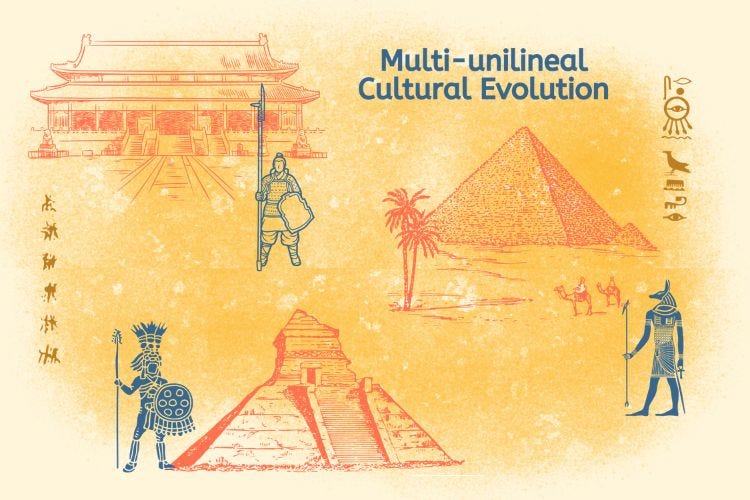
These are the patterns that essentially evolved almost the same way, yet slightly differently, in their local hues throughout the world.
Surprisingly enough, all our sociocultural institutions have majorly been erected by the mind and not through the dictates of the brain alone. The brain had worked independently when it devised wearing leather and burning fire to ward off cold and cook food. The same was true of inhabiting caves and inventing languages. And these were four supremely intelligent inventions that all tribes and races arrived at in differently similar ways globally.
But the sociocultural structures erected by the mind were unfortunately not so intelligent. They were flawed at best and harmful at worst in their design. And why it happened so was because the mind subjectively attached itself to its faulty apprehensions of threat to life, in other words to its self-preservative instincts. Hence, it cunningly took control of the brain’s activity in its fearful stupidity, thereby turning human needs into wants. All these structures were multi-unilenial in their evolutionary process.
Sociocultural Chakras
As I was building up my case against our sociocultural structures getting erected by the mind, an analogy dawned upon me
Maslow’s Hierarchy of Needs4
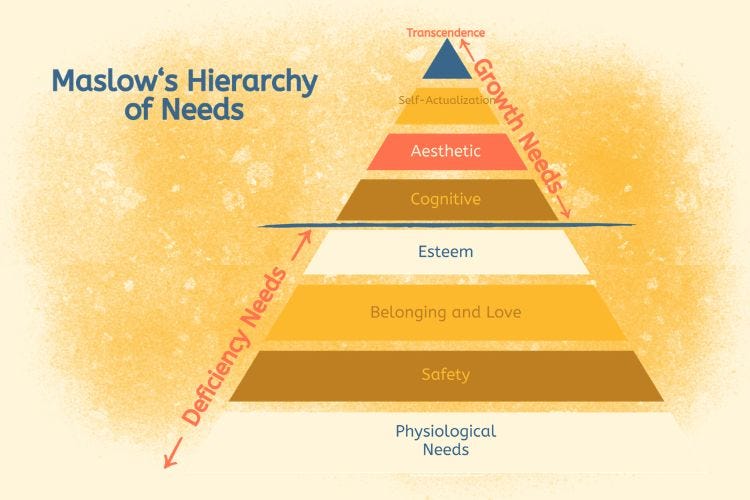
Before I come to the analogy, let us take a little detour. Abraham Maslow came up with ‘A Theory of Human Motivation’ in the year 1943. Later, he refined it in ‘Motivation and Personality’ in 1954 introducing Maslow’s Hierarchy of Needs.
Maslow’s Hierarchy of Needs comprises physiological needs, safety, love and belonging and esteem as deficiency needs, and cognition as a growth need. Growth needs further include aesthetic, self-actualization and transcendence needs.
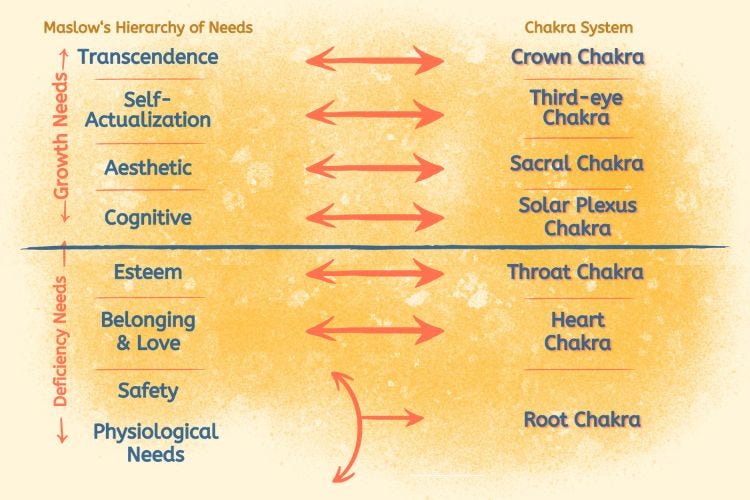
And now, let’s come back to my analogy. I find that the lowest two deficiency needs, namely “physiological needs” and “safety needs”, are parallel to the concerns of the root chakra within the chakra system. The third need from the bottom, “love and belonging”, parallels the heart chakra. The fourth deficiency need, “esteem”, is akin to the throat chakra. Moving to Maslow’s growth needs, “cognitive needs” parallel solar plexus chakra while “aesthetic”, “self-actualization” and “transcendence” needs find their chakra equivalents in sacral, third-eye and crown chakras, respectively.
Now that we have established that Maslow’s Hierarchy of Needs is analogous to the chakra system, I would like to bring our attention to a second analogy.
We know that an individual autonomous mind generates closed biological chakras in the human body by corrupting skeletal anatomy. I asked myself if a collective autonomous mind could have generated similarly closed sociocultural chakras in human society. The modus operandi could have been the corruption of social needs into societal wants
Things started getting distorted since the very beginning of our evolution into Homo sapiens. It all started with pursuing cognitive needs. We, as a society, cognized reality within what was a suffocating environment dotted with threats and challenges.
And that perceived reality continues till date.
Humanity is yet to take a sigh of relief, thereby seriously corrupting its breathing pattern.
It was this corruption that gave birth to a blocked sociocultural solar plexus chakra. Acting out of the mind’s fearful perception of so-called threats and challenges, humanity has always been in a hurry to control the environment which is a mirage in itself.
Just like the solar plexus charka leads to asthma and other diseases in the body, this sociocultural solar plexus chakra, i.e., hurry to control the environment, gives rise to social ‘diseases’ such as the ‘rat race’. And thus, humanity handed over the reins of cognition to its collective autonomous mind instead of a spontaneous collective brain.
We know that an open solar plexus chakra means renewing the brain continuously and thus energizing it cyclically. Unfortunately for us, since our sociocultural solar plexus chakra got closed, it left the collective autonomous mind stuck at its aggressive cognitive wants rather than needs.
These wants individualized personal ownership of resources used to fulfill genuine social needs before.
As this personal ownership of resources assumes a bigger-than-necessary stature, social needs start turning into personal wants. Needs are the realm of the brain while the mind is the abode of wants. Thus, they get corrupted and end up in sociocultural chakras in the hands of a collective autonomous mind. After all, human society is just a collective extension of multiple human bodies. And these sociocultural chakras would tend to block collective human energy flow exactly like biological chakras block individual energy flow.
Let us now combine the above two analogies, i.e. Maslow’s hierarchy of needs vis-a-vis chakra system + sociocultural chakras mirroring individual chakras
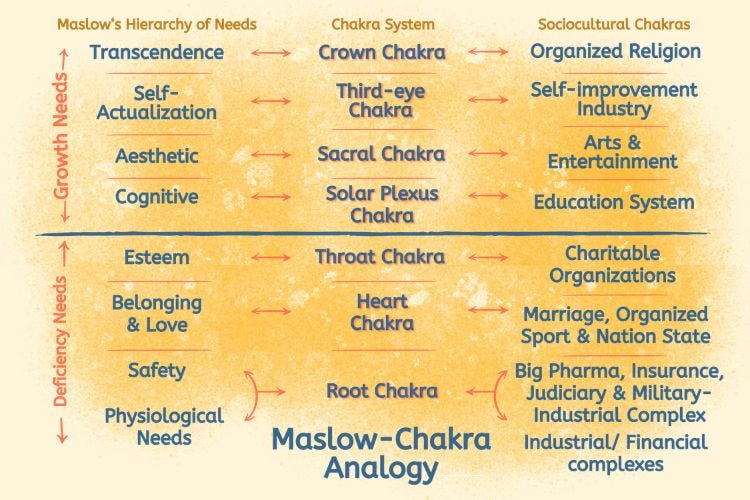
When individual energy flow gets blocked at the base of the chakra system, it results in a closed root chakra. Similarly, when the collective human energy flow gets blocked at the base of the chakra equivalent in Maslow’s Hierarchy of Needs, it does so at the lowest two levels of social needs, i.e., physiological and safety needs. Same would be true about the deficiency needs of love and belonging and esteem needs as well.
It is my contention that we, Homo sapiens, find ourselves today struggling with an imbalance in the mind-brain equilibrium as we go along Maslow’s Hierarchy of Needs from the lowest (physiological) deficiency needs to the highest (transcendence) growth needs. Individuals and societies that are stuck in making ends meet, i.e., meeting their physiological needs, tend to operate primarily from the brain.
As they ‘climb’ up the Hierarchy and their deficiency needs are met, a major shift seems to occur. This is where the mind starts taking over and the brain’s functionality starts getting stunted inflicting the lower chakras as well, along with the higher ones.
In other words, needs start yielding to wants. It is no surprise, then, that most of the growth needs are governed by the concerns of the mind way more than those of the brain.
Real Needs Overshadowed by Greedy Wants
This had its debilitating effect on the sociocultural equivalent of sacral chakra, namely aesthetic needs, as well. And it did so by negatively affecting the quality of sex that humanity was meant to enjoy. When sex gets frustrated, it tends to take refuge in its sublimation through arts in creative and aesthetic pursuits. This sublimation is the handiwork of none other than the mind!
In the process of sublimation, however, the mind does lose a little bit of its control as emotions give way to passion and sexual frustration yields to a broader creative perception. This works, but only partially, as a therapeutic process that addresses the aesthetic needs in Maslow’s Hierarchy of Needs at an individual level. In society, this partial therapy addresses this sociocultural sacral chakra in the form of cinema, poetry and other artistic expressions. However, the unaddressed part of this chakra results in the social disease that we know as ‘consumerism’. And we have even given it a rather ironic name, ‘retail therapy’. No wonder slogans like “the more, the better” appear to provide solace to our frustrations
Moving higher along the Hierarchy, the growth need of self actualization aims at discovering one’s inherent talents and developing them further. It results in achieving one’s full potential as far as socially productive soft skills are concerned. This is synonymous with the concerns of the third eye chakra. However, once corrupted by the mind at a social level, it leads to an analogous collective third eye charka resulting in social ‘diseases’ such as ‘professional qualifications’ as a want that is detached from the original need.
Transcendence needs are the ultimate that an individual in a society can cultivate, giving oneself to something beyond oneself. It enables one to create one’s personal heaven for oneself. At a social level, it parallels the sociocultural crown chakra which, when closed, leads to the social malaise of ‘acute insensitivity’. Consequently, opening this chakra sets the highest levels of collective human consciousness. Simultaneously, it sets all the lower chakras open as well, automatically addressing their related sociocultural ailments.
This has the potential to turn human life on earth into a collective heaven.
However, in reality, the collective mind fragments itself exactly like the individual biological mind and, thus, belittles every single real need in Maslow’s Hierarchy of Needs and, by extension, its analogous sociocultural chakra.
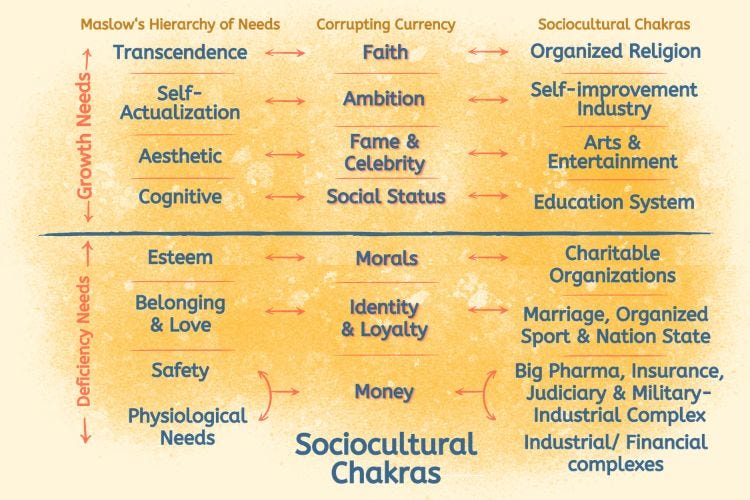
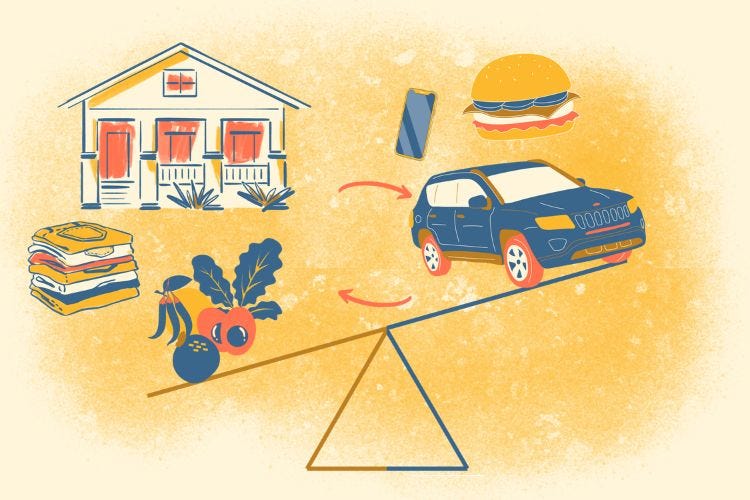
When it comes to our collective needs, human societies use various ‘currencies’ to enable exchange of these needs between their individuals or groups. It is these currencies that we used to fulfill real needs which later started assuming bigger stature in an individual mind, shifting the focus from needs to wants. As a result, those currencies got corrupted away from their original purpose and became ends in themselves as opposed to serving as mere means toward the ends which have always remained as those underlying needs
These corrupted currencies have led to several institutions in our societies that, I contend, are the physical manifestations of the underlying sociocultural chakras.
Within the construct that I have presented above, we can now look at sociocultural evolution in light of genuine needs getting usurped by the mere wants for their corrupted currencies.
Thanks for listening to this episode of Skeletal Leap: A Living Adventure! In the next episode, I will tell you about corruption in industrial complex, big pharma & insurance, military-industrial complex and politics-business nexus.
Be a part of Skeletal Leap Community! Subscribe to Skeletal Leap Newsletter. Click on the link in the description to subscribe.
🔗 Series Bridge:
This masterclass is a 19-week journey through my book, The Mind-Body Connection. If you missed the foundation, start here: The 16-Part Prequel: 14 Core Principles.
🔑 Unlock the Practical Plan:
To truly master the Skeletal Leap, you need the step-by-step memoir and the associated practice codes found in the book.
Get the Book: The “Resource Codes” for this chapter’s PDF practice plan are found in the Amazon Paperback Edition.
Join the Movement: Download the Free Prequel Ebook via StoryOrigin and join our community.

Subscribe: Follow SKELETAL LEAP: The Mind Body Connection on Substack for weekly deep-dives into the human potential archive.
You may also like…

______________________________________________________
References
Morgan, L. H. (1907). Ancient society, or researches in the lines of human progress from savagery, through barbarism, to civilization, by Lewis H. Morgan .. H. Holt.
White, L. A. (1959). The evolution of culture. Mcgraw-Hill.
Dawkins, R. (1976). In The selfish gene (pp. 15–15). essay, Oxford University Press. “At some point a particularly remarkable molecule was formed by accident. We will call it the Replicator. It may not necessarily have been the biggest or the most complex molecule around, but it had the extraordinary property of being able to create copies of itself.”
Maslow, A. H. (1973). The farther reaches of human nature. Penguin Books.