

SKELETAL LEAP: THE MIND BODY EVOLUTION SERIES
Wants vs Needs: Corruption of Growth Needs - Introduction
In 33rd episode of Skeletal Leap, I challenge the conventional wisdom surrounding education, self-improvement, and organized religion. I raise an intriguing question: is it merely coincidental that some of our most innovative talents emerge from the ranks of college dropouts?
This episode explains the systemic flaws of our education system, which often prioritizes rote learning and social status over genuine cognitive development and curiosity.
The episode begins by exploring how humanity has inadvertently surrendered its cognitive abilities to a collective autonomous mind. Instead of fostering a culture of exploration and insight, our education system has evolved into a factory-like model, producing graduates who are more like mechanical cogs than critical thinkers.
I emphasize that this regimentation not only stifles curiosity but also suppresses the innate talents that every child possesses.
As the conversation unfolds, I highlight the detrimental impact of ambition in the self-improvement industry, where the pursuit of perfection often overshadows the joy of the learning process. I argue that this shift in focus has led to a generation of individuals who pay lip service to the idea of excellence while chasing unattainable perfection.
The discussion also touches upon organized religion, which I critique for fragmenting the very essence of transcendence it aims to promote. I point out that the rise of multiple religions has often resulted in conflict rather than unity, demonstrating how moral fragmentation can lead to societal discord.
I encourage you to reflect on these themes and consider how our socio-cultural systems might evolve to better nurture human potential.
I conclude with a thought-provoking proposition: as we begin to open our biological chakras, the outdated institutions that no longer serve us may naturally dissolve, paving the way for a more enlightened society.
If you’re ready to challenge your perspectives and explore the intersections of education, self-improvement, and spirituality, tune into this compelling episode of Skeletal Leap. It’s time to embark on a journey toward a collective heaven on Earth.
In this episode, I explore the following:
The impact of social status on education and its implications for cognitive growth.
How ambition has transformed the self-improvement industry into a pursuit of perfection.
The fragmentation of organized religion and its consequences for societal unity.
🔑 Key Takeaways:
(00:00:01) - Education System
(00:11:51) - What is Religion
(00:15:04) - Questions of Science vs Religion
(00:22:57) - Ideas of Religions
🎙️ Listen to the Journey:
📽️ Watch the Masterclass:
Wants vs Needs: Corruption of Growth Needs - Transcript
“Is it just random that the best talent humanity is benefiting from comes mostly from the echelons of college dropouts?”
My name is Laadi Ojas. Welcome to “Skeletal Leap: A Living Adventure”. Skeletal Leap transforms one’s life into a personal heaven.
Today’s episode will tell you about corruption in education system, self-improvement industry and organized religion.
In Episode 29, we saw how humanity handed over the reins of cognition to its collective autonomous mind instead of a spontaneous collective brain. Thus our very cognition was the first casualty.
Therefore, when we started pursuing our collective growth needs, all of which are based on our cognition, we were already operating from a closed sociocultural solar plexus chakra and a host of other closed chakras due to corrupted pursuits of our deficiency needs.
It is no surprise that we ended up with more corrupted institutions that claim to fulfill our cognitive, self-actualization and transcendence needs.
Our education system falls under sociocultural solar plexus chakra that aims to fulfill cognitive needs by renewing the brain continuously and energizing it cyclically. However, the currency it uses is ‘social status’ such as qualifications and specializations that fall in the domain of the mind rather than brain, thus closing the sociocultural solar plexus chakra. Qualifications and specializations turned more important than fulfilling cognitive needs in an insightful manner.
Thus, the noble pursuit of educating the new generation with insight turned into regimented knowledge replicators. Today, it has reduced itself to transforming new generations into efficient mechanical cogs in the ever-rotating wheel of unending production. It all happened using the currency of ‘social status’. This directly led to the social disease of elitism that looks down upon the masses and is akin to closing our sociocultural solar plexus chakra.
Sociocultural Systems for Cognitive Needs: Education System
Homo sapiens had always had the onus of educating their young ones to the level of knowledge that the former generation had reached up to
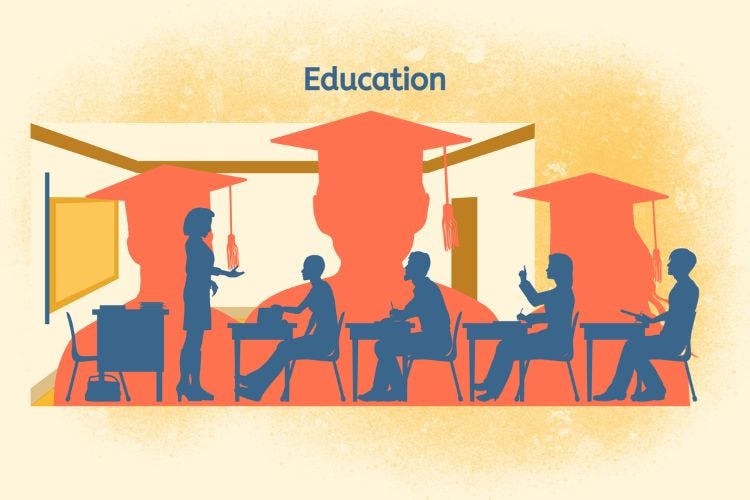
With Homo sapiens as opposed to with any other species, it has always been necessary to do so.
And with the passage of time through their evolution, our species has been experimenting with various ways to do it most effectively ever since our brain size started enhancing.
As far as we have reached up to this point of time, the education system has become one of the most important social institutions in modern human life.
I always had my reservations about the education system that we were being subjected to. It had dawned upon me as soon as I first set foot inside a school more than 60 years ago. The way this system works is like a machine churning out manufactured goods on an assembly line. The only difference is that it manufactures graduates in various disciplines of learning.
The onus of educating the new generation is on the shoulders of the immediately older one. That is how the new generation starts its journey of growing and developing knowledge. And that is how knowledge grows further from the point that the older generation has brought it to.
Education System for Junior Classes
The knowledge that humanity has gathered and developed up to this point of time is vast. It is so vast that no single individual can ingest it all in its totality. We can, at best, have a bird’s eye view of its entire repertoire and call it our general knowledge. That is what we are taught up to our high school or higher secondary classes.
General knowledge doesn’t make us a master in any of its disciplines.
And, unless we master a discipline in its entirety, we can neither practice it properly nor develop it further.
Education System for Senior Classes
So, after our high school or higher secondary education, we need to choose any one of these endless number of disciplines to specialize in. Then, we need to study it as wide and as deep as we can or wish to.
Ability to wisely choose what we effectively can and wish to study in detail depends on our aptitude. It doesn’t merely depend on what we studied in our junior classes but on how we studied them.
And this is where our education system fails us miserably. It doesn’t nurture talent well. It rather suppresses it to a detrimental level.
Pitfalls in Our Primary Education
The moment we are made to start our education, we are subjected to a complicated array of academic regimentation. We are taught mechanically without any real insight into the subject on the part of the teacher. They teach academics to the naive minds that have naturally been designed to exploring what their elders have in store for them.
Unfortunately, we are discouraged to explore. We are rather expected to conform to the authority by simply practicing the tools of knowledge. These tools are like written symbols of spoken language and mechanically taught procedures of mathematical operations.
In addition, we are expected to learn uninteresting academic details of scientific and social achievements of mankind. We do it to the satisfaction of the examining authorities who assess us. They grade us based on how much of this nonsense we were able to vomit out in tests.
Curiosity Gets Killed
We start hating academics and try to avoid it as much as we can. Our curiosity gets killed in this mechanical process of learning. As curiosity gets killed, we cannot discover our talents. They rather get suppressed deep inside us never to show up again.
Every single child who takes birth on earth brings at least one talent that s/he can develop to master. But that is only in case s/he is able to discover it in the very first place. The best talent we are born with is our aptitude for a specific discipline of knowledge.
Humanity Loses An Opportunity
We are rarely able to discover our talents and therefore don’t pursue them in the later years of our education. We rather pursue another discipline for some other reason. We will never excel in it as much as we would if we had discovered and pursued our inborn talent.
As it happens, humanity loses another great opportunity to benefit from another great talent. It is tragic that it loses a talent in a discipline that never got discovered and was lost in the oblivion.
Is it just random that the best talent humanity is benefiting from comes mostly from the echelons of college dropouts?
Sociocultural Systems for Self-Actualization Needs: Self-Improvement Industry
Soft skill development falls under sociocultural third eye chakra which strives to lead to self actualization in the society. The currency it uses is ‘ambition’. Ambitions spring out of the mind alone. Our brains want us to pledge and commit but our ambitious minds come in the way.
When ‘ambition’ became more important than fulfilling self-actualization needs, it defeated the whole purpose of self-actualization which is to let passion and joy flourish within us. Achieving goals became more important than the joy of the process that could take one there.
It is no wonder, then, that ends started justifying the means, thereby rendering the sociocultural third-eye chakra firmly shut. The self-improvement industry was born right out of this chakra.
Self-actualization needs were originally meant to be fulfilled via soft skill development as a personal concern of an individual. It enabled passion and joy to flourish, driven by curiosity to extend and expand hard skills learnt in the education system. Such passion and joy has the power to drive one toward achieving excellence in their self-actualization pursuits. However, slowly and gradually, the currency, namely ‘ambition’, itself became more important than passion and joy.
This gave rise to an entirely new industry that we now know as the ‘self-improvement’ industry which commercialized self-actualization. Consequently, excellence got replaced by perfection. Self-actualization needs got usurped by the currency of ambition. Excellence is a perennial process that never stops, it is rather a way of life. On the other hand, perfection is an end in itself which has no further prospects to improve.
This ended up closing the sociocultural third eye chakra generating an army of ambitious humans paying lip-service to idea of excellence while chasing perfection all along.
Sociocultural Systems for Transcendence Needs: Organized Religion
Organized religion falls under sociocultural crown chakra looking forward to transcendence in society. The currency it uses for the purpose is ‘faith’
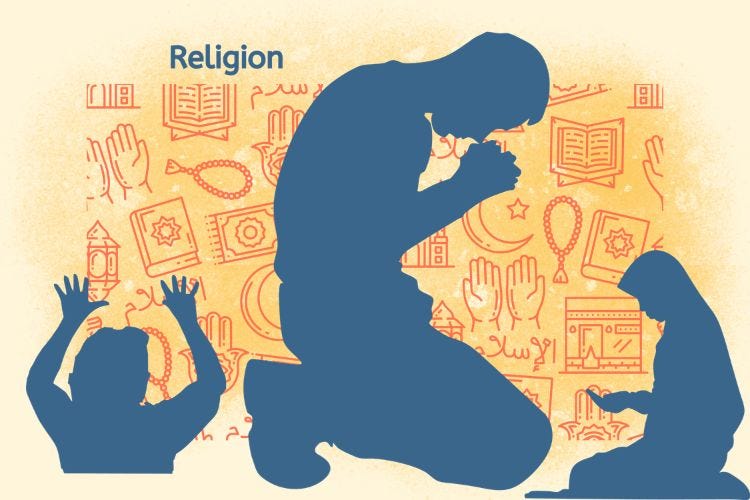
Unfortunately, this currency has corrupted the genuine need for transcendence resulting in multiple religions, almost all of them at daggers drawn between them. The highly revered rituals of ‘faith’ became more important than the ultimate needs of transcendence that they were meant to serve as a currency.
Religion started with the expression of awe for natural order and a recognition of the growth needs of transcendence in society. But it soon fragmented itself into organized religions which ultimately devolved into contending systems of belief, blind faith and fanatic moralistic reverence.
Religion as an entity started with an expression of awe over the miraculous events happening around a recently evolved brain. But as early Homo sapiens could not find any rationale for the same, they took an easy way out. They constituted a new element of faith in the supernatural which all religions share with one another till date.
During both the hunting-gathering and, later, the agricultural eras, the following traits1 of religiosity prevailed:
Animism | Belief in an afterlife | Shamanism | Ancestor worship | High gods who created human life | High gods who are active in human affairs
Animism amounts to attributing intent and lifelike qualities to inanimate objects. This might have caused a belief in supernatural aspects of unexplained natural facts seen around.
The seed of animism could easily spill over to a belief in an afterlife, shamanism and ancestral worship. Later when hunter-gatherer communities turned into agricultural communities, social hierarchies started coming into existence.
Thus, the egalitarian pattern of the hunting-gathering era gave way to a paradigm of ‘rulers versus the ruled’. High gods must have been in tune with the newly emerging experiences.
Consequently, a belief in high gods having created humans and then actively controlling their affairs might have been formed. As a result, the king started getting considered to be a representative of these high gods in controlling his subjects’ lives.
Today two-third2 of human population identifies with one religion or another. But the geographical distribution of this percentage is in a state of flux presently and in future projections.
For example, at present China is going through a phase of religious revival. Protestant Christianity is growing at an annual rate of 10% there. It has already crossed the 100 million mark. It is projected that it will become the world’s largest Christian population by the year 2030.
In contrast, the number of believers is sharply going down in Western Europe. In Scotland, 59% of its population has gone non-religious openly, with 66% being women and 55% men.
This might be a result of people’s exposure to a scientific outlook and a rational world view in developed countries. Science and religion have always gone along two opposite tangents. Both claim to establish the truth but there is a huge difference in their approaches.
While science is only one single body all over the world, there are more than 1000 religions, many of them making claims contradictory to one another. Also, science has always proved what it says is true either logically or statistically whereas religion hasn’t been able to prove even one of its own claims.
The Story of My First Interview for My First Job after Graduation
I remember an amusing story from my life when I had just secured my graduation in electronics engineering. I applied for a government job in Defense Research Development Organization as a scientific officer in one of its laboratories. After a few days, I received an interview call from Union Public Service Commission. I headed to its venue to face the interview on the scheduled date.
As I reached the venue of the interview, I saw hundreds of candidates waiting to be interviewed for the same post. It was only one single vacancy and there were so many candidates vying for it, it being a premium position. Seeing such a huge crowd, I immediately made up my mind for psychologically getting ready to be rejected.
Mathematically speaking, I had only 0.5% chance of getting selected. And the interview board had to complete all the interviews in one single day. Hence everyone was being given around 2.5 minutes to prove their worth for the post.
After a long wait, came my turn. I entered the interview hall. There was a board of four interviewers headed by the chairman sitting on the other side of a huge table. I greeted them and the chairman offered me a seat on the lone chair kept in front of their table. I was ready to answer any questions they would ask me for the next 2.5 minutes.
My application form was lying in front of the chairman who looked perplexed as he pored over it. I waited quietly to meet his first question with the best technically correct answer I could muster.
After a long eerie silence, came the chairman’s first question in the form of a blame. He really attacked me, saying, “What have you written here in your form under the “religion” column? You have written “N.A.”. What do you mean by that?”
I was amused. I said, “Sir, N.A. means not applicable.”
He got offended, “Well, I know what N.A. means. What I am asking is how it’s possible that it’s not applicable.”
I coolly said, “It’s because I don’t have any.”
“Any what?” he was getting impatient as well as irritated with me.
“Religion! I don’t have any religion.”
“But how’s that possible?” he wasn’t able to believe what I was saying.
“It’s possible, sir. You can see one in front of you sitting here,” I smiled.
“Don’t your parents have a religion?” came the next question from him. The other three members were absolutely quiet.
“They do,” I said.
“Then by default you have inherited it from them,” he tried to make me understand.
“I don’t think religion is an inheritable entity. One needs to develop one’s own faith to follow a certain religion,” I said.
He further got more perplexed, “And do you say you haven’t developed your faith yet?”
“Yes, I couldn’t,” I said, “and I don’t think we should develop any faith ever.”
He wasn’t able to believe what I was saying. He almost shrieked, “What are you talking? Are you a negative personality?”
I didn’t lose my cool, “No sir, I am an agnostic personality.”
“Do you mean atheist?” the inflection in his voice suggested scorn.
I still kept my cool, “I am an agnostic.”
“What does that mean?” looked like he wasn’t much familiar with the deep meaning of this particular word.
I tried to tell him the differences between, theism, atheism and agnosticism. But he didn’t look convinced.
We kept discussing on this same topic for 15 long minutes when, suddenly, he realized he was under pressure of time. He immediately said, “Let’s have the technical interview now.”
He wasn’t looking very pleased with the direction that our discussion had taken exposing his intolerance. Under the influence of his value system, he might have pre-assessed my technical knowledge to be pathetic. Hence, to show me down, he might have thought of mocking me. He asked me the easiest question on the topic at hand to check if I knew at least that much or not.
“Can you even draw an adder circuit?” he was smiling conspiringly.
“No sir, I don’t remember it right at the moment,” I said.
His smile went wider, “You don’t even know how to draw an adder circuit?” his tone oozed with condescension.
“No sir, I do know how but not off-hand because I don’t keep my mind burdened with information alone,” I explained.
“What’ll you do if you need to draw it during your work?” he challenged me once again.
“I will deduce it then and there,” I offered the immediate solution.
“And how much time will you take deducing it?” he was trying to show that it wasn’t a feasible solution.
“Say, 20 seconds,” I threw his challenge back to him.
“Here is your paper and here is your pen. Your time starts now!” he started looking at his watch as he said this.
I was on my job without losing any time. And when I gave back my paper in just 15 seconds with deduction and drawing, he could not believe his eyes.
“Did you really deduce it right now or are you just trying to impress us?” he asked, doubting my intentions.
“I don’t think I need to impress you, sir,” by this time I had become fed up of his senile behavior.
“Okay, that’s it. You can go now,” he said in a curt voice.
As I was going back, I heard him saying in a sorry tone, “God bless you!”
It was as if he was seeking His pardon on my behalf. While walking out of the interview hall, I checked the time and realized that I had been in there for full 18 minutes.
And none of the other three members of the interview board had asked me a single question during all that time.
I gave up all hopes of getting selected and started applying elsewhere. But, to my utter astonishment, one day I received a letter informing me that I had been selected. I could not believe that such an antagonistic interview would ever end up in my selection for such a coveted position.
Anyway, I joined the job and discovered that the chairman of that interview panel was a deputy director in the laboratory and its second in-charge. He didn’t look happy to see me there and never talked to me cordially.
By the way, there was another deputy director in the laboratory who was third in-charge of it. He somehow took a liking for me. He would often call me to his office after lunch to have a cup of coffee or tea together. Though I was way younger and even way junior to him yet for some reason, he became fond of our informal chats.
One day, while we were chatting, he suddenly asked me, “Do you know how you were selected for your job?”
“No!” I said, “Even I was surprised when I got the selection letter. There were hundreds of candidates in the interview, many of them being quite experienced as well. I really wonder how it happened.”
“You scored the highest points in the board members’ assessment!” he smiled.
“But the chairman had sounded quite annoyed with me in the interview,” I put forth my point of doubt.
“That’s why he gave you a score of zero out of a maximum of fifty that he could give,” I saw a smirk on his face
“Then?” I was really confused now, “ How was it possible for me to get selected in that case?”
“You got the highest 150 marks out of 200. And it was because the other three members scored you at the maximum of fifty each.”
And he burst into a loud laughter as did I along with him.
This experience had shown me the level of orthodoxy that believers in religion could go up to!
Religious minds are driven by morality that is based on differentiating between ‘good’ and ‘bad’. Empty minds are driven by curiosity and creativity leading to a beautiful life that is filled with passion and joy.
To add to this, unluckily religion didn’t go along sociocultural evolution as a common, homogenous entity, unlike business and education. It may have been so in the very beginning of this process of splitting the mind into fragments that eventually ended up at odds with one another. It was initiated by the generation of a moral fragment in the mind.
But then this moral fragmentation went a step further by fragmenting the fragments as religion slowly changed from a homogenous single entity to several diverse religions. Religions comprised multiple entities as sub-fragments of multiple-morals within a broad moral fragment. Christian morals were different from Muslim morals as both of them were further different from Hindu morals and so on.
Morals always assume a dominating tendency within the mind unlike instincts. They are aggressive simply because they want to spread their message even at the cost of suppressing and repressing instincts.
But with the multiplicity of sub-fragmented morals, the fragmented and then indoctrinated mind sides with one of them and decides to suppress the rest. The Christian sub-fragment tries to suppress the Muslim, Hindu, Buddhist and other morals, for example. And this suppression then moves outward from the mind to the outside physical world. That is what culminates into all kinds of religious wars and conflicts on the planet from time to time.
And ironically, it doesn’t even stop there. There are further sub-sub-fragments that get generated within sub-fragments as well. Shia-Sunni, Protestants-Catholics, Kshatriya-Shudra et cetera are examples of such sub-sub-fragments. These follow the same pattern of trying to uphold the ones that the mind sides with and suppress the rest in the outside world. It further gives rise to newer intra-religious wars and conflicts in the world, like in Ireland or the Iran-Iraq wars.
All along our sociocultural evolution, our minds have gotten more and more complex. A complex mind gives birth to the perception of a similarly complex world. The result has been all kinds of religious wars and communal conflicts killing innumerable people on the planet.
It is only Homo sapiens who kill the members of their own species in such an organized way!
Don’t we need to stop this nonsense now?
What will happen to all these compromised sociocultural systems and/ or institutions in a society which starts moving toward filling the holes of Homo sapiens bipedal evolution?
It is my contention that the said sociocultural systems/ institutions will dissolve automatically in much the same way as opening the biological chakras ends up dissolving them in individual biological systems.
How would this dissolution come into manifestation?
Let us now peep inside for a few glimpses of how new social systems could heal themselves in a society energized by Skeletal Leap.
Thanks for listening to this episode of Skeletal Leap: A Living Adventure! In the next episode, I will tell you about manifesting a collective heaven on earth.
Be a part of Skeletal Leap Community! Subscribe to Skeletal Leap Newsletter. Click on the link in the description to subscribe.
🔗 Series Bridge:
This masterclass is a 19-week journey through my book, The Mind-Body Connection. If you missed the foundation, start here: The 16-Part Prequel: 14 Core Principles.
🔑 Unlock the Practical Plan:
To truly master the Skeletal Leap, you need the step-by-step memoir and the associated practice codes found in the book.
Get the Book: The “Resource Codes” for this chapter’s PDF practice plan are found in the Amazon Paperback Edition.
Join the Movement: Download the Free Prequel Ebook via StoryOrigin and join our community.
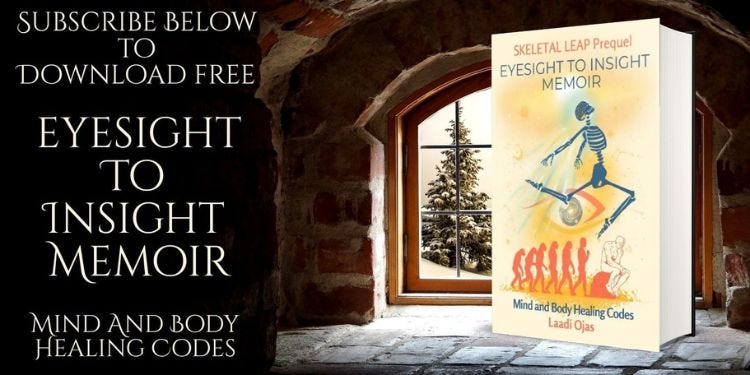
Subscribe: Follow SKELETAL LEAP: The Mind Body Connection on Substack for weekly deep-dives into the human potential archive.
You may also like…

______________________________________________________
References
Saroglou, Vassilis (2002). “Religion and the five-factors of personality: A meta-analytic review”. Personality and Individual Differences. 32: 15–25. doi:10.1016/S0191-8869(00)00233-6
Gallup Poll. (2015, June 8). Losing our religion? Two thirds of people still claim to be religious. Gallup International. https://www.gallup-international.bg/en/33531/losing-our-religion-two-thirds-of-people-still-claim-to-be-religious/