

SKELETAL LEAP: THE MIND BODY EVOLUTION SERIES
Introduction:
In a world increasingly driven by the pursuit of wealth and resources, this 30th episode of Skeletal Leap poses critical questions about our societal structures and their impact on our lives.
I invite you to engage in a thought experiment inspired by the great Albert Einstein, challenging our perceptions of needs versus wants.
The episode deals with the concept of the socio-cultural root chakra, which I argue has been corrupted by the relentless pursuit of personal ownership and material wealth
I highlight the alarming reality that 80% of the world’s wealth is controlled by just 20% of the population, raising concerns about the ethical implications of such inequality.
I suggest that our collective focus on money and ownership has led to a fragmented society, where genuine physiological and safety needs are often overlooked.
Throughout the discussion, I draw parallels between various societal institutions, including the military industrial complex, big pharma, and the politics-business nexus.
I argue that these entities prioritize profit over people, perpetuating a cycle of corruption that hinders true progress and well-being.
The episode emphasizes the importance of holistic healing and the need to address root causes rather than merely treating symptoms, a concept that resonates deeply in today’s fast-paced, outcome-driven world.
You are encouraged to reflect on your own lives and consider whether you are living as slaves to your minds, driven by fear and greed, or if you can embrace a more aesthetic approach to existence.
I conclude by asserting that true freedom comes from within, urging you to empty your mind and reconnect with your innate sense of purpose and passion.
This episode is not just a critique of modern society; it’s a call to action for you to reclaim your lives from the grips of corruption and rediscover what it means to live authentically.
Join me on this enlightening journey and explore the profound implications of our socio-cultural structures.
Tune in to Skeletal Leap and take the first step toward a more liberated existence.
🔑 Key Takeaways:
(00:00:01) - What is the Corruption in our Social Systems?
(00:09:39) - Living A Comfortable Life
(00:14:13) - Power of Business-Politics Nexus
(00:18:37) - Socio-cultural Root Chakra
(00:20:31) - What makes us prone to falling in the trap of an unhealthy life?
(00:25:03) - Health of Modern People vs Holistic Healing
(00:31:47) - Healthcare and the Military
(00:42:05) - Art and Entertainment: Aesthetic Needs
(00:44:14) - Skeletal Leap: Corruption in Marriage
🎙️ Listen to the Journey:
📽️ Watch the Masterclass:
Transcript:
“Let us do a thought experiment (one of the most favorite tools of one Dr. Albert Einstein). Think of yourself as an idealist for a moment.”
My name is Laadi Ojas. Welcome to “Skeletal Leap: A Living Adventure”. Skeletal Leap transforms one’s life into a personal heaven.
Today’s episode will tell you about corruption in industrial complex, big pharma & insurance, military-industrial complex and politics-business nexus.
The first casualty, as was the case with our biology, was the sociocultural root chakra.
As it stands today, closed sociocultural chakras have blocked the human energy right at the lowest level of Maslow’s Hierarchy of Needs, namely physiological and safety needs.
As explained above, the root of the problem lies in faulty cognition of reality whereby societal wants function as proxies for social needs.
Personal ownership of resources became more important than the physiological or aesthetic needs it fulfilled. Thus, money, as a means to personal ownership of resources, became a currency for the exchange of the goods and services that fulfilled these needs. Sociocultural institutions belonging to the sociocultural root chakra include the most sought after core of society at present. Physiological needs comprise the biological component of human survival guaranteeing homeostasis to the human body.
These are provided by the social systems such as industrial complexes for jobs and financial complexes to enable and manage transactions using ‘personal ownership’ of resources as its main currency.
However, this currency turned into a source of widespread corruption.
Pursuit of Genuine Physiological Needs Instead of Its Corrupted Currency, Personal Ownership of Resources (Money)
Let us do a thought experiment (one of the most favorite tools of one Dr. Albert Einstein). Think of yourself as an idealist for a moment.
What if you tell me that I will get whatever I need whenever I need as much I need unconditionally?
Imagine what would my reaction be.
If I am fearful, controlled by my mind, I could easily turn greedy. I may say, “Just change the word need with the word want and I am okay.”
Needs are physical phenomena whereas wants are psychological in their basic etymology.
What decides what I need and what decides what I want?
Aren’t these two entities the calls given by the brain and the mind respectively?
Back to the thought experiment…had I not been corrupted by my mind, I would have been the happiest man on earth to have been offered this proposal by you! I would have immediately accepted your proposal and asked you what I need to do for that.
However, let’s continue with the version of me that IS being driven by fear.
You say, “Throw the yoke of all your possessions off your shoulders and just be a free man.”
I may not believe you for a moment and retort, “Why? Do YOU want to take away all my possessions?”
“I don’t need to…,” you smile. “I don’t need to want,” you repeat.
“Won’t you like ruling the world? Don’t you want that?” I sound stupid to my own self as I ask.
“Why would I?” you give a carefree look, “Uneasy lies the head that wears a crown!”
“But what would I do if I get what I need without doing anything for getting it?” I am intrigued.
“Decide it for yourself if you really feel like doing something,” you are still smiling.
“It would turn me crazy,” I retort.
“That you already are,” you show me the mirror, “A slave to your mind!”
“By the same token, aren’t you a slave to your brain too?” I challenge.
“My brain is my friend. Your mind is your boss. It keeps you scared with a threat of starving in case you don’t earn the right to live,” you sound cool.
“And your brain?” I ask again.
“It doesn’t think of future. It lets me do what I feel like doing right now,” you reveal.
“YOU do what you feel like doing. What would I do, I don’t know,” I nervously say.
“Enable me to enable my guarantee that I just gave you!” you start laughing.
I get taken aback for a moment. Then I start laughing along.
That ends our thought experiment. It tells us idealism is not as impossible as it is presented to be.
The entire question swings between two different approaches to life, ‘to have’ or ‘to be’.
Do we have a gene within us that would answer this question? If it says the fittest survives, doesn’t our thought experiment hint toward that possibility even when threatened by human-induced climate change?
Cavemen never felt they ever required any private property.
If it were in our genes, we would have started going along that track right then and there. If we did it later, something new must have conspired to do so.
I hypothesize, it was simply our mind gone greedy, trying to save itself from starving to death in future.
We had evolved to grow our own food on the fertile land.
But we hadn’t evolved to own the land primarily and go on expanding its perimeter to the last days of our lives.
Doing so through putting the yoke of all its stressful burdens on our shoulders took its toll on our health. No other species in the entire animal world ever does that. And if we got a brain, did we get it for wasting it on such petty concerns?
We certainly went wrong somewhere when we shifted from hunting-gathering to agriculture and personal ownership of resources. We thought it would give us freedom but what it gave us was slavery and disease alone. The more personal resource ownership we amassed, the more it impoverished us in other ways.
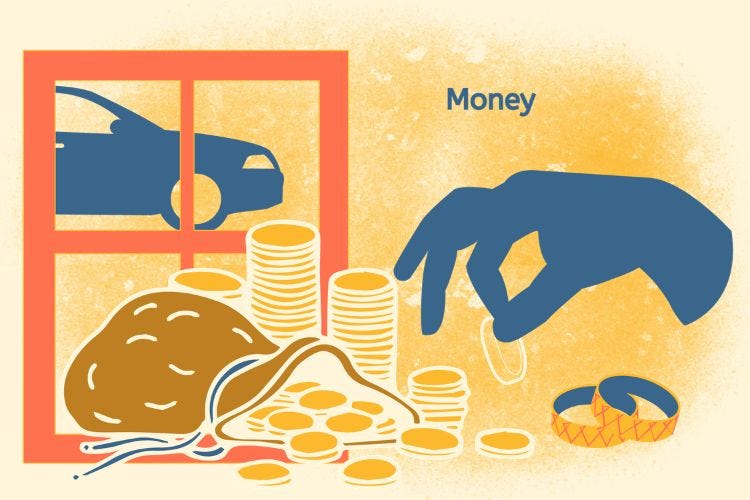
Have we ever thought how much energy we waste just in the petty pursuit of staying alive and comfortable? In fact, to secure our comfortable living in the future, we ‘want’ to amass resources that are many times more than we would ever really need. Doesn’t this amount to stealing from others who could have used those resources to live a comfortable life? But unluckily 80% of the human wealth lies under the control of 20% of the human population. The rest 80% live a life of have nots. And majority of these 20% people has acquired the 80% of the human wealth through unethical if not illegal means.
Here are two quotes of this Pareto’s principle of 20-80 distribution…
“Pareto’s observation was in connection with population and wealth. Pareto noticed that approximately 80% of Italy’s land was owned by 20% of the population. He then carried out surveys on a variety of other countries and found to his surprise that a similar distribution applied.”
Courtesy Wikipedia 2022
“A chart that gave the effect a very visible and comprehensible form, the so-called “champagne glass” effect, was contained in the 1992 United Nations Development Program Report, which showed that distribution of global income is very uneven, with the richest 20% of the world’s population receiving 82.7% of the world’s income.”
Courtesy Wikipedia 2022
If we don’t have sufficient ownership of resources in order to live a comfortable life, we will keep dreaming of it all the time. If we have way more resources than needed, it keeps us too busy not to lose them and, therefore, to grow them further.
Why?
It is because nothing is sufficient for human greed which is driven by the human fear of losing everything one has. In both cases, we are not living a life full of freedom. We are doomed to remain slaves to the same wicked design that we ourselves created as our sociocultural structure.
It not only robs us personally of our joy of living a free life but also socially of the countless geniuses hidden in broad daylight amidst us. This is because they never become free to exhibit their talents while they are busy dreaming of and toiling for the ownership of a bigger chunk of resources.
Slaves never enjoy. They don’t enjoy because they are not free. Slave holders never enjoy either. They don’t enjoy because they are busy keeping slaves as slaves forever. Hence their slaves don’t let them be free.
They become the slaves of their slaves. I still remember a couplet that I had read in my early childhood:
Leave your birthplace
And roam around the world,
Refusing either to be a slave
Or a slave holder.
I wouldn’t be surprised if you are asking as you read this, “Who decides what is comfortable?”. Well, it is my contention that ‘Skeletally Leapt” humans, operating primarily from their brains, would answer that question organically and would arrive at similar, if not the same, answers as a society.
Therefore, we don’t really need to take any direct corrective action in order to resolve this dilemma. We just need to empty our mind via Skeletal Leap to regain our health. And leave it to our brain to take the right spontaneous decisions.
What constitutes a comfortable life would be as obvious to them the same way that existence of matter is self-evident to science and that of life is self-evident to each one of us.
Sociocultural Root Chakra: Industrial Complex
The first 6000 years after the transition from the mode of hunting-gathering to that of agriculture and cattle-rearing resulted in two strong social institutions: business and the state. Business was in the rudimentary form of loosely organized crafts, trades and services while the state gradually evolved into aggressive empires that constantly fought with one another and extended their control over further chunks of lands and populations.
Everything remained in flux for a very long period of around the next 6,000 years. Empires kept changing hands by new power centers forcing businesses to keep changing their currencies.
Much later, after the Industrial Revolution in Europe took place in the eighteenth century, businesses were able to revolutionize their speed of production. Their sizes started getting bigger and bigger needing bigger markets for their products and more raw materials for their production.
This started an era of certain European nations colonizing far-flung countries in Asia, Africa and South America mainly for the resources that lay untapped therein. The ones that missed the bus then tried to compensate later by waging the two World Wars that they eventually lost. Still, these two wars left the imperial powers’ control on their colonies severely depleted. They were forced to move out, limiting them back to their own homelands.
Since the world came out of the trend of nations attacking others to extend their boundaries and control, political control has given way to business control all over the world. The power of big business has assumed the size of financial empires, bestowing them with real powers to manipulate governments.
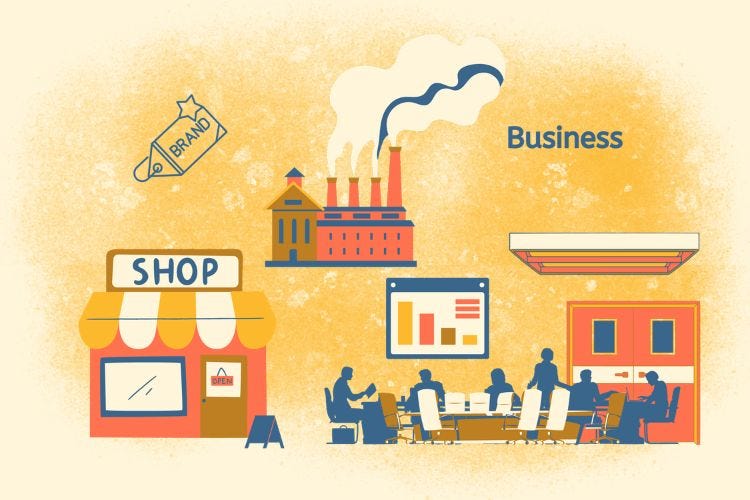
Business morphed into a profit generating machine more than a responsible facilitator of comforts and innovations. Politics-business nexus began centralizing unprecedented powers to control almost every single aspect of people’s lives.
As of today, business as an entity has started controlling every single aspect of our life on earth.
Sociocultural Root Chakra: Politics-Business Nexus
Power got concentrated in the hands of the cunning and the corrupt. And they took extra care to ensure that it never slipped off their hands.
All the instruments of the state that existed in the name of serving the masses actually started being co-opted by secret agenda. These agenda took care that the cunning and the corrupt were able to maintain their control over people’s lives and prosperity.
Countries were never a part of the package that we received as we evolved into a thinking species on earth.
What was offered to us was an unnamed vast expanse of land to live and move around on.
This nexus between the state and the business threatens the very welfare of humanity.
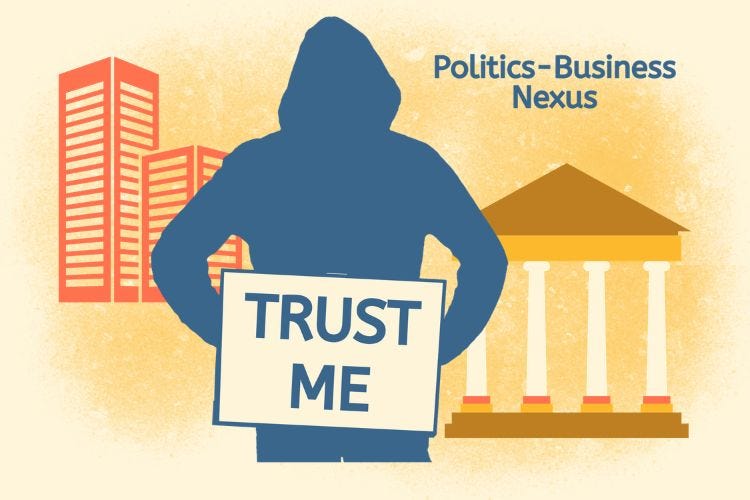
Business, as an entity, has grown so powerful that it can even make or break political structures anywhere. Both of them have their respective vested interests which generally don’t align with the genuine interests of the very populace that they each claim to ‘serve’.
Human-induced climate change is a direct outcome of this misalignment.
During the COP261, the yearly UN climate summit held in Glasgow in 2021, the well-known climate activist Greta Thunberg2 protested in Glasgow, saying COP26 wasn’t leading us anywhere. Only pledges and commitments aren’t going to stop temperature from rising beyond 1.5C. We do need to implement them under a strict regimen holding all parties accountable to their commitments.
COP27 was held in Sharm El Sheikh, Egypt, from 6 November until 20 November 2022. Its credibility was dealt a serious blow by the absence of big powers, Russia and China.
COP28, held from 30 November to 13 December 2023 at Expo City, Dubai, United Arab Emirates received widespread criticism as it lacked a clear-cut time-based commitment to either fossil fuel phase-out or phase-down. China and India did not even sign the pledge to triple their output of renewable energy by the year 2030 and committed to coal power instead.
COP29 held from 11 November to 22 November 2024 in Baku, Ajerbaijan couldn’t break any new ground too, limiting itself to lip service alone.
Who will ensure that the targets of these summits are met before it is too late?
Unluckily, here again, the national ambitions of the politics-business nexus are coming in the way of its success. The point of no return is very close and, when it arrives, it will be no less than Nero playing the fiddle while Rome was burning!
This, though, is only half the story of the sociocultural root chakra.
The other half of the sociocultural root chakra got closed by the corruption of our safety needs through the ‘currency’ we know as ‘public welfare’. Safety needs comprise healthcare along with security. These are provided by healthcare facilities, judiciary for providing justice, army and warfare for defense and governments for making policies.
Sociocultural Root Chakra: Big Pharma & Health Insurance
Healthcare has, of course, helped the masses in a great way but only to manage ailing conditions, not curing them permanently. It definitely did its bit in surgical interventions excellently but then fell short of energizing society cyclically.
As far as judicial systems are concerned, they do their job only up to the point where the political system at the helm of power doesn’t get challenged.
After that point is reached, politics-judiciary nexus immediately gets created by those in political power at the moment in a covert dictatorial way. We have seen it happening in more than one countries in the recent past.
Similarly, public welfare got diminished by sloganeering that takes center stage rather than fulfilling safety needs in reality. Armies have always remained an instrument of offense rather than genuine defense for safety. Warfare has been a way of life along the passage of history.
What essentially is it that makes us prone to falling in the trap of an unhealthy life?
An Unhealthy Fragmented Mind:
As already described in Episode 26 in detail, a fragmented mind is an unhealthy mind.
Okay, but what exactly do we mean by the fragmentation of mind?
Well, fragmentation simply means divided in two or more parts rather than being one single entity as a whole.
When it comes to an undivided mind, it means a mind focused at one single thing at one given time. It happens when the mind is emptied of all its motivations and left alone with its passion.
From Interest to Involvement to Focus:
When the mind is focused at one single thing like this, it works at its best. All its energies get aligned, producing a laser-like effect in order to deal with the concern in question.
Such focus comes with absolute involvement in the process that the mind is busy with.
But generally, the mind lacks that level of involvement in almost anything it lays its hands on.
Why?
Simply because it is not REALLY interested in it!
It is interested in what it is going to get out of it.
Herein lies the biggest lacuna of human health, i.e., the way humanity lives an unhealthy life.
Passion Vs Motivation:
We do an action not because that action is our passion. We rather do it based on the motivation for what it is going to reward us with.
We act out of motivation, not out of passion.
If motivation is the driving force behind our mental action, it has already fragmented our mind. Mind is doing one thing in the present and thinking about another in the future or the past, for that matter.
It is not really involved in the action, simply because it is not really interested in the action.
Motivation Is A Mirage:
It is interested in something other than acting in the present. It is rather the action of dreaming about the future when it hopefully will have rewarded us with its outcome.
Motivation and passion don’t ever go hand in hand with each other.
Motivation comes from outside. It is needed only when we are not passionate about what we are doing from within.
In that sense, we can think of punishment as its opposite. If we are not passionate, we are shown a carrot to do a thing to the best of our efficiency. If that fails, a rod as punishment is the next option that is applied.
If we are passionate from within, we neither need a carrot as motivation nor a rod as punishment.
The greed for a carrot or the fear of a rod can only make cosmetic enhancements in efficiency. Neither can ever match the efficiency that comes from passion for the action at hand. This is simply because the reward-punishment approach doesn’t enjoy the process, it is rather preoccupied with outcome alone.
But humanity performs almost all its actions out of motivation for the outcome, not out of passion for the action.
The results are always much less than optimal.
It further fragments our mind, looking for an even stronger motivation the next time. Our petty vision keeps us limited but still satisfied in just doing the job a little better each time.
But it is never going to happen!
We may come up with various acceptable outcomes that our society has become accustomed to. But we will never be able to come up with an optimally excellent outcome generating an exhilarating experience in life.
Mind Affecting Body:
This was all about the dynamics of an unhealthy mind in action.
What about its effects on the body? The body is responsible for healthy physiological processes, after all.
Well, it turns out that an unhealthy mind makes the body unhealthy too.
When two opposite driving forces pull the mind in two opposite directions, the body mirrors the same.
This results largely due to the nerves carrying two or more opposing signals from the brain. These conflicting signals confound the muscles to move in two or more opposite directions.
In such a situation, it becomes physically impossible for the muscles to follow such opposing signals from the brain.
Fragmentation Generates Stress:
An unhealthy fragmented mind makes the brain go haywire.
When the muscles are not able to follow the conflicting signals from the brain, what do they do?
They just get set in a state of limbo, which turns them rigid.
Rigidified involuntary muscles inside the body as well as the voluntary ones outside it turn the body rigid.
This rigidity manifests itself in the body’s internal physiological processes as well as its external actions.
This is how mental stress, which is nothing but a state of fragmented mind, turns into physical stress. It debilitates the body and renders it prone to all kinds of lifestyle diseases.
Holistic Healing Vs Modern Pharmaceutical Medicine:
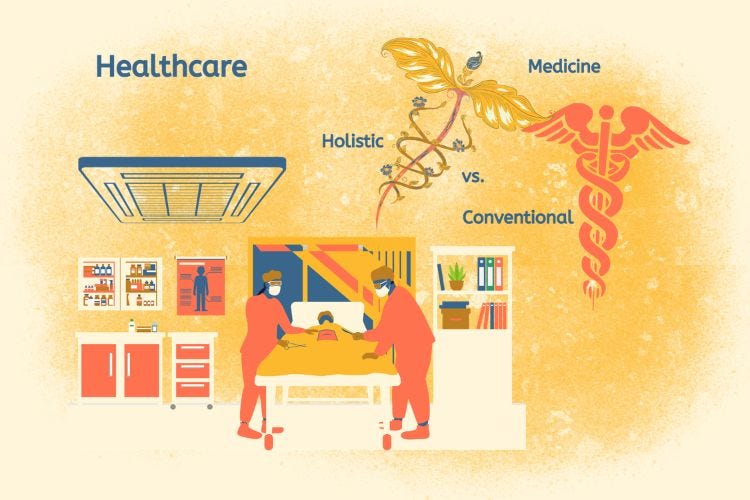
Holistic healing is a philosophical approach to healing. It stands 180 degree opposite to the approach of modern pharmaceutical medicine. This is as far as taking care of human health is concerned.
Pharmaceutical medicine, also known as ‘Big Pharma’, is a big business with its size being over one trillion U.S. dollars per year. It is very natural that business will do its best never to let its grip loosen on such a large market. Especially when an alternative approach such as holistic healing starts growing roots in the mindset of the masses.
I would like to point out here that it is not a mere coincidence that, whenever a social institution such as pharmaceutical medicine attempts to fulfill a real safety need (health, in this case), the already corrupted institution of business takes over. It is much the same way that an individual human body in which the root chakra is closed is prone to the higher chakras getting closed as well. No wonder then, that we are dealing with “too big to fail” monsters such as politics-business nexus, politics-judiciary nexus, ‘big pharma’ and many other harmful nexuses that we will talk further about.
Scientific Validity:
The way big business thwarts an alternative approach to healing is by challenging its scientific validity. Its main assertion is that any such procedures need to undergo strict laboratory testing. Health authorities always look for convincing statistical data to establish the efficacy of any new approach to address human health.
But in doing so, the field of pharmaceutical medicine ignores the most basic philosophy of healing which is to do away with the root cause of any health problem. It is not sufficient to do away with the symptoms of the problem alone.
If the symptoms alone are done away with, the problem tends to relapse. Almost everyone has experienced this. That is, perhaps, why the modern medical approach calls their procedures ‘treatments’ and not ‘cures’.
Treatment Vs Cure:
Healing, on the other hand, concerns itself with curing an illness permanently as opposed to treating it temporarily by focusing on its symptoms alone.
Treating symptoms temporarily can be a much swifter process than curing the root cause permanently. This is the reason why modern pharmaceutical medicine has gained acceptance among the masses. In the age of fast food, people look for fast medicine as well. It doesn’t matter if it damages their health in the long run.
Treating Symptoms Alone Spoils Health:
How does treating only symptoms damage health in the long run?
It does so in two main ways:
First, as the symptoms temporarily disappear, the patients psychologically feel that the problem has been eliminated. Hence they revert to their old lifestyles that had caused the problem in the very first place. As a result, the problem relapses after some time turning them weaker and weaker every time it does.
Second, the symptoms cannot be naturally eliminated without addressing the causative factors. What pharmaceutical medicine actually does is that it suppresses the symptoms artificially by sending an army of antibodies from outside. It doesn’t strengthen the antibodies that the innate immune system generates within. The immune system is just not given enough time or chance to fight the illness with its own natural antibodies.
As a result, in the long run, it gets conditioned not to be able to generate these antibodies efficiently anymore. It leads to incrementally reduced immunity in the mind-body system after taking every course of modern pharmaceutical medicine.
Every new relapse of the same condition proves to be more serious than the former, complicating the treatment more complex each time.
Health deteriorates further!
Lifestyle Diseases:
Apart from normal acute diseases, there are more permanent lifestyle diseases too.
migraines | diabetes | hypothyroid | hyperthyroid | hypertension | heart conditions | acidity | constipation | obesity | liver cirrhosis | kidney failure | asthma | anxiety | depression | and many more.
Unfortunately, modern pharmaceutical medicine doesn’t have any permanent cure for them. It only has a few options to merely manage the above-listed conditions somehow.
Role of Money:
Significant resources are required in carrying out such monitored tests on sample sets of patients. ‘Big Pharma’ is the entity that funds this research and then has to make it all back by lobbying for, marketing and force-feeding medicines that only cure symptoms to a populace that, at best, gets habituated and, at worst, gets addicted to them. It is something like pop music and popular movies selling way more than classical ones or fast food more than nutritious diet.
Both time and resources go against holistic healing procedures. They aren’t effectively able to carry out monitored tests on large enough sample sizes of patients for a long enough time. Hence they are at a loss to show better statistical results in a scientifically convincing manner.
It is very much like the rich becoming richer even if inefficient, and the poor becoming poorer even if more virtuous.
Healthcare also brings in another big business as a huge commercial activity called health insurance. It benefits from people’s fear of falling ill or else dying prematurely, both of which have scary consequences to deal with. There is also a much costlier fear of losing what one has, including one’s business and costly belongings.
In a healthy society supported by strong pillars of closely-knit communities, such fears wouldn’t have rooted themselves deep enough. But since that is not what it is, an individual feels alienated, scared of being left alone in any such emergency. The only available option one finds to feel reasonably safe and secure is a legally binding insurance to take care in case any such casualty happens.
And ironically, the agency that provides this feeling of safety is one of the biggest businesses on earth. Although it does provide the feeling of a legal safety, the socio-psychological security network is awfully missing. On top of it, recurring payments for various kinds of insurance add up fast to a considerable sum to part with, every month.
The insurance companies have the last laugh with a heavy bank balance at their disposal. Even after the legal safety is purchased, the lonely individual mind never sits relaxed! It is always the mind that fears. Brain simply acts in a passionately focused manner if needed.
Sociocultural Root Chakra: Military-Industrial Complex
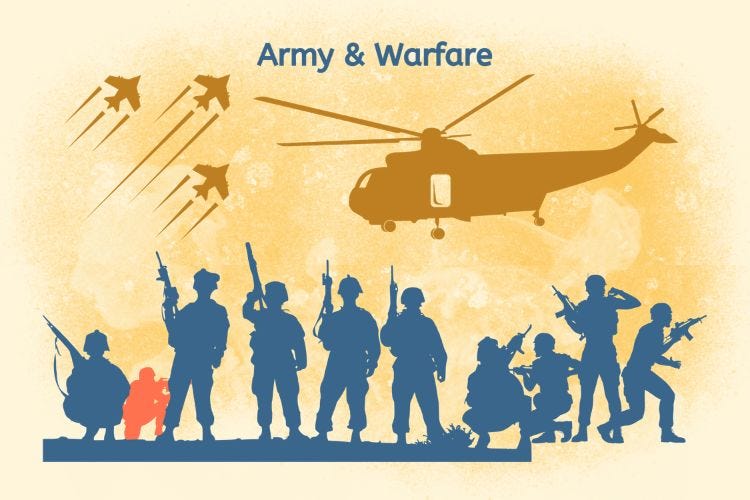
Army - A Social Institution Licensed to Kill:
Army is one of the most weird social institutions that Homo sapiens ever built on earth!
Is it possible for a sensitive soldier to kill an enemy soldier without feeling bad about it?
Killing a man is not like killing an animal. Had it been so, consuming human flesh could have been a norm like eating animal flesh is.
But we don’t eat our own species simply because we sense a common link among us. Even the thought of doing so invokes a strong revulsion not only in our mind but in our body too.
Won’t a real killing of a real man invoke a similar reaction in someone with a normal level of sensitivity?
It should! It ought to!
Sensitivity Vs Insensitivity:
If it doesn’t, it simply shows that the person concerned is not sensitive enough to feel bad about it.
But then, throughout the history of mankind there have been armies invading other armies to kill soldiers in wars.
Who are these people who do so and don’t ever feel a tinge about it?
One can only infer that the human mind can certainly be trained to become insensitive enough not to feel bad about killing other humans.
But is that a healthy state to achieve?
What implications will such insensitivity have on the mental health of the person concerned?
The real act of love depends on sensitivity in order for its subtleties to be felt! Will a killer ever be able to love another human being with all the soft and tender feelings?
Certainly not!
His/her act of love would also be something like an act of winning a war.
An Army Against Another Army:
That was from the perspective of an individual soldier who is trained to kill.
Let’s ponder upon it from a totally different perspective now.
How can the collective humanity justify raising armies aimed at killing other humans?
What turns certain armies enemy to one another?
Soldiers in the two enemy armies don’t even know one another, let alone being each other’s enemies!
The same enemies might have been the best of friends, had they met one another in different circumstances elsewhere in life.
Why all this enmity?
And who can guarantee it will continue like this in the future? On retirement, they may settle down in some foreign land and end up being next door neighbors. They may even turn out to be passionately fond of each other!
Anything is possible! We just investigated one such hypothetical situation.
Even if some lands are spared being tagged as adversaries by the political bosses, our sensitivities may never be with them. We may turn insensitive to the people residing in those lands.
We inherited this beautiful earth and we divided it into countries and nationalities making it look so ugly!
In today’s world, this enmity is further strengthened by mainly two kinds of narratives. The first one is the border disputes that generally afflict neighboring nations. The second narrative has to do with the ideological differences. Nations tend to resist worldviews that affect the kind of society they have designed for themselves, even if such resistance comes from thousands of miles away.
Any suspicious move by one is interpreted as a conspiracy on their behalf intending to devour the very existence of the other. In such a scenario, every nation is always in a constant state of paranoia.
Politicians very well know how to create narratives benefiting them in strengthening their control on the internal politics of their own states. They can easily turn them as a dangerous threat to their very existence as a nation. A sprawling wave of fear spreads all over in the minds of its inhabitants who, then, are ready to unconditionally support their rulers. The armies are alerted, recruiting more soldiers and purchasing new lethal arms for them. Everyone shuns their brains, panicking and acting emotionally in a haphazard manner. We have seen it happening all around the world for various political motives.
Fast Forward to The Present Day:
Let us fast forward to the present day scenario of the state.
The state changed its form in almost all countries and nationalities from feudal kingdoms to the so-called democratic republics. They should actually have been called plutocratic republics instead.
The dominance of resources in the present form of money still persists as far as formation of the governments in all countries and nationalities is concerned. It was only the form of the state that changed, not its essential character.
The cunning and the corrupt are still in power in every state of the world. Thanks to the power of money that gets them elected to represent millions of people under the mask of patriotism. This is now an irrefutable fact.
Aesthetic Needs
Arts and entertainment networks are social institutions that fall under sociocultural sacral chakra arising from the suppression/ repression of sexual gratification. The currencies it uses are ‘fame’ and ‘celebrity’. The growth needs that these institutions aim to fulfill are aesthetic needs. However, these aesthetic needs got corrupted by the currency of ‘fame’ and ‘celebrity’ into phenomena such as the ‘star system’ in the film industry.
And since the suppression/ repression of sexual gratification was an intensive as well as an extensive phenomenon, almost everyone looked forward to aesthetic experiences either in the form of a creator or else a consumer. Consuming was way easier than creating aesthetic experiences offering day-dreams to them.
Naturally, consumers of such aesthetic experiences found an element of entertainment in them. As a result, such experiences started pulling in huge crowds to their performances. Their creators and performers started acquiring fame and celebrity resulting in a special status for them in society.
This helped them to not only become rich but also objects of desire for their consumers. This also helped them in coming out of suppression/ repression of their sexual gratification. Soon, they started acquiring a larger than life stature in society, epitomizing its most sought after desires.
Thus, art, the purpose of which was to fulfill aesthetic needs got waylaid by the artist and, consequently, the sociocultural sacral chakra got closed.
Thanks for listening to this episode of Skeletal Leap: A Living Adventure! In the next episode, I will tell you about corruption in marriage, organized sport, and nation state.
Be a part of Skeletal Leap Community! Subscribe to Skeletal Leap Newsletter. Click on the link in the description to subscribe.
🔗 Series Bridge:
This masterclass is a 19-week journey through my book, The Mind-Body Connection. If you missed the foundation, start here: The 16-Part Prequel: 14 Core Principles.
🔑 Unlock the Practical Plan:
To truly master the Skeletal Leap, you need the step-by-step memoir and the associated practice codes found in the book.
Get the Book: The “Resource Codes” for this chapter’s PDF practice plan are found in the Amazon Paperback Edition.
Join the Movement: Download the Free Prequel Ebook via StoryOrigin and join our community.
Subscribe: Follow SKELETAL LEAP: The Mind Body Connection on Substack for weekly deep-dives into the human potential archive.
You may also like…
Weird Sociocultural Evolution Comprising Social Evolution & Cultural Evolution!

SKELETAL LEAP: THE MIND BODY EVOLUTION SERIES
______________________________________________________
References
Campbell, P., Hook, L., & Pickard, J. (2021, November 9). COP26: Deal to end car emissions by 2040 idles as motor giants refuse to sign. Financial Times. https://www.ft.com/content/8c4a1809-902f-4582-a29e-1c83a97b9dff
Goodman, A., & Thunberg, G. (2019, January 4). You Are Stealing Our Future: Greta Thunberg, 15, Condemns the World’s Inaction on Climate Change. Democracy Now! other.